
MAC Resource Allocation and Scheduling in 5G/6G: Balancing eMBB, URLLC, and mMTC

MAC Resource Allocation and Scheduling: Making the Most of 5G and 6G Spectrum
One of the biggest hurdles in 5G and upcoming 6G networks is how to effectively allocate spectrum resources. With different service types such as enhanced Mobile Broadband (eMBB), Ultra-Reliable Low-Latency Communications (URLLC), and massive Machine-Type Communications (mMTC), the Medium Access Control (MAC) layer is crucial for balancing all these competing demands.
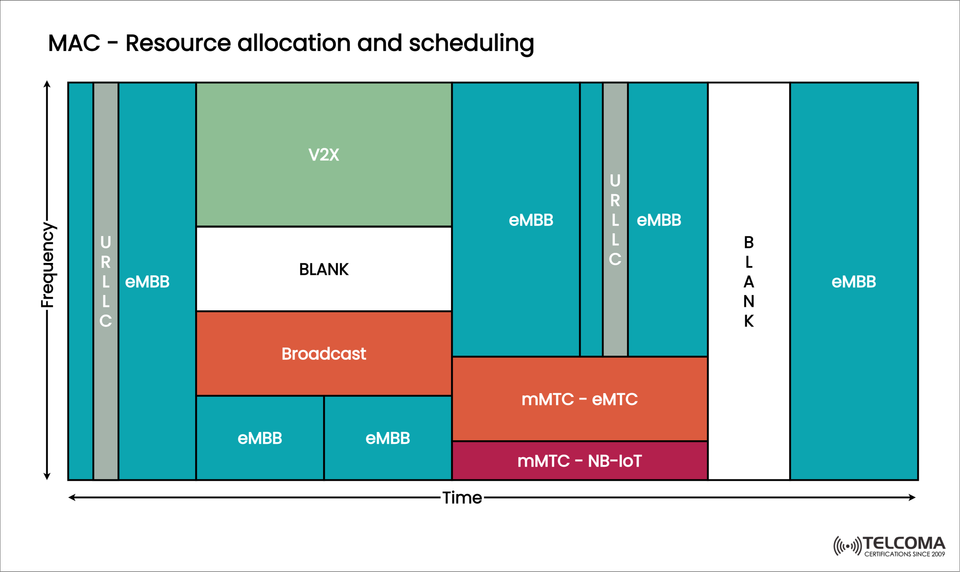
The image we’ve included illustrates how frequency and time are divided to accommodate various services — from broadcasts and V2X (Vehicle-to-Everything) to eMBB, NB-IoT, and URLLC. This kind of dynamic scheduling ensures that each service gets the necessary Quality of Service (QoS) while also maximizing spectral efficiency.
Gaining a Grasp on the MAC Layer in 5G/6G
The MAC layer is part of the data link layer in the protocol stack. It has several key responsibilities, including:
Resource Allocation: Figuring out how to distribute frequency-time blocks among users and services.
Scheduling: Deciding who gets to send and receive data and when.
QoS Enforcement: Making sure each service meets its latency, reliability, and throughput standards.
In OFDMA-based 5G/6G systems, the MAC layer takes on the task of allocating time-frequency resource blocks (RBs) for different services.
Key Services That Are Competing for Resources
The image outlines the main services that 5G and beyond can support, each having its own specific needs:
eMBB (Enhanced Mobile Broadband) * Offers high data rate services like video streaming, AR/VR, and cloud gaming. * Needs large bandwidth, but its latency requirements are pretty moderate.
URLLC (Ultra-Reliable Low-Latency Communications) * Used for mission-critical applications like autonomous driving, remote surgery, and industrial automation. * Requires extremely low latency (<1 ms) and near-perfect reliability (10^-5 to 10^-9).
mMTC (Massive Machine-Type Communication) * Designed to support billions of low-power IoT devices. * Focuses on scalability and energy efficiency rather than high throughput. * Subcategories include: * eMTC (enhanced MTC): Tailored for moderate data IoT. * NB-IoT (Narrowband IoT): Created for ultra-low data rate IoT.
V2X (Vehicle-to-Everything) * Facilitates communication between vehicles, infrastructure, and pedestrians. * Needs low latency and high reliability for safety-critical applications.
Broadcast Channels * Utilized for disseminating system information, public alerts, and sometimes group communication.
BLANK Spaces * Reserved resources for interference management, spectrum coordination, or future use cases.
How Resource Allocation Functions
The diagram illustrates how frequency (y-axis) and time (x-axis) are divided up. Each block shows how the MAC allocates spectrum to different services.
Example Scheduling Insights:
eMBB Takes Up Most Spectrum * Large blocks are given to high-data services like streaming. * Allocated across several time slots.
URLLC Receives Dedicated Narrow Bands * Smaller but more frequent allocations. * Ensures predictable latency for critical tasks.
mMTC Gets Compact Allocation * NB-IoT is squeezed into very narrow bands. * eMTC receives larger allocations but still smaller than eMBB.
V2X Gets Mid-Sized Allocations * Strikes a balance between reliability and latency.
Blank Slots Offer Flexibility * Can be tapped for avoiding interference, coordinating with other operators, or for emergency priority use.
Scheduling Strategies in 5G/6G MAC
The choice of scheduling algorithm depends on the network's objectives:
Round Robin: Fair, but not the best for maximizing throughput.
Proportional Fair (PF): Aims to balance fairness with throughput efficiency.
Latency-Aware Scheduling: Gives priority to URLLC and V2X traffic.
QoS-Aware Scheduling: Allocates based on service-level agreements.
Looking ahead to 6G, we can expect AI and machine learning to take a stronger role, predicting traffic trends and dynamically adjusting resource allocation for the best efficiency.
Trade-Offs in Resource Allocation
The MAC scheduler faces the challenge of balancing conflicting needs:
High Throughput vs. Low Latency: * eMBB requires high data rates, while URLLC needs quick responses.
Scalability vs. Efficiency: * mMTC must support millions of devices, even with small packets.
Reliability vs. Flexibility: * URLLC needs dedicated resources, which can impact overall efficiency.
That’s why those blank slots are so critical — they allow for quick adjustments when URLLC demands arise or for coordination with the network.
Comparing Services and Their Requirements
Service Type | Latency | Reliability | Throughput | Connection Density
eMBB | Medium | Medium | High | Medium
URLLC | Ultra-low | Ultra-high | Low–Medium | Low
mMTC (eMTC/NB-IoT) | High | Medium | Low | Very High
V2X | Low | High | Medium | Medium
Broadcast | Medium | High | Low | High (for group services)
This table illustrates why resource allocation isn't one-size-fits-all — each type of service drives different MAC scheduling strategies.
The MAC’s Role in Future 6G
As we look toward 6G, expect the MAC layer to evolve even further:
AI-Driven Scheduling: Using predictive analytics to allocate resources even before they’re needed.
3D Resource Allocation: Expanding into aerial (UAV) and maritime networks.
Dynamic Spectrum Sharing: Allowing flexible allocation across both licensed and unlicensed bands.
Energy-Aware Scheduling: Focusing on green networking for IoT and large-scale setups.
Wrapping Up
The MAC layer’s resource allocation and scheduling role is fundamental to 5G and 6G networks, ensuring fair and efficient spectrum usage across eMBB, URLLC, mMTC, V2X, and broadcast services.
By smartly distributing time-frequency resources, the MAC guarantees that essential applications like URLLC and V2X get the low-latency reliability they require while also accommodating the massive demands of eMBB and mMTC.
In 6G, we’re likely to see AI-driven, energy-efficient, and dynamic scheduling strategies that adapt in real time to meet the varied and growing needs of our hyper-connected world.