
Maintaining Voice Call Continuity Across 2G, 3G, 4G, and 5G Networks with Integrated 5G Systems

Continuity of Voice Calls Across 2G, 3G, 4G, and 5G - with Tight Integration With 5G
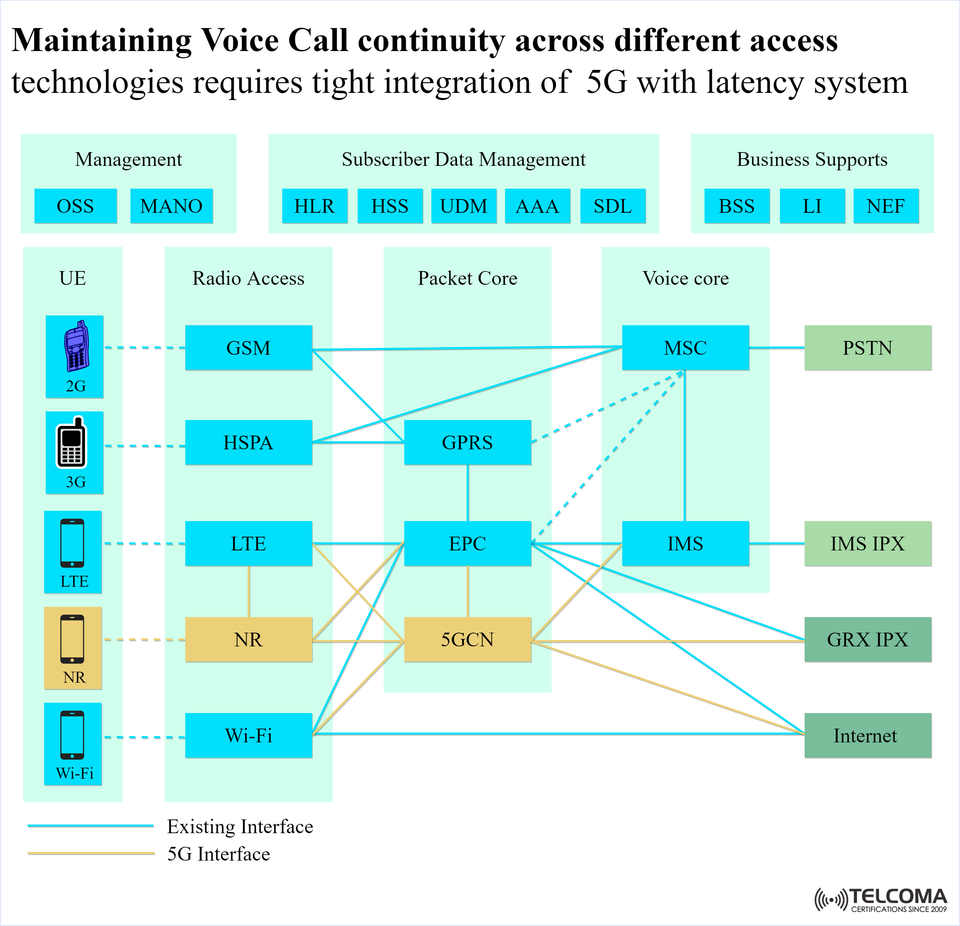
As mobile networks develop from 2G to 5G, continuity of voice calls is a critical need and challenge - the figure above shows the need for complex architectures to accommodate legacy systems with modern 5G Core (5GCN) systems to support voice services across all access technologies - including 2G (GSM), 3G (HSPA), 4G (LTE), 5G (NR) and Wi-Fi.
This blog post will explore voice continuity based on integration of 5G systems with legacy packet cores, voice cores and subscriber management environments.
Why is Voice Call Continuity Important in 5G Evolution?
Voice is still viewed as one of the core mobile services - even with the introduction of 5G. Whether a user is voice calling on LTE or jumps into a call on Wi-Fi and switches to 5G NR, user call continuity is required. Poor user experiences resulting from dropped calls or slow call reconnections have potential impacts on business and emergency communication.
To maintain voice call continuity the system would need to be tightly integrated with latency-aware infrastructures that would bridge legacy and next-gen technologies.
Understanding the Architecture: What's Inside?
As seen in the diagram, the components are arranged as follows:
- User Equipment (UE) Access Technologies
2G (GSM)
3G (HSPA)
4G (LTE)
5G (NR)
Wi-Fi
- Radio Access Network (RAN)
GSM and HSPA service telephony-based voice using traditional circuit-switched switch process.
LTE and NR began using labels of Uses of VoLTE (Voice over LTE); VoNR (Voice over NR or 5G); in both case the voice goes over IP, using the architecture of IMS.
Wi-Fi can also be used to transmit voice over Wi-Fi (VoWiFi); again usually integrated with IMS architecture.
- Packet Core
GPRS - a legacy packet core specifically built for GSM/HSPA.
EPC (Evolution Packet Core) - the packet core developed for 4G LTE; and maintains VoLTE capabilities.
5GCN (5G core network) - the packet core with ultra-low latency and higher 5G NR throughput.
- Voice Core
MSC Mobile Switching Centre - switched voice traffic for 2G and 3G voice.
IMS (IP Multimedia Subsystem) - key element to deliver voice over LTE/Wi-Fi/5G NR.
- Subscriber and Management Systems
HLR, HSS, UDM, AAA, SDL - serve to identity, follow user location and subscription usage model on real-time basis and authentication, appropriate access and session context for voice and data.
OSS & MANO - deliver to orchestrate (mandate)/monitor infrastructure and services.
BSS, LI, NEF - deliver to bill, lawful intercept and network placement exposure.
- Business and External Interfaces
PSTN - old, outdated interconnection capabilities for the old landlines in the their old interconnection systems.
IMS IPX / GRX IPX - their carrier-grade interconnections for only the voice, or data.
Internet - form of conventional Over-The-Top products or all of its Voice-IP based services.
How the Integration of 5G ensures we can still play with traditional services
🔄 Established Interfaces (Blue Lines)
Older MSC/EPC/GPRS were connected together to enable any backdoor fallback or handover between the old voice options/on traditional interconnection of voice offerings.
Voice calls can still handover from LTE, on 4G, from to 3G or GSM when using Circuit-Switched Fallback (CSFB).
⚡ 5G Interface Integration (Gold Lines)
5GCN provides direct support for NR, Wi-Fi and IMS interfaces.
IMS bridges LTE, NR, and Wi-Fi for all-IP voice (VoLTE, VoNR, VoWiFi).
The close integration of EPC and 5GCN enables dual connectivity and seamless migration.
Summary Takeaways for Telco Professionals
Component Legacy (2G/3G/4G) 5G Interfaces
Access Network GSM, HSPA, LTE NR, Wi-Fi
Packet Core GPRS, EPC 5GCN
Voice Core MSC, IMS IMS only (for all IP-based voice)
Interface Type Existing Interfaces (blue) 5G Interfaces (gold)
Call Continuity CSFB, SRVCC VoLTE to VoNR, VoWiFi, seamless handovers
The Benefits of Close Integration
Seamless Voice Handover: Between LTE ↔ 5G, LTE ↔ Wi-Fi, NR ↔ Wi-Fi
Reduced Latency: With ultra-low-latency architecture of 5GCN
Improved QoS: By using IMS to maintain voice quality across networks
Backward Compatibility: Provides backwards compatibility to GSM, HSPA
Scalability: Maintain modular architecture for future expansion
Conclusion
As 5G matures into the predominant technology for mobile access and as services with voice call continuity evolve through multiple generations, there will be increased complexity in delivering seamless call continuity that can be designed to be near-natural — it can be — but it becomes critical and must be done right to meet quality experience needs. IMS, EPC and 5GC supports the service provider's ability to provide a seamless and high-quality experience as the user transits across generations of access technology.
VoIP Continuity Challenges
While it is clear that VoIP continuity can provide many advantages, there are still some challenges in adopting a seamless VoIP continuity model.
Legacy Networks and Users: not all networks or end-user devices will support the full VoNR or EPS-FB capabilities.
Latency: maintaining latency under 10ms for end-to-end real-time voice is a challenge in heterogeneous (and sometimes unknown) networks.
Security: Hanging a voice session across domain boundaries (from a Wi-Fi network or to an LTE service) requires many additional security related flows including encryption; authentication and integrity key management; and validation of user data plans.
Policy Control: Being able to manage QoS and continuity during handover or roaming, based on dynamic - but controlled session and bandwidth management is going to require tight integration of policies across UDM, PCF and NEF.
Telecom Operator Recommendations
To successfully launch voice continuity in all access networks, telecom operators should consider:
✔️ Ensuring their IMS Core is capable of SIP inter-working and can scale SIP applications.
✔️ Use service-area based SRVCC and seamless EPS-FB fallback.
✔️ Deploy 5GCN in parallel with EPC, and use interworking functions instead.
✔️ Utilize UDM, HSS and SDL for unified subscriber data management.
✔️ Use OSS and MANO platforms to monitor latency and QoS KPIs.
Key Measurable Takeaways
In today's race to 5G and beyond, ensuring the continuity of voice calls is more than a simple technical requirement - voice call continuity is now a critical consideration for telecom industry leadership. For performance within its impact on telecom industry professions, network architects must understand where and how all access technologies - GSM, HSPA, LTE, NR and Wi-Fi integrate into their overall voice service (VoIP or circuit switched) delivery.
By delivering the most advanced services; employing the capabilities of 5GCN; and unifying the capabilities of IMS to mass-market consumer and business routers, as well as legacy capabilities, telecom operators can...