
Major Components of a 5G Network: User Equipment, RAN, Edge, and Core Explained

Introduction: Why It's Important to Understand 5G Architecture
5G, or the fifth generation of mobile networks, isn't just about faster speeds. It's a complete overhaul in how networks are built, rolled out, and utilized. Compared to older generations, 5G brings in some exciting features like ultra-low latency, massive machine-type communication (mMTC), and enhanced mobile broadband (eMBB).
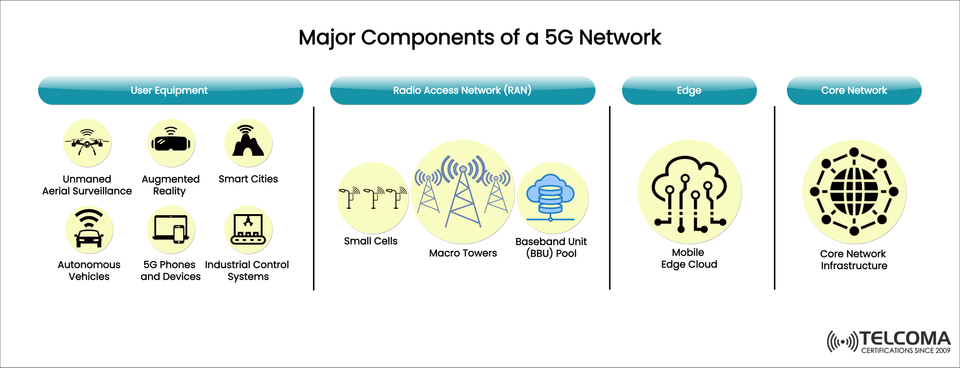
To really grasp how these new capabilities work, we need to look into the key parts of a 5G network. The diagram uploaded outlines them clearly as User Equipment (UE), Radio Access Network (RAN), Edge, and Core Network. Each of these elements has a unique role but they all work together to provide seamless connectivity.
In this blog, we’ll take a closer look at each component, discuss how they interact, and why they matter in real-world telecom scenarios.
- User Equipment (UE): The Entry Point to 5G Services
User Equipment (UE) is all about the devices and systems that connect to the 5G network. This category isn't just limited to smartphones; it includes a wide range of technologies.
Examples of User Equipment in 5G:
Drones: They utilize 5G for transmitting real-time video, better navigation, and remote control in areas like defense, agriculture, and logistics.
Augmented Reality (AR): Devices such as AR glasses and headsets depend on 5G’s low latency to smoothly integrate digital information into the physical world.
Smart Cities: IoT devices found in traffic lights and public safety systems, as well as those monitoring the environment, use 5G for instant data sharing.
Autonomous Vehicles: These cars need ultra-reliable low-latency communication (URLLC) to interact with other vehicles, infrastructure, and cloud-based AI.
5G Phones and Devices: Smartphones, tablets, and laptops are the most common types of UE, capable of supporting enhanced mobile broadband.
Industrial Control Systems: Factories are leveraging connected sensors and robotics powered by 5G for Industry 4.0 automation.
What UE Plays: These devices serve as the gateway to the network, requiring high throughput, reliability, and extensive coverage.
- Radio Access Network (RAN): How Devices Connect to the Network
The Radio Access Network (RAN) is what gives user equipment a wireless link to the core network. In 5G, RAN has seen significant upgrades, including features like network densification, virtualization, and beamforming.
Key Components of the RAN:
Small Cells: Low-powered nodes placed in busy urban areas that enhance coverage and capacity where data usage is high.
Macro Towers: Traditional tall towers that cover larger regions, ensuring extensive coverage and supporting mobility.
Baseband Unit (BBU) Pool: This processes digital signals from multiple radio units and is often a part of Centralized RAN (C-RAN), where BBUs are centralized for better efficiency.
Why RAN is Crucial:
It ensures solid signal coverage and connectivity for user equipment.
Supports advanced technologies like massive MIMO, carrier aggregation, and mmWave spectrum utilization.
Allows for network slicing, allocating different resources for various applications.
- Edge: Bringing the Cloud Closer to Users
The Edge is the layer that sits between the RAN and the Core Network. A key player in 5G, Mobile Edge Computing (MEC) is a game-changer.
Mobile Edge Cloud
It moves computing and storage resources closer to users and devices.
This helps reduce latency by processing data locally instead of sending everything to a centralized core.
It’s beneficial for applications like:
Real-time industrial IoT analytics
Safety systems for autonomous driving
Cloud gaming and immersive AR/VR experiences.
The Edge’s Main Advantage: It boosts application responsiveness and enables time-sensitive services, making it critical for mission-critical applications.
- Core Network: The Brain of 5G
The 5G Core Network (5GC) is the nerve center of the entire system, managing everything from connections and mobility to security and service delivery.
Core Network Infrastructure
Control Plane Functions:
Handles session setup, authentication, and mobility.
User Plane Functions:
Efficiently routes user data packets.
Service-Based Architecture (SBA):
A modular design where each network function communicates via APIs.
Network Slicing:
Allows multiple virtual networks to run on shared infrastructure (like one slice for emergency services and another for streaming).
Core’s Importance:
Offers flexibility and scalability through cloud-native functions.
Enables massive IoT connectivity by accommodating millions of devices.
Guarantees end-to-end Quality of Service (QoS).
How the Four Components Interact
Here’s a simplified look at how these components interact:
UE Starts a Connection:
For instance, a 5G smartphone requests a data session.
RAN Provides Access:
The signal travels through small cells or macro towers before being processed by the BBU pool.
Edge Cuts Latency:
Local processing of gaming, AR applications, or real-time analytics happens at the mobile edge cloud.
Core Manages Services:
The core network takes care of authentication, routing, and service delivery, optimizing resources through network slicing.
This end-to-end architecture is what delivers the ultra-fast speeds and low latency that 5G promises.
Table: Key Components of 5G Networks at a Glance
Component | Key Elements | Role in 5G Network
User Equipment | Drones, AR devices, IoT gadgets, cars, smartphones | Entry point for accessing 5G services
RAN | Small Cells, Macro Towers, BBUs | Provides wireless connectivity and signal processing
Edge | Mobile Edge Cloud | Decreases latency, facilitates real-time services
Core Network | Control & User Plane, SBA, Network Slicing | Manages sessions, security, scalability, and QoS.
Real-World Uses of 5G Components
Healthcare: Edge processing and URLLC enable remote surgeries.
Automotive: Connected cars use RAN and edge computing for collision avoidance.
Smart Manufacturing: Industrial robots are managed using Core slicing and low-latency Edge connections.
Entertainment: Fast RAN and Edge computing support cloud gaming and AR/VR experiences.
Conclusion: Shaping the Future with 5G Components
The effectiveness of 5G comes from more than a single technology; it’s about how its four major components—User Equipment, RAN, Edge, and Core Network—work together.
UE drives demand with cutting-edge devices.
RAN serves as the vital connectivity backbone.
Edge positions computation closer to users.
Core ensures smart management and scalability.
Together, these components are set to empower industries and transform digital experiences, paving the way for smart cities, self-driving cars, and much more.
For telecom professionals and tech enthusiasts alike, getting a grip on these foundational elements is key to deploying, optimizing, and innovating in the 5G landscape.