
MANO Architecture Explained: NFV Orchestration, VNFM, and VIM in 5G Networks

As networks grow to support 5G, edge computing, and vast IoT deployments, the old hardware-based way of doing things just isn't cutting it anymore. The industry is pivoting towards Network Functions Virtualization (NFV), where functions such as firewalls, EPC, IMS, or load balancers operate as software-based Virtual Network Functions (VNFs) on off-the-shelf hardware.
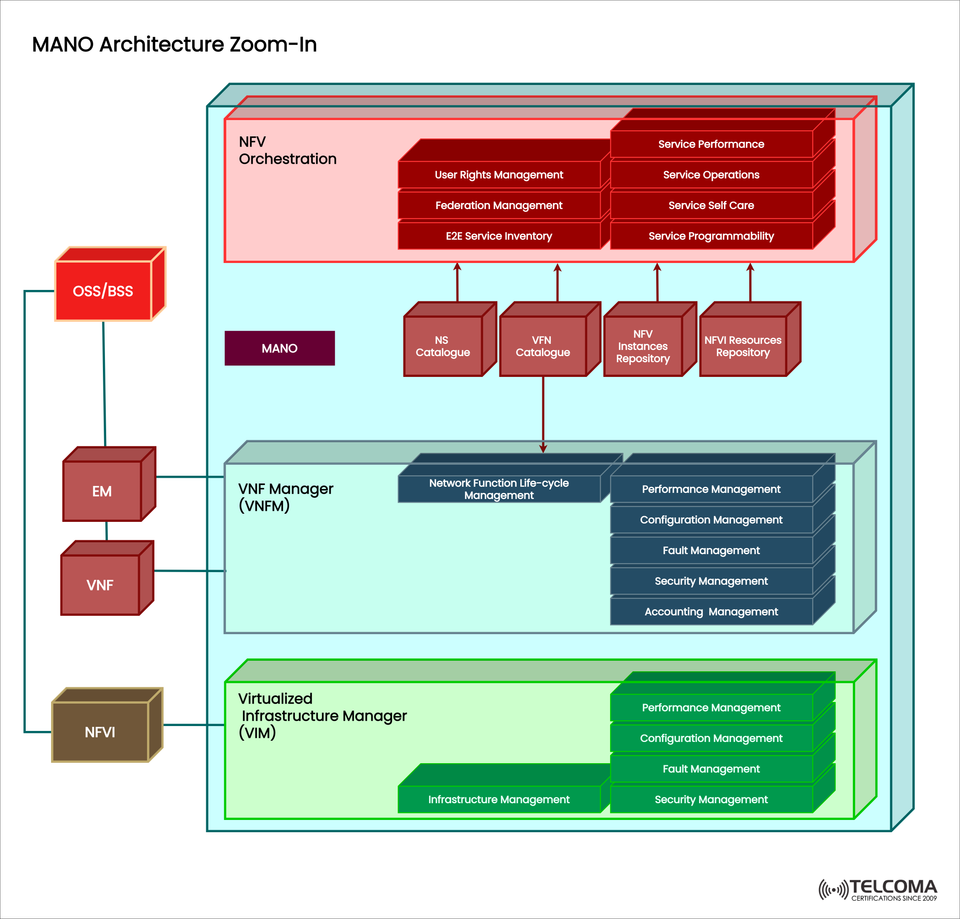
To effectively deploy, manage, and scale these VNFs, the ETSI NFV MANO (Management and Orchestration) framework was established. In the uploaded diagram, you can see a closer look at the MANO architecture and its key components: NFV Orchestrator (NFVO), VNF Manager (VNFM), and Virtualized Infrastructure Manager (VIM), along with supporting catalogs, repositories, and management interfaces.
In this blog, we’ll dive into MANO’s structure, components, and its importance in 5G and NFV-based networks.
What is MANO in NFV?
MANO (Management and Orchestration) serves as the core framework for overseeing:
VNFs (Virtualized Network Functions) – the software equivalents of network functions.
NFVI (Network Function Virtualization Infrastructure) – the collection of computing, storage, and networking resources.
End-to-end services that integrate VNFs and resources.
The main aims of MANO are to:
Automate deploying, scaling, and shutting down VNFs.
Promote agility in services through orchestration.
Manage performance, faults, and security across various layers.
Facilitate network slicing and programmability within 5G.
Key Components of MANO Architecture
The diagram showcases the three main functional blocks of MANO, along with their supporting modules.
- NFV Orchestrator (NFVO)
The NFV Orchestrator is the brains of the MANO architecture. It oversees the whole lifecycle of network services, ensuring that VNFs and infrastructure resources are allocated effectively.
Responsibilities:
Service Orchestration: It manages how different VNFs come together to form a complete service.
Resource Orchestration: Allocates computing, storage, and networking resources across various VIMs.
Catalogues & Repositories: Works with the NS Catalogue, VNF Catalogue, NFV Instances Repository, and NFVI Resources Repository.
User Rights & Federation Management: Ensures secure multi-tenant access and federation across different domains.
Service Assurance: Monitors performance, service operations, self-care, and programmability.
By providing northbound APIs to OSS/BSS, the NFVO links business workflows with network orchestration.
- VNF Manager (VNFM)
The VNF Manager takes care of managing the lifecycle of individual VNFs, ensuring they're deployed, monitored, and adjusted as needed.
Responsibilities:
Instantiation & Termination: Deploys VNFs when necessary and shuts them down when they’re not.
Configuration Management: Sets up parameters and interfaces for VNFs.
Scaling: Adjusts VNFs’ resources dynamically based on demand.
Fault & Performance Management: Checks the health and performance indicators of VNFs.
Security & Accounting: Enforces policies and keeps records of usage.
VNFM can either be designed to support multiple VNFs or dedicated to a single vendor’s VNF.
- Virtualized Infrastructure Manager (VIM)
The VIM is responsible for managing the NFV Infrastructure (NFVI), which covers the compute, storage, and network resources. It ensures that the infrastructure is well-equipped and optimized for running VNFs.
Responsibilities:
Infrastructure Management: Allocates both physical and virtual resources.
Performance & Fault Management: Keeps an eye on infrastructure performance metrics and resolves issues as they come up.
Security Management: Implements isolation and access control at the resource level.
Configuration Management: Ensures configurations are consistent across NFVI components.
Common VIM platforms include OpenStack, VMware, and Kubernetes in cloud-native NFV contexts.
Supporting Modules in MANO Architecture
The close-up diagram also highlights the catalogs and repositories that function as databases for managing MANO operations:
NS Catalogue: Holds the Network Service Descriptors (NSDs).
VNF Catalogue: Contains the VNF Descriptors (VNFDs).
NFV Instances Repository: Maintains the runtime states of network services and VNFs.
NFVI Resources Repository: Tracks available and assigned resources in the NFVI.
These modules help the MANO framework make smart decisions regarding orchestration and scaling.
MANO Workflow in NFV Environments
Here’s a peek at how the MANO components interact during actual operations:
Service Request: OSS/BSS asks for a new service (like VoLTE or a 5G core slice).
Orchestration: NFVO picks the necessary VNFs from the VNF Catalogue and outlines the service chaining.
Resource Allocation: NFVO coordinates with VIM to allocate the needed compute, network, and storage resources.
VNF Lifecycle: VNFM instantiates and sets up the VNFs according to the VNFD.
Monitoring & Assurance: VNFM and VIM manage performance and faults while NFVO oversees service assurance.
Scaling/Termination: Depending on demand, VNFM adjusts the size of VNFs or NFVO terminates any services that are no longer in use.
MANO in 5G Networks
5G is heavily reliant on virtualization and cloud-native designs, making MANO vital for:
Network Slicing: NFVO orchestrates resources according to different slices (eMBB, URLLC, mMTC).
Edge Computing: VNFM places VNFs nearer to users at edge sites.
Dynamic Scaling: VIM accommodates elastic scaling for spikes in IoT traffic or AR/VR apps.
Service Exposure: APIs from NFVO enable integration with third-party applications.
Without MANO, we wouldn’t be able to achieve the flexibility and programmability that 5G offers.
Benefits of MANO Architecture
Agility: Quick rollout of new services.
Efficiency: Better use of infrastructure resources.
Automation: Cuts down on manual work with closed-loop orchestration.
Interoperability: ETSI standards ensure compatibility across vendors.
Scalability: VNFs and services can scale elastically.
Resilience: Built-in fault management and redundancy through NFVO, VNFM, and VIM.
Challenges in MANO Implementation
Even though it’s powerful, adopting MANO comes with its own set of challenges:
Complexity: Integrating multiple vendors requires standardized APIs.
Performance Overhead: Virtualization might introduce latency if not properly optimized.
Security Risks: More components and APIs can increase vulnerability.
Skill Gap: It demands expertise in cloud, virtualization, and orchestration.
To tackle these challenges, operators are increasingly looking into AI/ML-driven orchestration and cloud-native VNFs (CNFs).
MANO vs Traditional Network Management
Aspect Traditional Networks NFV MANO Function Deployment Hardware appliances Software VNFs Resource Management Static provisioning Dynamic orchestration Scaling Manual, hardware-bound Automated, elastic Vendor Flexibility Proprietary Multi-vendor interoperability Agility Slow Fast, programmable
Conclusion
The MANO architecture forms the backbone of NFV-based telecom networks, enabling operators to efficiently manage VNFs, NFVI, and end-to-end services. With its three key components—NFV Orchestrator, VNF Manager, and Virtualized Infrastructure Manager—it ensures smooth service delivery in a multi-vendor, cloud-native setting.
For telecom professionals, getting a handle on MANO is crucial for rolling out and operating 5G, IoT, and next-gen digital services. For tech enthusiasts, it represents a blend of telecom and IT principles, where networks evolve into programmable, automated, and smart systems.
As we head toward 5G, 6G, and AI-driven networks, MANO will remain a cornerstone for virtualization, helping operators deliver services more quickly, affordably, and securely.