
MANO Architecture in NFV | Detailed Zoom-In for 5G Networks

Overview of MANO in NFV
In the realm of Network Function Virtualization (NFV), the MANO (Management and Orchestration) architecture stands out as a key framework set out by ETSI (European Telecommunications Standards Institute). It’s essentially the brain that helps orchestrate, automate, and manage network services and resources across various virtualized setups.
The MANO framework enables telecom operators to roll out new services more quickly, cut down on operational costs, and scale effectively. This becomes crucial with the rollout of 5G networks, where there’s a need for features like dynamic resource allocation, slicing, and automation.
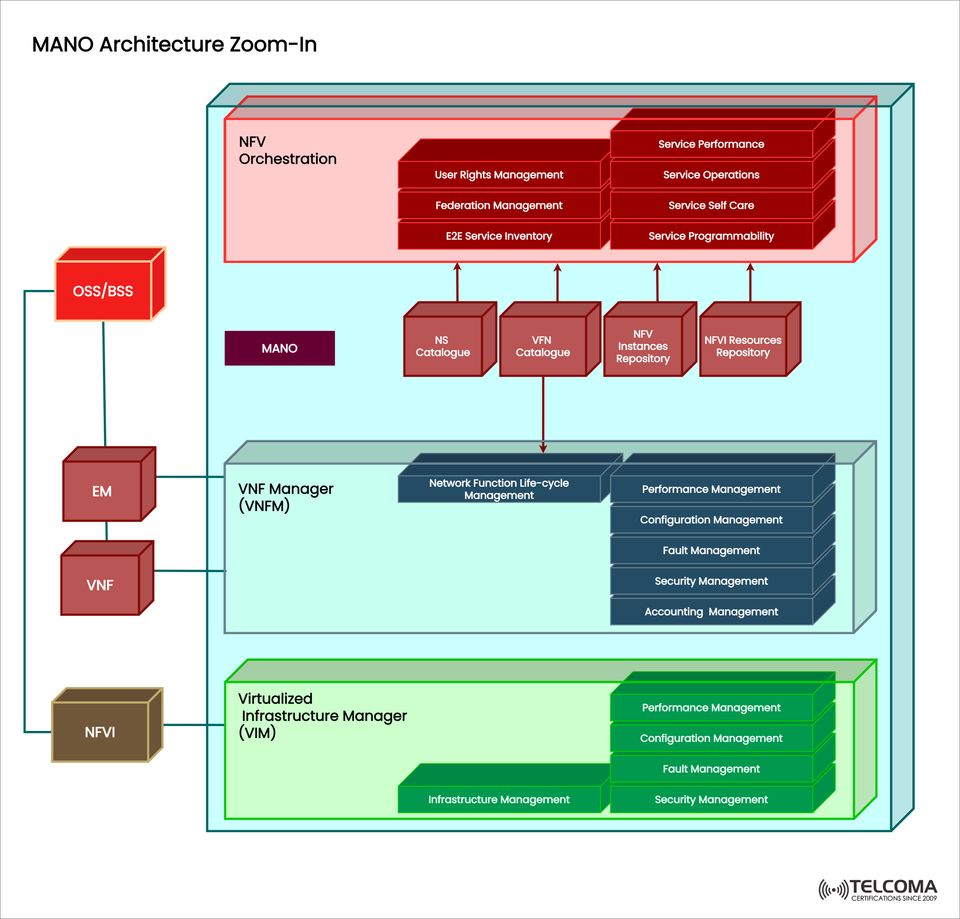
Check out the uploaded image that clearly showcases the components of the MANO architecture:
NFV Orchestrator (NFVO)
VNF Manager (VNFM)
Virtualized Infrastructure Manager (VIM)
Related repositories and catalogs
Components of the MANO Architecture
The MANO framework is broken down into three main blocks, each playing a unique role in managing network functions and infrastructure.
- NFV Orchestrator (NFVO)
The NFVO is in charge of the end-to-end orchestration of network services, ensuring seamless operation throughout the NFV environment.
Main Duties:
Service Orchestration: Aligns network services across various VNFs.
Resource Orchestration: Dynamically allocates computing, storage, and network resources.
Catalog & Repository Management: Manages catalogs, including NS Catalogue, VNF Catalogue, NFV Instances Repository, and NFVI Resources Repository.
Federation Management: Supports interoperability across different domains or operators.
Service Assurance: Monitors service performance, operations, programmability, and self-care.
Importance for 5G: The NFVO enables on-demand slicing, multi-domain service orchestration, and dynamic scaling—critical for applications like IoT, AR/VR, and autonomous vehicles.
- VNF Manager (VNFM)
The VNF Manager takes care of the lifecycle management of Virtual Network Functions (VNFs).
Main Duties:
Instantiation & Termination: Deploys or removes VNFs as needed.
Scaling: Automatically adjusts VNFs up or down based on traffic conditions.
Configuration Management: Tweaks parameters to meet service needs.
Fault Management: Detects issues and responds to failures to maintain high availability.
Security & Accounting Management: Ensures VNFs are secure and properly tracked for billing.
The VNFM makes sure each VNF instance is running smoothly, configured correctly, and efficient in the infrastructure.
- Virtualized Infrastructure Manager (VIM)
The VIM oversees the underlying virtualized infrastructure, commonly known as NFVI (Network Functions Virtualization Infrastructure). This encompasses computing, network, and storage resources.
Main Duties:
Infrastructure Management: Manages both physical and virtualized resources.
Resource Allocation: Dynamically assigns CPU, memory, bandwidth, and storage.
Fault & Performance Management: Ensures NFVI resources comply with SLAs (Service Level Agreements).
Security Management: Safeguards resources against unauthorized access or attacks.
Some examples of VIMs include OpenStack, Kubernetes, and VMware solutions.
Supporting Components of MANO
Beyond the three core blocks, MANO relies on catalogs and repositories for data-centric orchestration:
NS Catalogue: Holds descriptions of network services.
VNF Catalogue: Contains essential metadata and descriptors for VNFs.
NFV Instances Repository: Keeps track of active network service and VNF instances.
NFVI Resources Repository: Provides details on both physical and virtual resources available.
These repositories are what allow MANO to access the data and metadata it needs to deploy, monitor, and optimize VNFs and network services effectively.
Integration with OSS/BSS and EM
The MANO framework doesn’t work in a vacuum. It integrates with:
OSS/BSS (Operations Support Systems / Business Support Systems): Supplies service orders, billing info, and customer-facing functions.
EM (Element Manager): Manages vendor-specific configurations and fault handling at the VNF level.
This integration helps ensure that MANO fits seamlessly into the larger telecom ecosystem, connecting business operations with network automation.
MANO and 5G: Its Significance
With 5G networks, MANO's role becomes even more crucial:
Network Slicing: MANO enables the creation and management of multiple network slices, isolating resources for sectors like automotive, healthcare, or smart cities.
Multi-Domain Orchestration: Coordinates resources across cloud, edge, and core domains.
Edge Computing Support: Places VNFs at the edge to cater to ultra-low-latency needs.
Elastic Resource Scaling: Automatically adjusts resources in response to unpredictable workloads (e.g., spikes from IoT devices).
MANO in Real-World Applications
Enterprise 5G Networks: Private slices managed through NFVO. Secure and tailored VNFs for various industries.
IoT Ecosystems: Efficient scaling for countless devices. Automated fault management for reliability.
Content Delivery & AR/VR: Dynamically positions VNFs close to users for reduced latency. Load balancing performed by VNFM and VIM.
Smart Cities: Orchestrates IoT, AI-driven analytics, and connectivity. Automates services from end to end.
Table: Quick Look at MANO Functional Blocks
Component Role Key Functions Example Tools NFVO Orchestration Service orchestration, catalogs, resource management ONAP, OSMVNFMVNF Lifecycle Management Instantiation, scaling, fault, security management Vendor-specific VNFMVIM Infrastructure Management Resource allocation, fault, performance management OpenStack, Kubernetes
Extended View: MANO vs Legacy Network Management
Back in the day, traditional networks leaned pretty heavily on OSS/BSS and Element Management Systems (EMS) for handling operations. These systems worked fine in more static, hardware-based setups, but they just didn't cut it in the fast-paced, virtualized environments of NFV and 5G.
Characteristics of Legacy OSS/BSS & EMS
Static provisioning of network resources.
Manual intervention needed for deploying services.
Scaling or updating network functions often meant hardware changes.
There was a real issue with vendor lock-in because of proprietary systems.
Why MANO Is Better Than Legacy Models
Offers dynamic orchestration across mixed infrastructures.
Automation helps reduce the need for manual work, which cuts down on OPEX.
Provides elastic scaling of VNFs and services on the fly.
Ensures interoperability with systems from different vendors.
It’s designed to support cloud-native and containerized environments through VIM and VNFM.
This comparison really highlights why MANO is essential for networks ready for 5G.
Summary
The MANO architecture serves as the brain behind NFV ecosystems, ensuring that telecom networks are scalable, automated, and service-focused. By syncing the NFVO, VNFM, and VIM, it lays out a robust framework for managing network services—from the ground up to orchestration.
In this age of 5G and beyond, MANO empowers operators to roll out cutting-edge services like network slicing, IoT scalability, and ultra-low-latency applications. For those working in telecom, understanding MANO is crucial for shaping the networks of the future.
When operators get a handle on MANO, they not only streamline their network operations but also open the door to new revenue streams and enhanced customer experiences—turning their networks into programmable platforms ready for the next wave of innovation.