
Mapping 3GPP 5G Specifications to 5G Testing Architecture: A Complete Guide

Why It's Important to Map 3GPP 5G Specs to Testing
The fifth-generation mobile network (5G) is built on specifications developed by the 3rd Generation Partnership Project (3GPP). These guidelines cover everything from spectrum use to security measures, making sure that different systems can work together and that 5G can be adopted worldwide.
But having the specs is just the start. They need to be translated into a practical testing framework to ensure that we can verify performance, security, and reliability before rolling things out on a large scale. This is where 5G testing frameworks really connect the dots between the theory and actual networks.
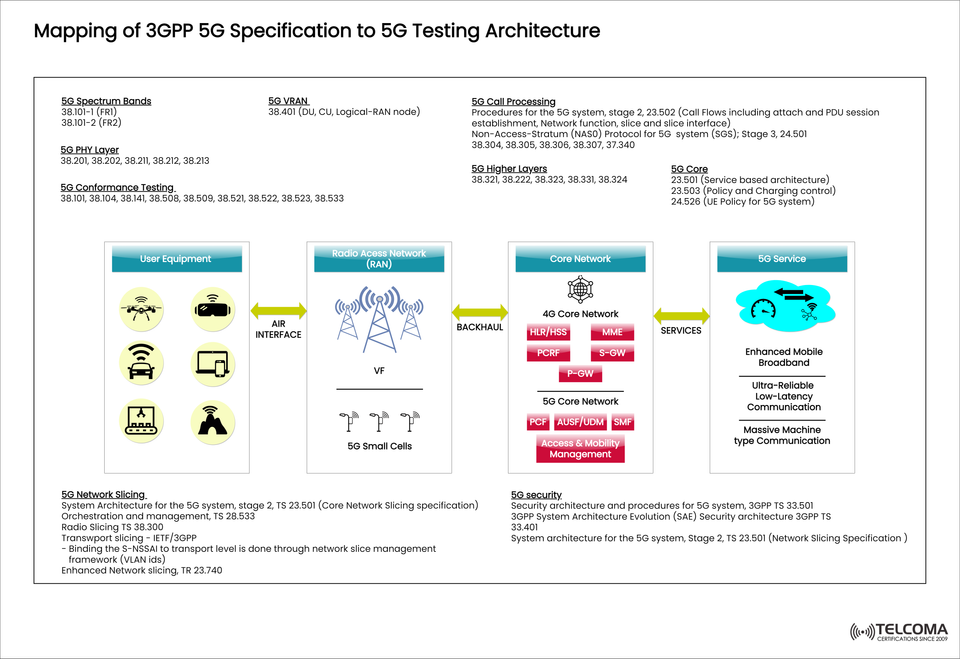
The diagram we've shared shows how the 3GPP 5G specifications fit into a structured testing architecture, which includes the User Equipment (UE), Radio Access Network (RAN), Core Network, and 5G Services. Let’s take a closer look at each piece.
5G Spectrum Bands: The Building Blocks of Wireless Performance
3GPP lays out two main spectrum ranges:
FR1 (Frequency Range 1): Covers sub-6 GHz bands, great for wide coverage and reliability. (38.101-1)
FR2 (Frequency Range 2): Focuses on millimeter-wave spectrum starting at 24 GHz, allowing for super-fast speeds and huge capacity. (38.101-2)
Why This Matters for Testing:
It confirms that devices and networks meet bandwidth and frequency requirements.
It checks for performance differences between the coverage-oriented FR1 and the high-capacity FR2.
5G PHY Layer: Validating the Physical Layer
Standards like 38.201, 38.202, 38.211, 38.212, and 38.213 outline the physical layer of 5G, which includes:
Modulation techniques (QPSK, 16-QAM, 64-QAM, 256-QAM)
Structure of the OFDM waveform
Channel coding (LDPC, Polar codes)
Testing Role:
Confirms transmission quality, error correction, and spectrum efficiency.
Ensures that devices meet the minimum standards for RF performance.
- 5G Conformance Testing: Making Sure Devices Comply
Conformance tests, outlined in documents like 38.101, 38.104, 38.141, 38.508, 38.509, 38.521, 38.522, 38.523, and 38.533, are essential for certifying UE.
Goals:
To verify compliance with RF, protocols, and performance.
To ensure that devices can work together regardless of the vendor.
To check how UE behaves under various network conditions.
Key Areas of Focus:
RF performance (including power levels and sensitivity)
Validating the protocol stack
Compatibility with older 4G networks
- 5G vRAN and Call Processing
Virtualized RAN (vRAN) – 38.401
Introduces Distributed Units (DU), Centralized Units (CU), and logical RAN nodes.
Offers flexibility and scalability by separating hardware from software functions.
Call Processing – 23.502 & 24.501
Covers:
Call flows (like attaching and establishing PDU sessions)
Slice and session management
Non-Access Stratum (NAS) signaling
Why Testing Matters:
Confirms call setup, session continuity, and handovers.
Verifies performance in multi-vendor and multi-slice setups.
- Higher Layers and the 5G Core
5G Higher Layers (38.321, 38.222, 38.323, 38.331, 38.324)
These specs define protocols like MAC, RLC, PDCP, and SDAP—ensuring that data is handled effectively.
5G Core (23.501, 23.503, 24.526)
Service-Based Architecture (SBA): Functions communicate through APIs.
Policy and Charging Control (PCC): Manages resource usage.
UE Policy Control: Controls QoS and network behavior.
Focus for Testing:
Validating service chaining based on SBA.
Ensuring policy enforcement for data prioritization.
Managing multi-slice service orchestration.
Core Network: Transitioning from 4G to 5G
The diagram shows how 4G Core and 5G Core can coexist:
4G Core Functions: * HLR/HSS (subscriber database) * MME (mobility management) * PCRF (policy control) * S-GW/P-GW (packet gateways)
5G Core Functions: * PCF (Policy Control Function) * AUSF/UDM (Authentication & User Data) * SMF (Session Management Function) * Access & Mobility Management
Why It’s Important:
Testing needs to ensure that 4G and 5G can work together, making transitions seamless during rollouts.
5G Services: What Testing Means for Users
The main aim of 5G testing is to confirm three essential service categories:
Enhanced Mobile Broadband (eMBB): High-speed data for streaming, VR/AR, and cloud gaming.
Ultra-Reliable Low-Latency Communication (URLLC): Critical applications like self-driving cars and remote surgeries.
Massive Machine-Type Communication (mMTC): Scalable IoT with millions of connected devices.
Testing guarantees QoS and SLA compliance across these various applications.
- 5G Network Slicing: Tailoring Services
Covered in TS 23.501 and TS 28.533, network slicing lets us create multiple virtual networks using the same infrastructure.
Types of Slicing Tested:
Core Network Slicing – dedicating resources for specific services.
Radio Slicing (TS 38.300) – distributing RAN resources based on slices.
Transport Slicing (IETF/3GPP) – managing VLAN IDs across transport layers.
Testing Objective:
Ensure each slice meets its KPIs independently (like latency, throughput, and reliability).
Validate dynamic slice orchestration and lifecycle management.
- 5G Security: Safeguarding the Network
Standards like TS 33.501 and TS 33.401 outline 5G’s security framework.
Key Areas for Security Testing:
Authentication and key management
Secure channels for communication (NAS and AS)
Security policies specific to slices
Fraud detection and resilience against attacks
What’s at Stake:
We need a network that’s not just fast but also secure, reliable, and compliant.
Table: Mapping 3GPP Specifications to Testing Functions
Domain3GPP Specs Testing Focus Spectrum Bands38.101-1, 38.101-2RF compliance across FR1/FR2PHY Layer38.201–38.213Modulation, coding, OFDM efficiency Conformance Testing38.101–38.533UE certification, protocol validationvRAN38.401DU/CU separation, virtualization Call Processing23.502, 24.501Call/session flows, slice setup Higher Layers38.321–38.324MAC/RLC/PDCP/SDAP verification Core Network23.501, 23.503, 24.526SBA, policy, QoS, multi-slice supportSecurity33.501, 33.401Authentication, encryption, resilience Network Slicing23.501, 28.533, TR 23.740Slice orchestration, SLA compliance
Conclusion: Linking 3GPP Standards to Real-World 5G Networks
Moving from 3GPP specifications to a testing framework is crucial for successful 5G deployments. Without thorough testing, the specs are just theory.
Spectrum and PHY layers ensure physical performance.
RAN and Core confirm connectivity and orchestration.
Services and slicing show real-world impacts.
Security frameworks protect both users and operators.
For those in the telecom field, grasping this mapping is vital for designing, testing, and rolling out reliable 5G networks. It helps ensure that when 5G services launch, they live up to their promises of speed, low-latency, and scalability, all grounded in widely accepted 3GPP standards.