
Mapping KPIs to Candidate 5G Technologies: A Complete Guide for Telecom Professionals

Mapping KPIs to Candidate 5G Technologies: Connecting Vision and Reality
The direction towards 5G is filled with clear performance target - the Key Performance Indicators (KPIs) that drive network design, spectrum management, and technology incorporation. By mapping KPIs to various candidate 5G technologies, telecom engineers and strategists can determine how to link innovation with desired network performance measures.
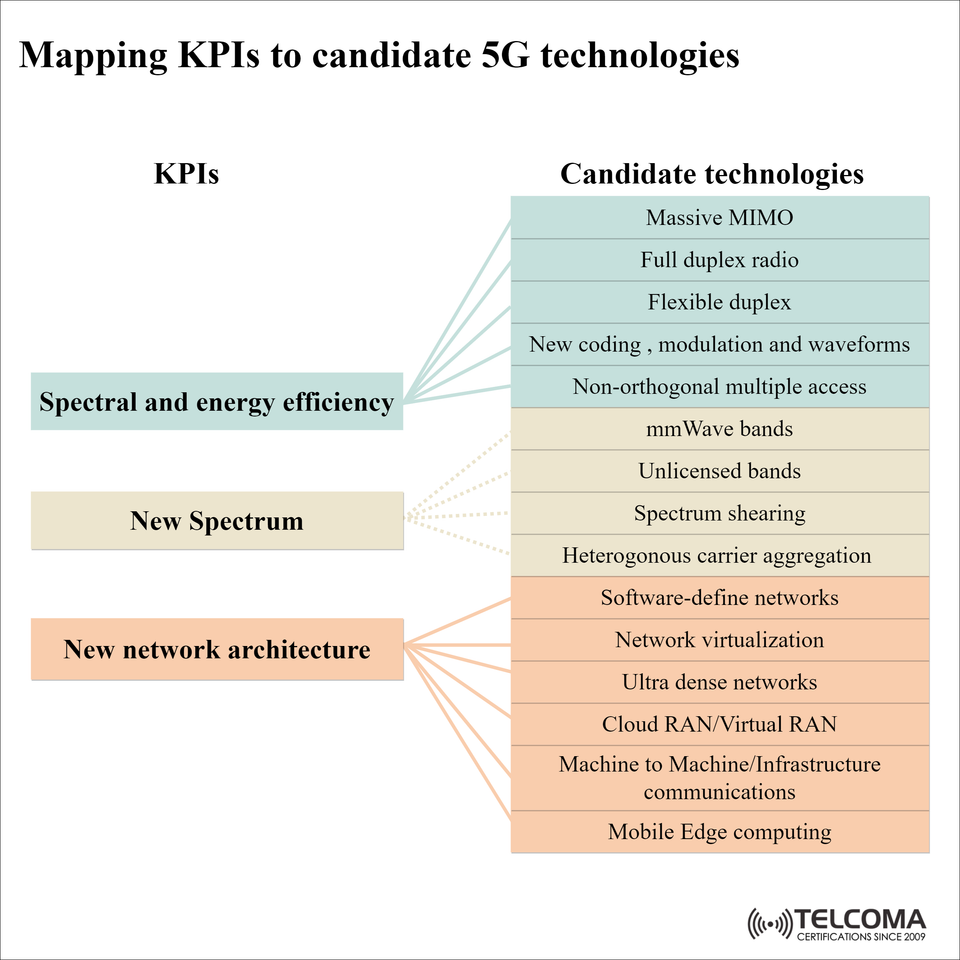
The Terlcoma chart uploaded below provides a simple visual representation, so let's explore what that means for the industry.
- Spectral efficiency and serious energy efficiency.- Maximize capacity with the least possible wasted capacity.
KPIs for spectral efficiency and energy efficiency focus on:
How to obtain the maximum throughput from the spectrum being used, and at the same time, doing it with the least amount of power.
Candidate technologies for these categories:
Massive MIMO – This candidate technology employs a very large number of antennas to increase spectral efficiency through increased spatial multiplexing, thereby delivering higher throughput in a given bandwidth.
Full Duplex Radio – Full duplex radio technology enables users to transmit and receive in the same frequency channels simultaneously and therefore maximize efficiency.
Flexible Duplex – Flexible duplex is similar to the previous candidate technology, but allows the radio to operate in dynamic, asymmetric uplink/downlink ratios, depending on traffic demand.
New Coding, Modulation, and Waveform Efficiencies – Improved coding and modulation provide a more robust signal with better spectral efficiency.
Non-Orthogonal Multiple Access (NOMA) – NOMA allows for two (or more) users to share the same time-frequency resources, optimized with advance decoding methods.
As demand for user capacity and connected devices grows, it is critical that operators remain within prescribed spectral limits, and for their networks to perform within limited available base stations and power-generating capacity. Every watt and every hertz saved is a step toward sustainable scaled deployment of 5G. - New Spectrum: Broadening the Network's Playground
The availability of traditional sub-6 GHz bands alone cannot deliver the capacity and speed a 5G solution is capable of providing. The KPI here is availability and effective use of new spectrum assets.
Candidate Technologies:
mmWave Bands - Very high frequencies deliver tremendous bandwidth for ultra-high-speed data rates.
Unlicensed Bands - Can increase capacity using unlicensed shared spectrum, like 5 GHz or 6 GHz.
Spectrum Sharing - Dynamically reallocating spectrum between various operators or services.
Heterogeneous Carrier Aggregation - aggregating carriers from different frequency bands for enhanced throughput.
Why it matters:
Without new spectrum resources, there are hard limits in terms of calculating capacity - no amount of 5G core and RAN optimizations can equate to remove the limits.
3. New Network Architecture: Building to Embrace Flexibility and Growth.
5G is not just a radio upgrade-it's an architectural revolution to embrace flexibility, scale, and diversity of services.
Candidate Technologies:
Software Defined Networks (SDN) - Control and data planes decoupled, resulting in programmable, dynamic networks.
Network Virtualization - dynamically allocates network functions/services onto shared infracstructure.
Ultra-Dense Networks - More base stations increase coverage and capacity.
Cloud RAN / Virtual RAN - Baseband processing shifts to centralized, virtual environments.
Machine to Machine (M2M) / Infrastructure Communications - Enable IoT and industrial automation.
Summary Table: KPIs and their Relation to 5G Technologies
KPI Candidate Technologies
Spectral & Energy Efficiency Massive MIMO, Full Duplex, Flexible Duplex, New Coding & Modulation, NOMA
New Spectrum mmWave, Unlicensed Bands, Spectrum Sharing, Heterogeneous Carrier Aggregation
New Network Architecture SDN, Network Virtualization, Ultra-Dense Networks, Cloud/Virtual RAN, M2M/Infrastructure-Comms, MEC
Conclusion
Mapping KPIs to candidate technologies help ensure that the innovative solutions industry creates serve concrete, measurable objectives whether it is squeezing more bits from every herz, exploring new spectrum, or launching flexible, cloud-native network architectures. For professionals in telecom, this mapping encompasses more than is a diagram; it becomes their road-map to realising the promise of 5G in a technically sound and economically viable way.
4. Integrating Candidate Technologies into a 5G NR Deployment
5G New Radio (NR) is not only the next step towards faster data speeds for consumer end users, it is also an entirely new faster base technology building block to imagine a network that needs to dynamically adapt to a broad range of use cases, from enhanced mobile broadband (eMBB), ultra-reliable low-latency communications (URLLC) and massive machine-type communications (mMTC).
Here’s how each KPI-driven technology maps back to real-world 5G NR applications:
Spectral and Energy Efficiency in NR
Massive MIMO and Beamforming work together to improve the throughput and coverage of individual users, while limiting interference.
Flexible Duplex accommodates asymmetric traffic flows which are prevalent in streaming video and IoT uplinks.
NOMA fits into NR to enhance resource block utilization, especially in mMTC situations.
New Spectrum Usage in NR
Introducing mmWave adds capacity for eMBB in urban hotspots, stadiums and transport hubs.
Spectrum Sharing allows operators to borrow by dynamically utilizing an underutilized band, which is essential for any operator in early 5G deployment.
Carrier Aggregation in NR allows operators to combine fragmented spectrum assets into a single channel with high throughput.
New Network Architecture for NR
SDN and Network Slicing allows virtualized, service-specific “lanes” in the network, keeping industrial IoT traffic separate from mobile gaming flows.
Cloud RAN optimizes resources to process variable traffic loads, keeping operating expenditure low.
Mobile Edge Computing provides ultra-low-latency applications to support autonomous vehicles and remote operations like surgery.
- Strategic Takeaways for Telecom Professionals
For telecom professionals that are planning, deploying or optimizing 5G, the KPI-to-technology mapping provides more than a list or checklist, it provides a structure for priority and investment (R&D) priorities.
Conclusion
Transitioning from LTE-A to 5G NR is not just one step, it is multi-layered path where objectives are defined by KPIs, and candidate technologies are defined by how we travel. With this mapping, the telecommunications practitioner can navigate the chasm between new technology innovations and measurable performance, allowing operators to create 5G networks that not only meet the demands of today, but also evolve for tomorrow.