
MDT Architecture in Telecom: Components, Working, and Benefits

Introduction to MDT Architecture
The rise of mobile networks and the growing demand for a top-notch user experience have pushed telecom operators to prioritize network optimization. In the past, they heavily relied on drive tests to evaluate network performance and spot issues. But this approach is costly, time-consuming, and often limited in scope. That's where Minimization of Drive Tests (MDT) steps in, introduced under 3GPP standards.
MDT architecture uses real-time data from user equipment (UE) and marries it with the network’s control and management systems. This setup allows operators to keep an eye on, analyze, and optimize network performance without needing extensive physical drive testing.
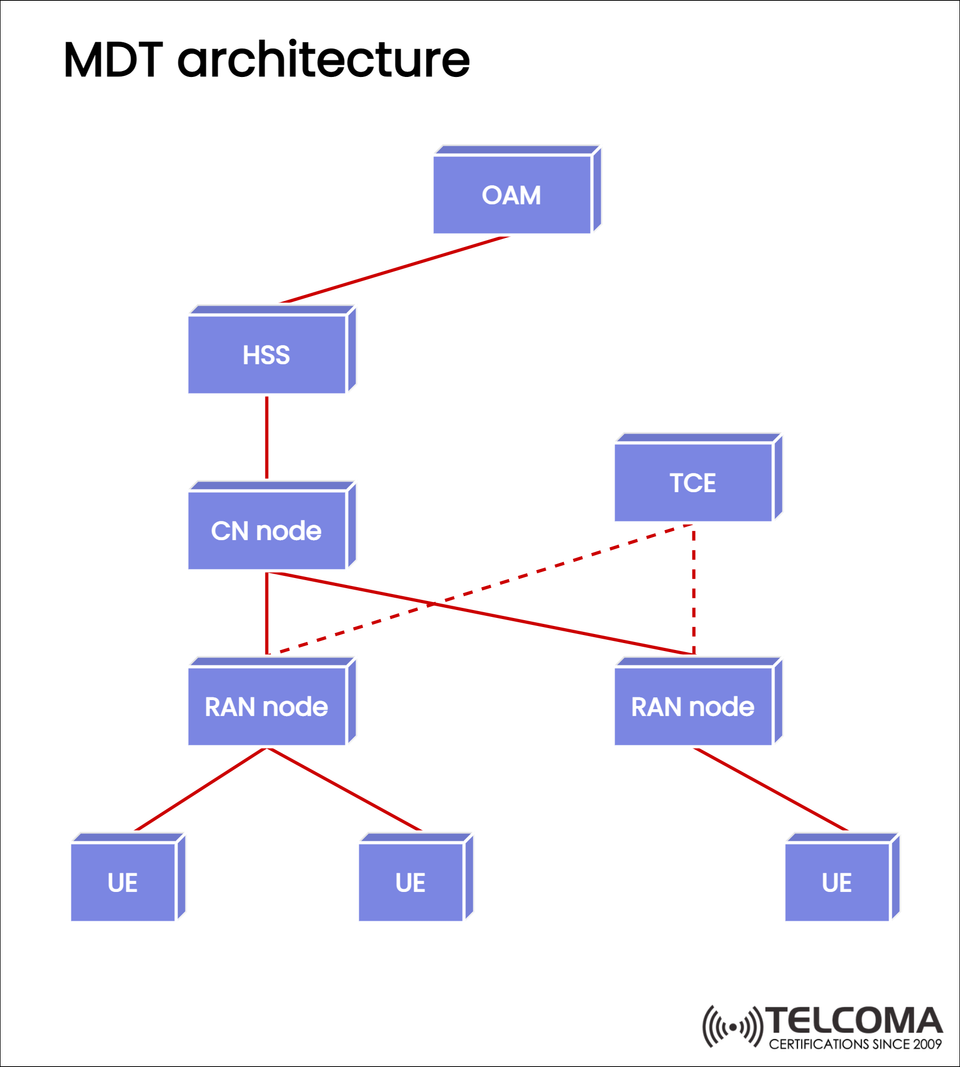
The diagram provided paints a clear picture of the MDT architecture, illustrating how OAM, HSS, CN nodes, RAN nodes, TCE, and UEs work together to create a seamless system for automated performance monitoring.
Key Components of MDT Architecture
MDT architecture consists of several vital entities, each playing its own role:
- User Equipment (UE)
UEs include mobile devices like smartphones, tablets, and IoT devices that produce real-time measurement data.
They send back info on signal strength, location, handover events, and radio link failures.
This data is key to grasping the user’s Quality of Experience (QoE).
- RAN Node
The Radio Access Network (RAN) nodes connect UEs to the network.
They gather and forward measurement data from UEs.
RAN nodes ensure a correct mapping of UE measurements with network events, such as call drops and coverage gaps.
- Core Network (CN) Node
CN nodes oversee the signaling and mobility of UEs throughout the network.
They’re crucial in forwarding MDT measurement reports to other entities like TCE or OAM.
They help integrate MDT data with network-level performance management.
- Home Subscriber Server (HSS)
The HSS holds subscriber data, authentication info, and service profiles.
In the context of MDT, it helps provide context about the user’s subscription and how they use services.
- OAM (Operations, Administration, and Maintenance)
OAM systems are central for network monitoring and optimization.
They set up MDT policies, gather aggregated reports, and enable analytics.
With MDT, OAM gets smarter thanks to UE-driven measurements.
- TCE (Trace Collection Entity)
The TCE collects and stores MDT trace data.
It allows for post-processing and correlation of measurements, enabling advanced diagnostics.
It works closely with CN and RAN nodes for end-to-end performance analysis.
How MDT Architecture Works
Here’s a quick rundown on how MDT architecture operates:
Configuration: OAM sets up MDT policies, like measurement types (signal quality, RSRP, RSRQ) and when to report. These details are sent to UEs via RAN nodes.
Data Collection from UE: UEs gather radio measurement data in both idle or connected modes. This data might include cell ID, location, handover attempts, call drops, and throughput levels.
Forwarding to Network Nodes: RAN nodes compile measurement reports from several UEs. CN nodes make sure these reports reach the TCE or OAM for further action.
Storage and Analysis: TCE keeps trace data for offline analysis. OAM uses these reports for real-time monitoring, troubleshooting, and network improvement.
Network Optimization: Operators look at the gathered data to find coverage gaps, problematic handover zones, or congestion. Based on what they see, they can make adjustments or tune parameters to boost Q o S and Q o E.
Benefits of MDT Architecture
The introduction of MDT architecture offers significant perks for telecom operators and users:
- Reduced Drive Testing
Lessens reliance on expensive and resource-heavy field drive tests.
Provides broad coverage analysis, even in hard-to-reach indoor areas.
- Improved Network Performance
Real-time measurements driven by UEs provide an accurate view of network performance from the user's angle.
Helps quickly spot and fix coverage gaps, call drops, and interference.
- Cost and Time Efficiency
Cuts down on operational costs by swapping physical tests for automated measurements.
Speeds up issue detection and resolution.
- Enhanced Quality of Experience (QoE)
Measures user experience directly, making sure customers are satisfied.
Encourages proactive enhancements in service quality.
- Regulatory Compliance
MDT aids in regulatory reporting by offering standardized data formats for network coverage and performance.
MDT Architecture: Interfaces and Data Flows
The image clearly shows how different entities are interconnected:
OAM ↔ HSS / CN Node: Sharing configuration and subscriber data.
CN Node ↔ RAN Node: Sending measurement reports.
RAN Node ↔ UE: Collecting data via measurement setups.
CN Node / RAN Node ↔ TCE: Transferring trace data for analysis.
These connections ensure smooth collaboration and reliable delivery of MDT measurements.
Types of MDT Measurements
MDT falls into two main types:
- Immediate MDT
UEs report data instantaneously while connected.
Great for real-time troubleshooting and spotting sudden issues.
- Logged MDT
UEs store measurements while idle and upload them later.
Helpful for understanding coverage where real-time reporting isn’t possible (think indoor or low-traffic areas).
MDT Use Cases in Modern Networks
Telecom operators utilize MDT for various optimization scenarios:
Coverage Optimization: Identify coverage gaps and weak signal spots.
Mobility Management: Analyze handover failures and refine mobility parameters.
Interference Detection: Locate areas prone to interference for necessary actions.
Capacity Planning: Grasp user distribution and traffic hotspots for resource allocation.
Indoor Coverage Analysis: Gather performance data inside buildings without the high costs of drive tests.
Conclusion
MDT architecture is a game-changer for optimizing telecom networks. By merging data from UEs, RAN nodes, CN nodes, HSS, OAM, and TCE, operators can lessen their dependence on traditional drive testing while achieving higher efficiency, lower costs, and better user experiences.
In a time when seamless connectivity and customer satisfaction are paramount, MDT equips telecom operators with the tools needed for real-time performance monitoring, predictive optimization, and enhanced service quality.
By embracing MDT, operators can not only cut back on operational costs but also gain valuable insights into how users experience their network. This makes MDT a key player in modern network performance management and an essential enabler for both 4G and 5G rollouts.