
MEC Architecture Explained: Key Components, Interfaces, and Role in 5G Networks

MEC Architecture: An In-Depth Overview
The rapid rise of 5G, IoT, and ultra-low latency applications has brought computing closer to users. This change is driven by Multi-access Edge Computing (MEC), a framework that’s been standardized by the ETSI (European Telecommunications Standards Institute).
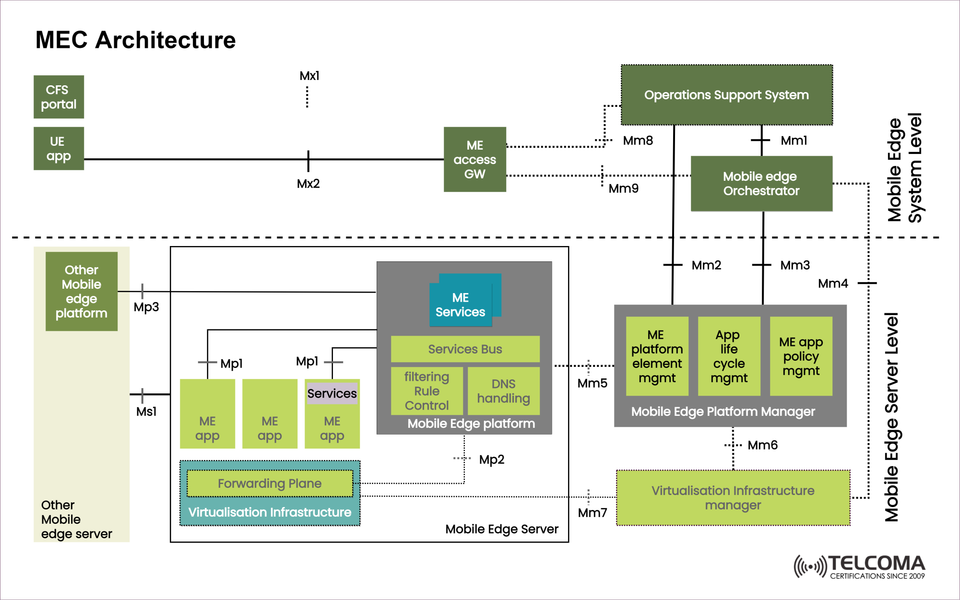
The diagram provided showcases the MEC Architecture, which splits into system-level orchestration and server-level execution. For telecom professionals and tech enthusiasts alike, getting to grips with this layered architecture is key to understanding how MEC backs up next-gen services like autonomous driving, immersive AR/VR, and smart city operations.
What is MEC Architecture?
MEC (Multi-access Edge Computing) architecture is designed to let applications operate at the edge of telecom networks, right by the users and devices. This setup cuts down on latency, saves bandwidth, and enhances context-aware services by making use of local data.
The architecture is structured around two primary layers:
Mobile Edge System Level – For orchestration and overall management.
Mobile Edge Server Level – The environment where MEC apps are executed.
MEC Architecture: Key Components
The MEC reference architecture identifies several entities that work together to create an efficient edge-computing ecosystem.
- Mobile Edge System Level
At this layer, orchestration and operator functions make sure that MEC resources are well-managed and monitored throughout the network.
Operations Support System (OSS): * Ensures service reliability, manages resources, and monitors faults. * Connects with the orchestrator through Mm8.
Mobile Edge Orchestrator: * This is the main decision-maker. * Responsible for managing app placement, lifecycle, and resource optimization across various MEC hosts. * Links with MEC platform managers using Mm2–Mm4.
ME Access Gateway: * Acts as a bridge between user applications and CFS portal requests into the MEC ecosystem. * Communicates through the Mx2 and Mm9 interfaces.
- Mobile Edge Server Level
This level is where the MEC applications actually run.
a. MEC Applications (ME Apps)
These apps are deployed at the edge to handle specific tasks like AR/VR, video analytics, V2X communication, or IoT data processing.
They interact with each other and MEC platform services over Mp1.
b. MEC Platform
This acts as the middleware linking MEC applications and the underlying infrastructure. It offers crucial services like:
Service Bus: This connects MEC apps to platform services.
Filtering Rule Control: Manages traffic and ensures quality of service (QoS).
DNS Handling: Helps with address resolution at the edge.
Interfaces include:
Mp2: Connects the MEC platform to the forwarding plane/virtualization.
Mm5: Links the MEC platform with the platform manager.
c. Mobile Edge Platform Manager
This entity is in charge of management and orchestration at the server level. Key functions include:
ME Platform Element Management (Mm2).
App Lifecycle Management (Mm3).
App Policy Management (Mm4).
d. Virtualization Infrastructure
Facilitates deployment of MEC applications, whether VM- or container-based.
Offers resources (CPU, storage, network) for applications.
Managed by the Virtualization Infrastructure Manager (VIM) through Mm6 and Mm7.
e. Forwarding Plane
Deals with user traffic at the edge.
Works closely with virtualization infrastructure for effective data routing.
- Inter-platform Communication
MEC systems frequently connect across various hosts.
Ms1 and Mp3 interfaces enable communication between MEC applications and external MEC platforms, ensuring scalability in distributed environments.
MEC Interfaces: Essential for Interoperability
The MEC reference architecture lays out interfaces (Mx, Mm, Mp, Ms) that drive standardization.
Interface Functions:
Mx1, Mx2: These connect user/device applications and CFS portals to the MEC system.
Mm1–Mm9: Links orchestrator, OSS, and platform managers for effective orchestration.
Mp1–Mp3: Connects MEC applications to services, platforms, and other MEC hosts.
Ms1: Enables communication between MEC apps running on different servers.
Mm6–Mm7: Interfaces with the Virtualization Infrastructure Manager.
MEC Services
MEC boosts applications with context-aware services that the platform provides, including:
Location Service: Tracks user/device locations in real-time.
Bandwidth Management: Optimizes the use of network resources.
Radio Network Information: Gives insights into radio access network performance.
UE Identity: Ensures secure identification for applications.
Traffic Rule Control: Dynamically directs packets based on established policies.
DNS Handling: Efficiently resolves edge service addresses.
Benefits of MEC Architecture
Ultra-Low Latency: Brings applications closer to end-users.
Efficient Bandwidth Usage: Helps reduce backhaul congestion.
Context Awareness: Apps can utilize network and user data to make informed decisions.
Scalability: New MEC servers can be added as needed.
Security: Keeps sensitive data local, minimizing exposure to the cloud.
Applications of MEC Architecture
Industry MEC Use Cases
Telecom (5G): Network slicing, low-latency services, AR/VR streaming.
Transportation: V2X communication, real-time traffic analytics.
Manufacturing: Robotics, predictive maintenance, process automation.
Smart Cities: Smart lighting, surveillance, waste and traffic management.
Healthcare: Remote surgeries, patient monitoring with real-time data.
Media & Gaming: Cloud gaming, immersive VR/AR experiences.
Challenges in MEC Deployment
Integration Complexity: Needs to work well with existing OSS/BSS systems.
High Deployment Cost: Setting up edge servers and orchestration platforms can be pricey.
Security Risks: Distributed edge nodes are potentially more vulnerable.
Standardization Issues: Even with ETSI defining MEC, vendor-specific solutions can differ.
MEC in the 5G Era and Beyond
MEC is a key building block for 5G standalone (SA) architecture. It works alongside 5G core functions to enable:
URLLC (Ultra-Reliable Low-Latency Communication).
mMTC (Massive Machine-Type Communications).
eMBB (Enhanced Mobile Broadband).
Looking forward, MEC will play a vital role in 6G networks, AI-driven edge computing, and cloud-edge convergence.
Conclusion
The MEC Architecture lays out the framework for rolling out multi-access edge computing in telecom networks. With clear system-level orchestration, server-level execution, and standardized interfaces, it paves the way for low-latency, secure, and scalable edge services.
For telecom operators, MEC isn't just an add-on to 5G; it's a fundamental enabler of next-gen networks, fueling innovations in IoT, AR/VR, smart cities, and much more.