
Microservices Architecture Explained: Benefits, Components, and Telecom Applications

As businesses move toward digital-first strategies, monolithic applications just aren't cutting it anymore when it comes to scalability, resilience, and agility. In the telecom and IT sectors, the answer lies in microservices architecture.
Unlike monolithic systems that put everything into a single codebase, microservices break applications down into independent, loosely connected services. This means each service can be developed, deployed, and scaled independently, which enhances performance and minimizes downtime.
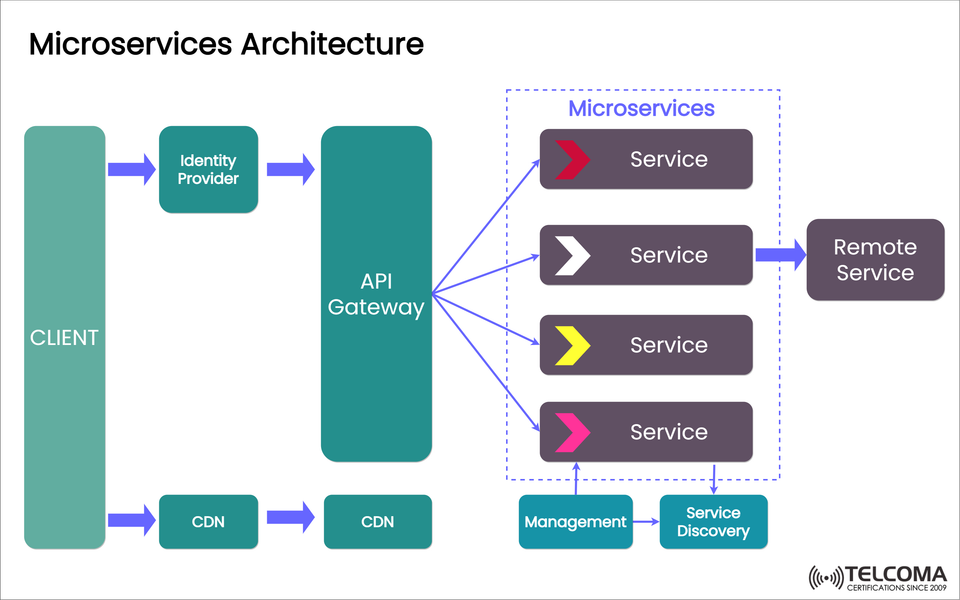
The diagram above gives a clear look at microservices architecture, showcasing key components like the client, identity provider, API gateway, microservices, service discovery, management, CDN, and remote services.
In this blog, we’ll dive into the architecture, its components, benefits, challenges, and how it's applied within telecom systems.
What is Microservices Architecture?
Microservices architecture is a design pattern where large applications are created as a collection of small, independent services. Each microservice operates in its own process, communicates through lightweight APIs, and focuses on a specific business capability.
Some key characteristics of microservices are:
Independence: Each service is self-sufficient and can be deployed on its own.
Resilience: If one service fails, it doesn’t take down the entire system.
Scalability: Services can scale on their own based on demand.
Flexibility: Supports continuous development and deployment (CI/CD).
In telecom, microservices are essential for enabling 5G core networks, modernizing OSS/BSS, and facilitating network function virtualization (NFV).
Components of Microservices Architecture (Explained from the Diagram)
The uploaded image illustrates how different components interact within a microservices ecosystem. Let’s break down each of them:
- Client
This is the end-user or application that makes requests.
It can be a mobile app, web portal, or IoT device.
Requests are sent via APIs to access backend services.
- Identity Provider
This ensures secure access to microservices.
It handles authentication and authorization.
Examples include OAuth2, OpenID Connect, and Keycloak.
In telecom, it ensures only authorized users or applications can access subscriber data.
- API Gateway
Serves as the single entry point for clients.
It routes requests to the right microservice.
Provides essential functionalities like authentication, load balancing, rate limiting, and request/response transformation.
Examples: Kong, NGINX, AWS API Gateway.
- Microservices
These are independent services that manage specific business logic.
Each service has its own database and operational lifecycle.
Some common examples in telecom are subscriber management, billing and charging, policy control (PCF), and session management (SMF).
The diagram shows various services (indicated by arrows), emphasizing loose coupling and independent operation.
- Remote Service
This represents external services or third-party APIs that integrate with the system.
Examples include payment gateways, third-party analytics, and external telecom systems.
- CDN (Content Delivery Network)
This optimizes the delivery of static content like images, videos, and documents.
It boosts performance by caching data closer to users.
This is key for telecom operators, especially for streaming or high-traffic services.
- Service Discovery
This allows services to find and communicate with each other dynamically.
It eliminates the need for hardcoding IPs or endpoints.
Examples include Consul, Eureka, and Kubernetes DNS.
- Management
This encompasses monitoring, logging, scaling, and orchestrating services.
It ensures everything runs smoothly and is fault-tolerant.
It's usually implemented with tools like Kubernetes, Prometheus, and Grafana.
How Microservices Architecture Works (Step-by-Step)
Client Request
The user interacts with the client app.
The client authenticates through the identity provider.
API Gateway Routing
The request reaches the API gateway.
The gateway authenticates the request and sends it to the correct microservice.
Microservices Processing
The relevant microservice carries out the business logic.
It might interact with other services or a remote service.
Service Discovery & Management
If necessary, services find one another through service discovery.
Management tools keep an eye on performance and auto-scale services.
CDN Delivery
For static content, the request might be served through the CDN for better speed.
Response Returned
The service sends the processed data back through the API gateway.
Finally, the client receives the response.
Benefits of Microservices Architecture
Scalability
Services can scale on their own according to demand.
Telecom operators can adjust session management without impacting billing.
Resilience
Fault isolation helps to avoid cascading failures.
For instance, if charging fails, it doesn’t take down policy control.
Faster Time-to-Market
Independent dev cycles let teams release updates more quickly.
Technology Flexibility
Different tech stacks can be used for different services.
Cloud-Native Compatibility
Works seamlessly with Kubernetes and containerized environments.
Challenges of Microservices Architecture
Increased Complexity: It's trickier to manage multiple services compared to monoliths.
Data Consistency: This requires distributed databases and eventual consistency.
Networking Overhead: More communication between services can lead to increased latency.
Security: Each service needs solid identity and access controls.
Monitoring & Debugging: With more components, observability becomes more complex.
Microservices in Telecom: Real-World Applications
5G Core Networks
Functions like AMF, SMF, and PCF are implemented as microservices.
This approach supports network slicing and dynamic scaling.
OSS/BSS Modernization
Functions like billing and customer portals transition to microservices.
This enhances agility in rolling out new telecom plans.
IoT Ecosystems
Microservices manage tasks like device registration, data collection, and analytics.
Edge Computing
Deploying microservices at the edge reduces latency for real-time services.
Microservices vs. Monolithic Architecture
Feature Monolithic Microservices Scalability Entire app scales Individual services scale Resilience Failure crashes app Failures isolated Deployment Slower, bulk updates Faster, independent updates Flexibility Single tech stack Multiple tech stacks Performance Lower network overhead More network calls
Future of Microservices in Telecom
As 5G advances to 5G-Advanced and then 6G, microservices will form the backbone of telecom's digital transformation. We can expect to see:
AI-driven orchestration of services.
Server less microservices for event-driven workloads.
Intent-based networking where services self-configure based on business goals.
Conclusion
Microservices architecture is changing the way telecom and IT systems are designed. By breaking applications down into smaller, independent services, operators can achieve scalability, agility, resilience, and faster innovation.
The diagram highlights how components like clients, API gateways, identity providers, CDNs, and management tools work together to deliver a flexible architecture.
For those in telecom, adopting microservices isn’t just a trend but a strategic necessity to remain competitive in the world of cloud-native 5G and beyond.
In a nutshell, microservices are the building blocks of our digital future, enabling next-gen networks, applications, and enhanced customer experiences.