
Migration Path from 4G to 5G: A Comprehensive Guide for Telecom Professionals

Migration Path from 4G to 5G: SA, NSA and Dynamic Spectrum Sharing
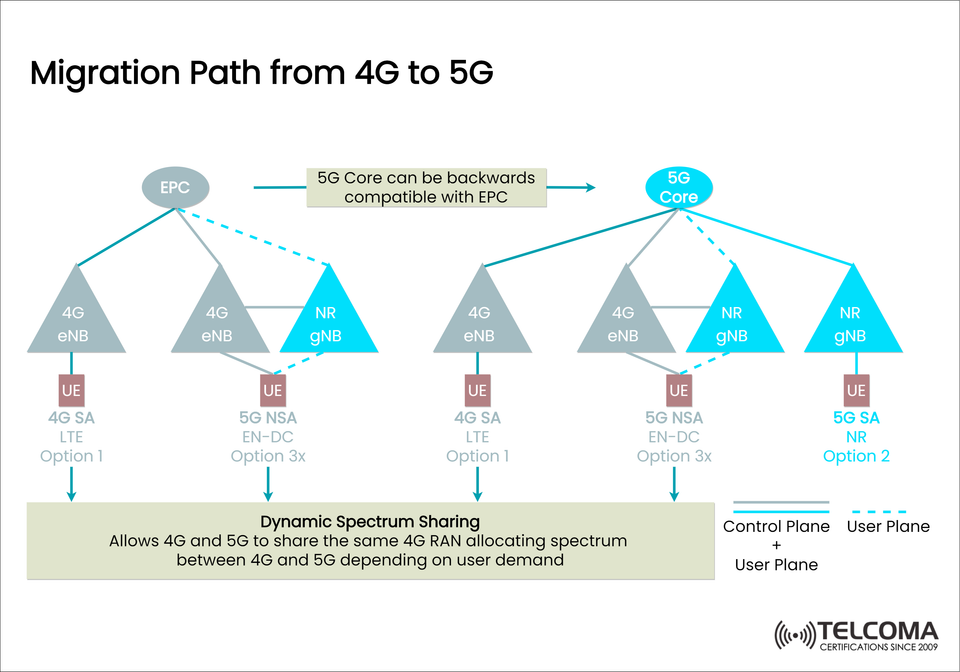
Moving from 4G LTE to 5G is not one move, but an evolution to ensure the best use of existing infrastructure while transitioning to full 5G capabilities. The above image depicts the evolution to 5G clearly, showing various deployment phases with the various deployment models, which will help you see the roles of 4G eNBs and 5G NR gNBs as well as the evolution of core networks from EPC to 5G Core networks.
This guide will identify the differences between Standalone (SA) and Non-Standalone (NSA) paths, as well as the introduction of Dynamic Spectrum Sharing (DSS) will provide the Telco professional with a clear view of the evolution to 5G.
📶 Deployment options from LTE to 5G NR
- 4G Standalone (LTE - Option 1)
User Equipment (UE): 4G only
Access Network: 4G eNodeB (eNB)
Core Network: EPC (Evolved Packet Core)
Use Case: Traditional LTE network with no 5G enhancements
This is still the baseline 4G configuration, and is still being used widely today. This represents the base layer for many NSA deployment.
2. 5G Non-Standalone (NSA - Option 3x)
User Equipment: Dual connectivity capable device
Access Network: LTE eNB + NR gNB
Core Network: EPC (legacy 4G core)
3GPP supports a two-pronged approach to the 5G migration path, which involves Standalone (SA) and Non-Standalone (NSA) options.
- Non-Standalone (NSA - Option 3, 5G NR with EPC)
User Equipment: 4G / 5g device
Access Network: 5G NR gNB
Core Network: EPC or stub EPC
The NSA version of 5G uses existing 4G infrastructure as the control plane signaling connection while the 5G NR gNB provides a user plane for fast data transfer. The NSA option allows operators to roll out 5G NR quickly without providing a complete overhaul of the core network.
Key Features:
- Fast 5G deployment
- Reused 4G EPC
- Ideal for enhanced mobile broadband (eMBB)
- Standalone (SA - Option 2)
User Equipment: pure 5G device
Access Network: 5G NR gNB
Core Network: 5G Core
When 5G is deployed as a Standalone, all of the benefits of 5G are available to the user, such as ultra-reliable low-latency communication (URLLC), and network slicing. Standalone 5G requires you to deploy both a 5G RAN and 5G Core.
Key Features:
- Full feature set of 5G
- Lower latency
- Ability to use new 5G use cases (e.g IoT, mission-critical applications)
Backward compatibility of 5G Core with EPC
Important to consider when thinking about the migration path, is the ability to share traffic between the EPC and Core, meaning 5G operators can rollout the 5G Core while still supporting legacy EPC. This allows for a seamless experience for customers.
Dynamic Spectrum Sharing (DSS)
DSS provides the ability for both 4G LTE and 5G NR to coexist on the same frequency band. The base station dynamically shares spectrum between 4G and 5G in real time based on demand and is efficient.
Key Features:
- Spectrum efficiency
- Transition without re-farming
- Flexible
📊 Comparison Table: 4G vs NSA vs SA
Feature 4G SA (LTE) 5G NSA (Option 3x) 5G SA (Option 2)
RAN 4G eNB 4G eNB + 5G gNB 5G gNB
Core Network EPC EPC 5G Core
Data Plane 4G only 5G NR 5G NR
Control Plane 4G 4G 5G
Speed of Deployment Existing Fast Slow (requires new infra)
Features LTE eMBB eMBB, URLLC, Slicing
🧠 Why this is important to telecoms engineers and operators.
For telecoms engineers and operators, understanding the migration path is important for:
Planning investments in infrastructure.
Designing a hybrid network.
Creating a future-proof connectivity solution.
Sharing the ability to deploy NSA first before transitioning to SA, allows operators the flexibility to keep costs, complexity and performance in balance.
✅ Conclusion
The migration from 4G to 5G is a strategic multi-phase evolution. Telecom operators can begin with 4G LTE, transition to 5G with NSA (which is 4G and 5G), and finally transition to SA 5G with a new core network. Evolution gives the telecom operators the flexibility to evolve based on demand, resources available to them and user readiness. Additionally, technologies such as Dynamic Spectrum Sharing (DSS) will enable operators to transition from 4G to 5G by optimizing the resources they currently have from a capacity investment, which lessens burden when continuing to investment in upgrades to their radio network that relies on additional capacity.
For telecoms engineers, understanding this roadmap is crucial to deploy scalable, future-ready 5G networks.
🧩 Technical Concerns for 5G Transition
As telecom operators move from 4G to 5G, they will face a number of technical hurdles and planning considerations:
- Radio Access Network (RAN) Changes
4G eNodeBs must be updated to support EN-DC (E-UTRAN New Radio - Dual Connectivity) for NSA.
New NR gNodeBs will have to be installed for both NSA and SA options.
DSS will aid in achieving the best spectrum usage without re-farming spectrum.
2. Core Network Changes
EPC provides NSA options but lacks 5G specific capabilities such as network slicing, service-based architecture (SBA) and low-latency routing.
5G Core incorporates:
Control and User Plane Separation (CUPS)
Service Based Interfaces (SBI)
Cloud-native and containerized environment
3. Devices
NSA devices must have dual connectivity (4G + 5G).
SA devices connect independently to the 5G Core with NR gNB.
DSS devices must demonstrate significant gains in improved performance if they plan to function in a mixed-use environment.
4. Backhaul and Transport
5G requires high-capacity backhaul (fibre or mmWave) to provide higher throughput and ultra-low latency.
The underlying packet core must be and generally scalable, and network function virtualization (NFV) required to address data and service demands.
🚀 Looking Ahead: Moving to Whole 5G
The future of mobile networks does not stop with speed increases:
Standalone 5G will support:
Private 5G networks for companies
Ultra-low latency applications like remote surgery
Mission Critical communications for defence and public safety
Industry 4.0 automation - ultra dependable
Edge Computing integrated with 5G Core supporting local processing and minimal latency.
6G preparation will use these SA deployments, adding AI-native networks, THz spectrum, and integration with satellites.