
Migration Paths from LTE to 5G: Exploring NSA, SA, and EPC Integration Options
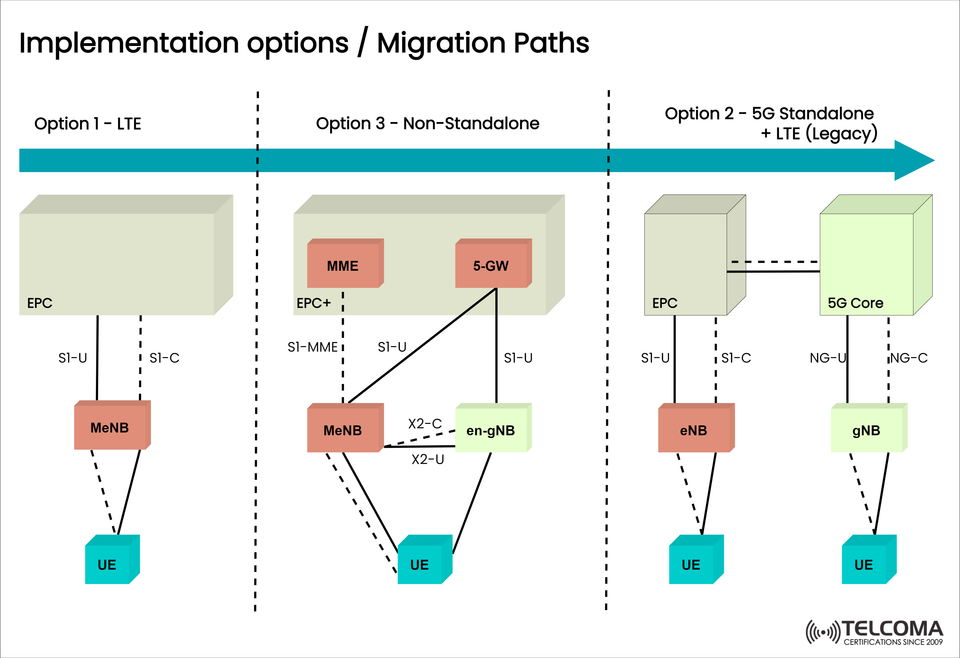

Examining LTE to 5G migration possibilities: NSA, SA, and EPC integration
In this age of rapid transition, as the journey from 4G to 5G accelerates, telecommunications networks are faced with some significant structural decisions on how best to evolve their network architecture. The evolution is not a singular leap from LTE to 5G, but it extends several options for implementation, providing network operators with some flexibility, opportunity, and optionality to migrate as they see fit, based on spectrum/spectrum availability, investing perspective, and market/pressures demand.
The graphic above illustrates the three main migration choices from LTE to 5G, each with entirely different deployment architectures, contractual integrations, and functional relationships between the Evolved Packet Core (EPC) and the 5G Core (5GC).
Option 1: LTE with EPC – The Original Baseline
This is the legacy baseline 4G LTE network architecture. The deployment structure is described below.
• The User Equipment (UE) connects to the Master eNodeB (MeNB).
• The MeNB connects to the EPC via:
• s1-C Control Plane (CP) control signaling
• s1-U User Plane (UP) data traffic.
General attributes:
• Fully reliant on EPC
• No 5G capabilities
• Represents the "starting point" or lowest form of migration - one stratum before evolution and migration.
✅a solid, stable, and mature deployment
❌no integration with 5G RAN and/or 5G core
Option 3: Non-standalone (NSA) – Using LTE with 5G RAN
NSA is the most common initial option for deployment of 5G. NSA is a merge of using current and available 4G EPC architectures and integrating with a 5G New Radio (NR) - which is a more readily available option to deploy and potentially less costly in the deployment stages/steps.
Key Components:
MeNB (Master eNB): continues providing the control signaling on S1-C.
en-gNB (5G NR base station): continues providing high-speed user plane data.
EPC+: the EPC enhanced by inclusion of additional functions, in the following components:
MME (Mobility Management Entity)
5-GW (5G Gateway)
Communication Can Be Achieved Using:
S1-MME, S1-U from MeNB on EPC
X2-C, X2-U between MeNB and en-gNB
Characteristics:
Dual connectivity: LTE (control) + 5G NR (user)
Rapid deployability using existing EPC
Good option for 5G trial / rollout
✅ Budgetary-friendly upgrade path
✅ Experience 5G data speeds
❌ Still relies on LTE Control plane
Option 2: Standalone (SA) – Full 5G Deployment with Legacy Access
This is the most advanced migration path because it provides true 5G capabilities and access through a dedicated 5G Core (5GC).
Architecture Overview:
The gNB (next-gen Node B) connects to the 5G Core via:
NG-C (Control Plane)
NG-U (User Plane)
the eNB and LTE networks are still allowed to function via EPC for legacy support.
This model provides the opportunity for true 5G features including:
Ultra-low latency
Network slicing
Service-based architecture
Characteristics:
Decoupled from EPC
Control and User Plane architecture based on 5G network functionality
Higher performance and efficiency for network operators
✅ Full 5G features supported
✅ Future-ready architecture
❌ Higher CAPEX and complexity
Comparison Table: LTE Migration Options to 5G
Feature / Aspect Option 1 - LTE Option 3 - NSA Option 2 - SA
Core Network EPC EPC + 5G Core-5GC
Radio Access eNB (meNB) eNB + 5G NR (en-gNB) gNB (5G NR only)
Control Plane S1-C S1-MME + X2-C NG-C
User Plane S1-U X2-U NG-U
Latency Optimization ❌ Partial ✅
Network Slicing ❌ ❌ ✅
Best For Legacy LTE users Fast rollout of 5G services Full-featured 5G networks
Telecommunications Deployment Strategy:
Which way should you go?
Your deployment path is dependent on a large number of things.
Consideration Recommended Path
Current LTE investment NSA or LTE-based EPC
Speed of deployment NSA
5G service & innovation SA (Standalone)
Budget limitations NSA / LTE
Future scalability SA
Conclusion:
Evolving Smart!
Transitioning from LTE to 5G is not one size fits all. Each operator must weigh the considerations regarding cost, performance, and readiness for deployment. There are however options to look at, and whether you are using an NSA path to use LTE infrastructure, or investing in a standalone 5G to put a 5G Core in your future, you are taking a path for greater 5G capability.
Understanding the alternative paths of Option 1 (LTE), Option 3 (NSA), and Option 2 (SA) will help connect network architecture to future visioning.
Use Case Scenarios: Migration Model Applications in Telecommunications Networks
📡 Non-Standalone (NSA) for Urban 5G Rollouts
For many operators, NSA starts in urban areas that already have good existing LTE coverage. This allows for:
5G-like throughput (via en-gNB 5G NR)
Steady rollout, and no investment in 5G Core.
Maximizing spectrum reuse with Dual Connectivity (EN-DC)
For example:
Cities like Seoul, London, and New York have deployed NSA architectures first to provide enhanced mobile broadband (eMBB) services with improved time to market.
🌐 Standalone (SA) for Enterprise and Industrial Use Cases
Standalone deployments are needed for:
Private 5G networks
Ultra-low latency use cases like autonomous vehicles, AR/VR, smart manufacturing, etc.
End-to-end slicing for enterprise-grade network isolation.
For example:
Factory 5G networks (e.g. Bosch, Ericsson) demand SA - with a dedicated gNB and 5GC that ensures low latency and deterministic control.
Deployment and Migration Considerations for Operators
If operators want to migrate from LTE to 5G efficiently, they need to consider the following dimensions:
🧠 Technical Readiness
EPC Compatibility: Is your EPC ready for NSA upgrades?
RAN Infrastructure: Do you have an existing radio installed out to any 5G NR-ready radios, or any upgrades needed?
Backhaul and Transport: Is your backhaul and transport network designed to accommodate an uplift in 5G data loads?
Visual Recap: Control and User Plane Interfaces
Interface Function Used in
S1-C LTE Control Plane Option 1, NSA
S1-U LTE User Plane All options
X2-C Control between eNB & en-gNB NSA
X2-U User plane between eNB & en-gNB NSA
NG-C 5G Control Plane SA
NG-U 5G User Plane SA