
Migration Roadmap from 4G to 5G: NSA, SA, and Converged Service Explained
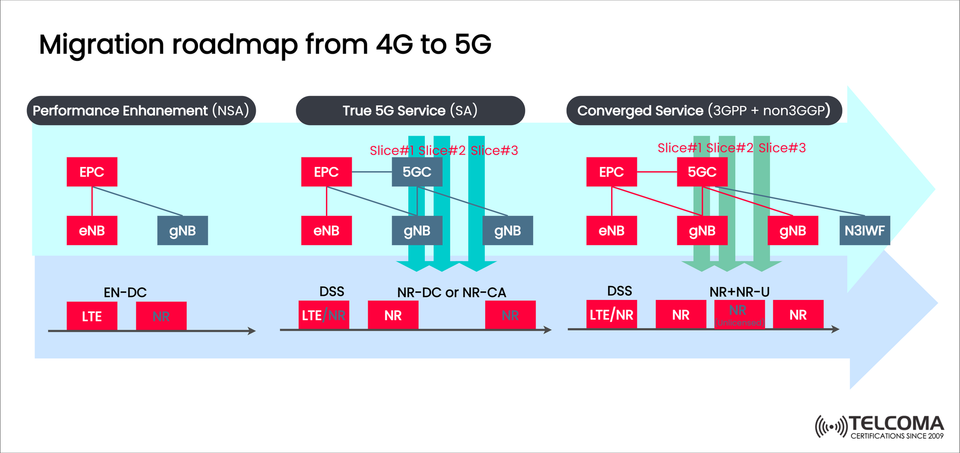

Transitioning from 4G LTE to 5G isn’t just a straightforward upgrade—it's a carefully planned migration designed to keep things running smoothly, improve efficiency, and allow for growth.
The image above shows the migration roadmap from 4G to 5G, highlighting some key phases:
Performance Enhancement (NSA – Non-Standalone)
True 5G Service (SA – Standalone)
Converged Service (3GPP + non-3GPP integration)
Each phase introduces new architectural features, better ways to use spectrum, and improved network capabilities. This transition paves the way for things like low latency, high data rates, massive IoT applications, and end-to-end network slicing.
In this blog, we’ll dive into the step-by-step roadmap, exploring how LTE (4G) evolves into 5G New Radio (NR) while keeping the service seamless.
Performance Enhancement (NSA): The First Step
The migration kicks off with the Non-Standalone (NSA) architecture, which is all about boosting the existing 4G performance while bringing in 5G New Radio (NR).
Key Features of NSA:
Evolved Packet Core (EPC) continues to serve as the main hub for control and user data.
eNodeB (eNB) stays as the primary LTE node.
gNodeB (gNB) starts being used for 5G NR, working together with LTE.
EN-DC (E-UTRA-NR Dual Connectivity): This allows devices to connect to both LTE and NR at the same time.
Benefits:
Quicker deployment because it makes use of the existing LTE core (EPC).
Early access to 5G radio capabilities like faster speeds and improved spectrum efficiency.
Acts as a bridge to standalone 5G without needing an immediate core replacement.
During this phase, operators can take advantage of Dynamic Spectrum Sharing (DSS), which lets LTE and NR share spectrum resources efficiently during the transition.
True 5G Service (SA): Standalone 5G
Once operators feel confident and have the right infrastructure in place, we move on to Standalone (SA) 5G, which truly unlocks what 5G can offer.
Key Features of SA:
The introduction of the 5G Core (5GC), which replaces the EPC.
gNodeBs (gNBs) connect directly to the 5GC.
Supports network slicing, allowing multiple logical networks to run on the same physical structure (like Slice#1 for eMBB, Slice#2 for URLLC, and Slice#3 for mMTC).
NR-DC (NR Dual Connectivity) and NR-CA (Carrier Aggregation) make it possible to use multiple frequency bands flexibly.
Benefits:
Unlocks the full spectrum of 5G features, including ultra-reliable low-latency communication (URLLC) and massive machine-type communication (mMTC).
Supports independent 5G deployments without depending on LTE.
Allows companies to set up private 5G networks tailored for automation, IoT, and essential applications.
In this stage, DSS continues to balance LTE and NR usage, but the focus shifts to using native NR deployments to achieve better performance.
Converged Service: 3GPP + non-3GPP Integration
The last step on the roadmap is converged service, where 5G integrates with both 3GPP and non-3GPP access methods. This phase aims to provide widespread connectivity, linking cellular and non-cellular networks.
Key Features:
The 5GC acts as the central hub for both LTE and NR.
Non-3GPP access (like Wi-Fi or unlicensed spectrum) connects through the N3IWF (Non-3GPP Interworking Function).
Expanded network slicing allows for multi-service support across different networks.
NR in unlicensed spectrum (NR-U) enables 5G to operate in Wi-Fi bands.
Benefits:
Offers a seamless user experience, regardless of whether you’re in a cellular or non-cellular setting.
Improved spectrum efficiency with the aggregation of licensed and unlicensed spectrum.
Opens up new business models, such as industrial IoT, private enterprise 5G, and smart city setups.
This converged approach ensures that 5G isn’t just an upgrade but becomes a unifying platform capable of supporting a variety of use cases.
Step-by-Step Migration Flow
Here’s a simplified table for a clearer view of the roadmap:
Stage | Architecture | Core | Radio Nodes | Key Features
NSA (Performance Enhancement) | Non-Standalone | EPC | eNB + gNB | EN-DC, DSS, LTE anchor
SA (True 5G Service) | Standalone | 5GC | gNB | Network slicing, NR-DC, NR-CA
Converged Service | 3GPP + non-3GPP | 5GC | gNB + N3IWF | NR-U, Wi-Fi integration, advanced slicing
Role of Technologies in Migration
- Dual Connectivity (EN-DC, NR-DC)
Ensures continuity between LTE and NR.
Allows devices to connect to both networks for better throughput.
- Dynamic Spectrum Sharing (DSS)
Lets operators allocate spectrum dynamically between LTE and 5G NR.
Reduces the necessity for dedicated 5G spectrum in the early stages.
- Carrier Aggregation (NR-CA)
Combines different frequency bands for higher data rates.
Offers flexibility in how spectrum is used.
- Network Slicing
Key for customizing network performance.
For example: eMBB slice for streaming, URLLC slice for automation, mMTC slice for IoT.
- N3IWF (Non-3GPP Interworking Function)
Connects Wi-Fi and other unlicensed networks to the 5GC.
Ensures connected services for both enterprises and consumers.
Challenges in Migration
Even though the roadmap is designed for a smooth process, there are some challenges:
Spectrum availability: Getting timely access to mid-band and high-band spectrum is essential.
Infrastructure costs: Deploying gNBs and upgrading to the 5GC comes with significant expenses.
Interoperability: Making sure handovers between LTE, NR, and Wi-Fi are seamless requires thorough testing.
Device readiness: Widespread adoption hinges on devices supporting EN-DC, DSS, and NR-CA.
Future Outlook
The migration roadmap does more than just link 4G and 5G—it sets the stage for the evolution of 6G. With SA and converged models, operators will already have:
AI-driven, cloud-native 5G cores.
Integration across multiple spectrums (both licensed and unlicensed).
Seamless interoperability with non-3GPP access methods.
This prepares the industry for beyond-5G services like terahertz communications, holographic applications, and intelligent IoT ecosystems.
Conclusion
The shift from 4G to 5G is a multi-phase journey featuring NSA, SA, and converged service models. Starting with LTE-backed NSA, operators gradually advance to standalone 5G with its own core, before finally reaching converged services that incorporate non-3GPP access like Wi-Fi.
Key technologies like EN-DC, DSS, NR-CA, NR-U, and network slicing are crucial for a smooth migration and for unlocking new business opportunities. Understanding this roadmap is vital for telecom professionals when planning networks, forming investment strategies, and fostering long-term innovation.