
Migration Roadmap to 5G SA via NSA Options Explained

Switching from 4G LTE to 5G isn't just a flip of a switch; it's more like a carefully planned progression. Telecom companies have to juggle network investments, keep older systems compatible, and boost performance as they gear up for a fully standalone (SA) 5G core network (5GC).
This is where Non-Standalone (NSA) deployment comes into play. With NSA, operators can tap into the existing 4G Evolved Packet Core (EPC) while adding 5G New Radio (NR) features. Over time, this migration plan leads to a Standalone (SA) setup, where the 5G Core (5GC) becomes central, opening up advanced features like network slicing, ultra-reliable low-latency communication (URLLC), and massive IoT (mIoT).
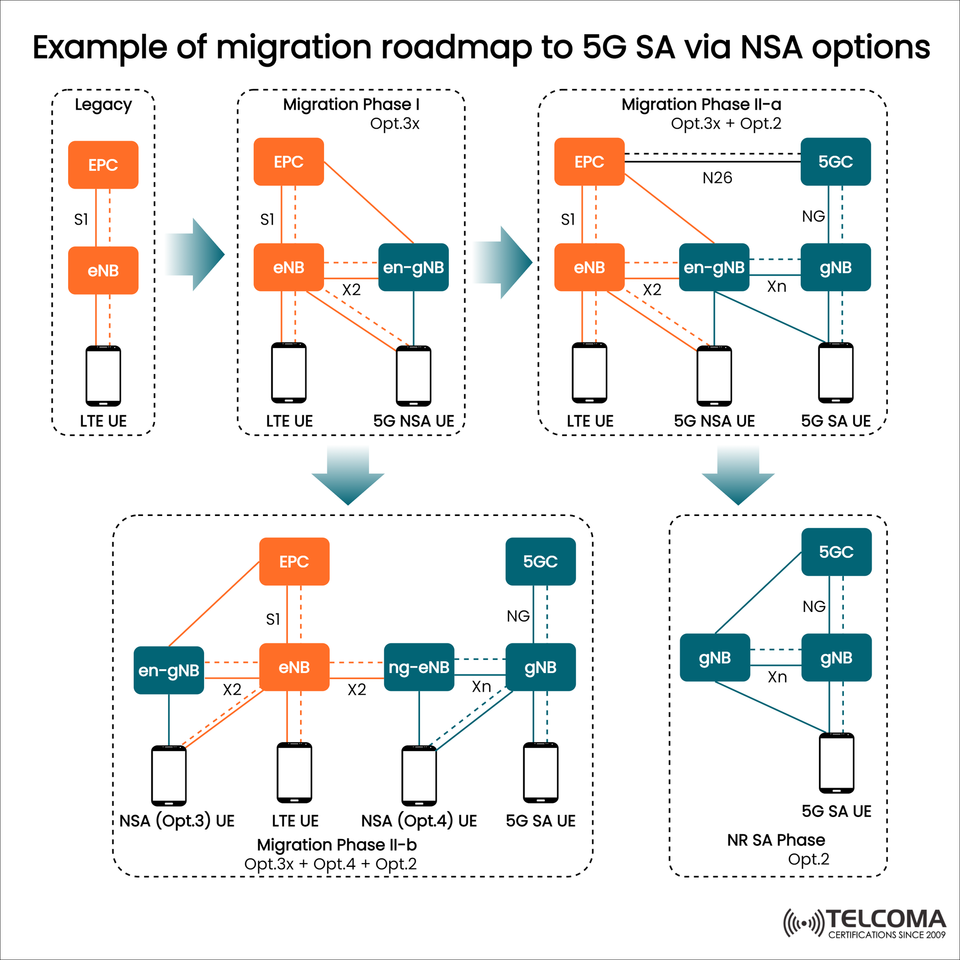
The image attached gives a clear roadmap for the transition from legacy LTE to 5G SA through NSA, outlining several phases, interfaces, and deployment choices. Let’s break it down.
Legacy Network (4G EPC + eNB)
In the first phase, the networks are running on:
Evolved Packet Core (EPC) – which manages control and user plane functions.
eNodeB (eNB) – providing radio access for LTE.
LTE UE – devices made specifically for 4G.
This setup forms the baseline 4G LTE system, ensuring good coverage and capacity, but it doesn’t offer the advanced flexibility that 5G does.
Migration Phase I – NSA Option 3x
The evolution kicks off with Non-Standalone 5G using Option 3x.
Architecture Components:
EPC remains central to the operation.
eNB gets an upgrade to Master eNB (MeNB).
A new en-gNB (5G-capable gNB) is introduced.
Connectivity:
The eNB connects to EPC through the S1 interface.
eNB and en-gNB are linked via the X2 interface.
Devices Supported:
LTE UEs connect through eNB.
5G NSA UEs can connect using both eNB and en-gNB for dual connectivity.
This phase gives operators a way to add 5G NR features without having to change out the EPC, boosting speed while keeping the LTE framework.
Migration Phase II-a – NSA (Option 3x + Option 2)
Here, we start integrating dual connectivity with some SA features.
Key Elements:
EPC continues to support LTE along with NSA UEs.
The 5GC gets introduced alongside the existing EPC.
gNBs connect to 5GC through the NG interface.
Interworking:
EPC and 5GC work together through the N26 interface for smooth handovers.
en-gNB talks to gNBs using the Xn interface.
Device Ecosystem:
LTE UEs connect via EPC.
NSA UEs connect through both eNB and en-gNB.
SA UEs connect to 5GC through gNB.
This hybrid setup allows for the parallel operation of LTE, NSA, and SA devices, making the transition gradual and manageable.
Migration Phase II-b – NSA (Option 3, Option 4, and Option 2)
At this juncture, multi-option support kicks in:
Option 3 (NSA): en-gNB + EPC.
Option 4 (NSA): ng-eNB + 5GC.
Option 2 (SA): gNB + 5GC.
Architecture Highlights:
EPC keeps supporting both LTE and NSA UEs.
ng-eNB connects to 5GC using the NG interface.
gNB links to 5GC with full 5G SA capabilities.
Communication among inter-gNB and ng-eNB happens through the Xn interface.
This phase maximizes flexibility for operators, letting them manage multiple UE types at once. It’s particularly helpful during large rollouts, as NSA can fill coverage gaps while SA grows.
Core Components:
EPC is completely phased out.
Only 5GC remains, handling all services.
gNBs connect directly to 5GC over the NG interface.
Interfaces:
The Xn interface is used for gNB-to-gNB communication.
Device Support:
Only 5G SA UEs are supported.
This is when all 5G capabilities are fully realized:
Network Slicing for bespoke enterprise services.
Ultra-Low Latency (URLLC) for critical applications.
Massive IoT support for smart cities, Industry 4.0, and beyond.
Comparison of Migration Phases
Phase Core Network Access Nodes UE Support Key Interfaces
Legacy EPC eNB LTE UES1
Phase I (NSA 3x)EPC eNB + en-gNB LTE UE, 5G NSA UES1, X2
Phase II-a (NSA + SA)EPC + 5GCeNB + en-gNB + gNBLTE, NSA, SA UEsS1, X2, NG, N26, Xn
Phase II-b (Mixed Options)EPC + 5GCen-gNB, ng-eNB, gNBLTE, NSA, SA UEsS1, X2, NG, Xn
Final (SA 2)5GCgNB5G SA UEsNG, Xn
Why NSA is Crucial for 5G Migration
Operators can’t just jump from 4G LTE to fully operational SA 5G due to:
Coverage Gaps: The rollout of 5G spectrum happens gradually.
Cost: Replacing EPC with 5GC everywhere is pricey.
Device Ecosystem: A lot of users still depend on LTE or NSA-capable devices.
NSA acts as the bridge technology, allowing:
A quicker launch of 5G services.
Reuse of existing 4G infrastructure.
A smooth user experience with dual connectivity.
The Migration Plan in Steps
- Legacy LTE Phase
Core: EPC
Radio Access: eNB
Devices: LTE-only UEs
Interfaces: S1
✔ Pros: Established ecosystem, broad coverage
✘ Cons: Limited scalability, lacks 5G NR
- NSA Phase I (Option 3x)
Core: EPC (5GC not yet in use)
Nodes: eNB (MeNB) + en-gNB (NR-capable node)
Devices: LTE UE + 5G NSA UE
Interfaces: S1 (EPC–eNB), X2 (eNB–en-gNB)
✔ Pros:
Fast 5G rollout without needing a full 5GC.
Makes good use of existing EPC investments.
Supports dual connectivity.
✘ Cons:
Limited 5G features (like no network slicing or URLLC).
EPC can be a bottleneck for scalability.
- NSA + SA Coexistence (Phase II-a)
Core: EPC + 5GC (dual)
Nodes: eNB, en-gNB, gNB
Devices: LTE UEs, NSA UEs, SA UEs
Interfaces: S1, X2, NG (5GC), N26 (EPC–5GC interworking), Xn (gNB–en-gNB)
✔ Pros:
Smooth migration with support for dual-core.
Enables early adoption of SA.
Compatible with multiple device ecosystems.
✘ Cons:
Increased complexity in managing both EPC and 5GC.
Higher costs to maintain dual networks.
- Multi-Option NSA/SA (Phase II-b)
Core: EPC + 5GC
Nodes: en-gNB, ng-eNB, gNB
Options Supported: * Option 3 (NSA with EPC) * Option 4 (NSA with 5GC) * Option 2 (SA with 5GC)
✔ Pros:
Offers operators maximum flexibility.
Addresses coverage gaps with NSA as SA grows.
Supports gradual device upgrades.
✘ Cons:
Network complexity reaches its peak.
High operational costs (running multiple options at once).
Conclusion
The migration roadmap to 5G SA through NSA options is a step-by-step evolution instead of a sudden change. Starting from legacy LTE, operators first roll out NSA (Option 3x) for a fast adoption of 5G NR, then gradually integrate the 5GC in hybrid phases (II-a, II-b), and finally, transition to pure SA (Option 2).
For those in telecom and network planning, getting a grip on this roadmap is key to ensuring smooth service continuity, smart investments, and networks that are ready for the future.
In the end, NSA is the bridge that allows SA to unleash the true potential of 5G, bringing features like network slicing, URLLC, and massive IoT scalability into action.