
Mini-Slot Transmission in 5G NR Downlink: Low-Latency Scheduling Explained
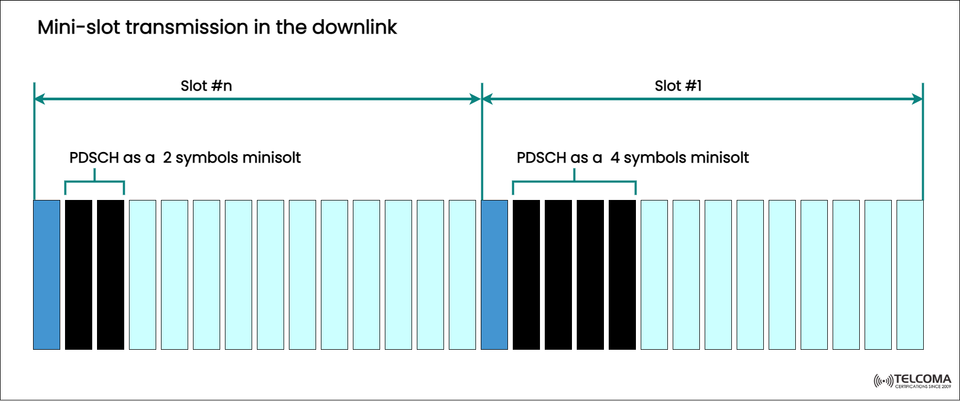

Mini-Slot Transmission in 5G NR Downlink
In the realm of 5G New Radio (NR), achieving ultra-low latency and high reliability is crucial for applications like autonomous vehicles, industrial automation, and mission-critical IoT. A standout feature introduced to meet these needs is mini-slot transmission. Unlike traditional full-slot scheduling, mini-slots enable data transmission right away, without waiting for the next slot boundary.
The image above shows how PDSCH (Physical Downlink Shared Channel) can utilize 2-symbol and 4-symbol mini-slots across various slot structures. This flexibility and efficiency are what 5G NR brings to downlink communication.
Understanding Mini-Slot Transmission
A mini-slot refers to a shorter transmission time interval (TTI) that uses fewer OFDM symbols than a full slot. Typically, a full slot has 14 OFDM symbols, while mini-slots can be made up of 2, 4, or 7 symbols. This allows for immediate data transmission, eliminating delays.
Why Mini-Slots Matter
Reduced latency: Data can be sent right away, skipping the wait for a slot boundary.
Efficient scheduling: Perfect for time-sensitive traffic like URLLC (Ultra-Reliable Low-Latency Communications).
Flexibility: Accommodates both dynamic and mixed numerologies within the same cell.
Enhanced coexistence: Allows for the simultaneous management of eMBB and URLLC traffic.
Slot Structure in 5G NR
To grasp mini-slot transmission, it’s key to understand the slot structure in 5G NR.
Parameter Full Slot Transmission Mini-Slot Transmission Number of OFDM Symbols142, 4, or 7Scheduling Boundary Starts at slot boundary Can start anytime Latency Higher (depends on slot timing)Lower (immediate transmission)Use Case e MBB, m MTCURLLC, low-latency applications Flexibility Fixed Highly flexible
The diagram illustrates that a 2-symbol mini-slot and a 4-symbol mini-slot can be scheduled at different times, each fitting within a slot structure labeled as Slot #n and Slot #1. This showcases how 5G supports asynchronous and independent downlink transmission scheduling.
Mini-Slot Transmission in the Downlink
In the downlink path, mini-slot transmissions primarily involve the PDSCH (Physical Downlink Shared Channel), which carries user data. By scheduling mini-slots, transmission can occur promptly to reduce delays.
How It Works
Mini-slots can be scheduled at any time during a slot.
The gNB (5G base station) sends data as soon as it’s ready, using either 2, 4, or 7 OFDM symbols, depending on the data size and required latency.
The UE (User Equipment) keeps an eye on specific search areas for mini-slot allocations and decodes the data as needed.
In the image:
The left side shows PDSCH as a 2-symbol mini-slot within Slot #n.
The right side illustrates PDSCH as a 4-symbol mini-slot in Slot #1, highlighting how 5G NR accommodates time-sensitive traffic through flexible scheduling.
Mini-Slot vs. Normal Slot Transmission
Feature Mini-Slot Transmission Normal Slot Transmission Slot Duration Partial (2, 4, or 7 symbols)Full (14 symbols)Transmission Timing Immediate, not tied to slot boundaries Aligned with slot boundaries Latency Very low Moderate Use Case URLLC, emergency data, control signaling e MBB, large data transfer Scheduling Flexibility High Medium Resource Utilization Adaptive Structured
By allowing non-aligned scheduling, 5G NR can ensure low-latency communication without sacrificing spectrum efficiency.
Numerology and Mini-Slot Transmission
Mini-slot operation closely relates to 5G NR numerology, which defines subcarrier spacing (SCS) and slot duration. Higher subcarrier spacings lead to shorter slot lengths, which helps in further reducing latency.
Numerology (μ)Subcarrier Spacing Slot Duration Typical Mini-Slot Duration (2 symbols)μ = 015 kHz1 ms~0.14 msμ = 130 kHz0.5 ms~0.07 msμ = 260 kHz0.25 ms~0.035 msμ = 3120 kHz0.125 ms~0.018 ms
This table illustrates how greater subcarrier spacing and shortened slots work together with mini-slot transmissions, helping meet 5G’s ultra-low latency objectives.
Applications of Mini-Slot Transmission
Mini-slots play a crucial role in various key 5G use cases, especially those needing swift responsiveness and reliability.
- Ultra-Reliable Low-Latency Communication (URLLC)
Mini-slots allow for the immediate sending of important packets, like vehicle control signals or robotic commands, without waiting for the next slot.
- Enhanced Mobile Broadband (eMBB)
While eMBB often relies on full slots, mini-slots can offer support in mixed traffic situations, permitting URLLC bursts during ongoing eMBB sessions.
- Industrial IoT and Factory Automation
Machine-to-machine communications frequently need tight latency control. Mini-slots provide consistent performance for industrial control loops.
- Edge Computing and Network Slicing
In network slices focused on real-time services, mini-slots guarantee low delays and preferential transmission for edge applications.
Scheduling and Resource Allocation
Mini-slot scheduling fits within dynamic scheduling in 5G NR, where resources are distributed according to traffic priority and channel conditions.
Dynamic Scheduling: gNB allocates mini-slots for URLLC as needed.
Preemption: Ongoing eMBB traffic can be temporarily overridden by URLLC transmissions if necessary.
HARQ Support: Mini-slots work well with Hybrid Automatic Repeat Request (HARQ), ensuring reliable data transfer.
This dynamic approach allows 5G networks to achieve massive flexibility, adjusting in real-time to user needs and service demands.
Benefits of Mini-Slot Transmission
Ultra-Low Latency: Data transmission can happen in under 1 ms.
Enhanced QoS: Prioritizes critical traffic without hindering overall throughput.
Effective Resource Use: Only the necessary symbols are utilized.
Backward Compatibility: Can work alongside traditional slot-based transmissions.
Support for Network Slicing: Perfect for URLLC and IoT slices.
Challenges and Considerations
Even with their benefits, mini-slots introduce some implementation challenges:
Complex Scheduling Algorithms: Requires precise timing and prioritization.
Increased Control Signaling: Frequent scheduling requests can lead to higher signaling overhead.
UE Complexity: Devices need to adeptly manage different slot lengths and synchronization.
Nonetheless, these challenges don't overshadow the performance advantages they provide for mission-critical applications.
Conclusion
Mini-slot transmission in the 5G NR downlink represents a significant advancement toward achieving real-time responsiveness and dynamic resource management. By allowing data transmissions to start immediately, independent of slot boundaries, 5G networks can deliver the ultra-low latency and high reliability needed for next-gen services like autonomous vehicles, industrial automation, and remote surgery.
The flexibility shown in the image — with PDSCH mini-slots spanning 2 or 4 symbols within different slots — encapsulates the essence of what makes 5G innovative: adaptability, efficiency, and speed.
In summary, mini-slots form a key part of 5G NR’s design philosophy, ensuring that every millisecond matters in our hyper-connected, real-time communication landscape.