
Mininet Network: Architecture, SDN Emulation, and Real-World Integration

The world of Software-Defined Networking (SDN) is changing, and it’s really important to test and validate new ideas before putting them on actual hardware. Mininet stands out as one of the go-to network emulators, helping developers, researchers, and network engineers create realistic virtual SDN environments right on their machines.
By simulating various components like hosts, switches, links, and controllers, Mininet makes it easy to prototype, debug, and experiment without the high costs that come with real hardware. Once you've tested everything, moving these experiments into real-world hardware networks is a breeze, which is what makes Mininet such a crucial link between theory and actual practice.
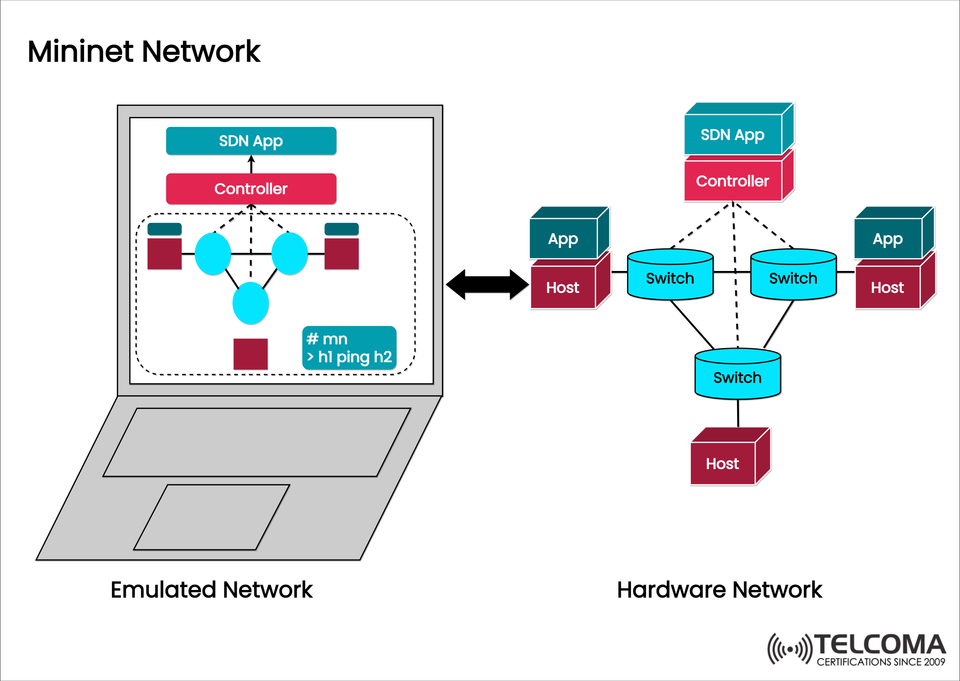
Take a look at the uploaded image: on the left, you can see a laptop running Mininet (that’s the emulated network), and on the right, it’s a physical hardware SDN setup. There’s a clear conceptual connection between the two.
What is Mininet?
Mininet is a nifty network emulator that creates a virtualized SDN environment. Unlike a simulator that just models how a network behaves, Mininet uses lightweight virtualization to create real host processes, network namespaces, and virtual Ethernet connections.
Hosts: They run standard Linux networking tools (like ping, iperf, ssh, etc.).
Switches: These are the OpenFlow-enabled SDN switches.
Controllers: They manage traffic forwarding rules using protocols such as OpenFlow.
Links: These are the emulated Ethernet connections that can be customized for delay, bandwidth, and packet loss.
Since everything is based on actual Linux networking stacks, apps tested in Mininet operate just like they would in a physical network.
Mininet Network Architecture
The image shows two main areas:
Emulated Network (Left Side)
Runs fully on a laptop or server.
Includes virtual hosts, OpenFlow switches, and an SDN controller.
Supports SDN applications (think routing, firewalls, load balancers).
Commands like # mn and h1 ping h2 are used for setting up and testing the network.
Hardware Network (Right Side)
Represents a real-world SDN environment with physical switches and hosts.
The controller and SDN apps can easily switch from Mininet to hardware.
Applications function the same in both setups.
This connection allows for smooth migration from research and development to actual deployment.
Key Features of Mininet
Mininet is popular thanks to its unique blend of simplicity, scalability, and a realistic approach. Here are some of its standout features:
Quick prototyping: Spin up and test topologies with just one command.
Realistic emulation: Runs unmodified code for apps and protocols.
Customizable topologies: Create line, tree, mesh, star, or whatever design you need.
Scalability: It can handle hundreds or even thousands of virtual nodes.
OpenFlow support: Works with various SDN controllers.
Flexible testing: You can simulate delay, loss, or bandwidth limits.
Mininet in SDN Research and Development
Mininet is key in SDN research because it allows for experimentation without the hefty cost of lab setups. Common uses include:
Testing SDN controllers (like ONOS, Ryu, OpenDaylight, Floodlight).
Evaluating SDN applications such as firewalls, QoS enforcers, or load balancers.
Performance analysis under different network scenarios.
Security research by introducing faults or malicious traffic patterns.
Education and training for students diving into SDN basics.
Workflow: From Emulation to Real Deployment
One of the greatest strengths of Mininet is the workflow between emulated and physical networks:
Design and Test in Mininet
Build a virtual topology using Python scripts or the command line.
Run experiments with SDN applications.
Confirm everything works using commands like ping, iperf, or custom monitoring tools.
Map to Real Hardware
Use the same SDN controller that was tested in Mininet with real switches.
Deploy SDN applications with ease.
Fine-tune parameters for scale and hardware optimizations.
This flow ensures cost efficiency, faster innovation, and reduces risks before committing to actual infrastructure.
Advantages of Using Mininet
Here’s why Mininet is a go-to testbed for many:
Cost-effective: No need for pricey lab hardware.
Portable: Can operate on a laptop, VM, or in the cloud.
Standard-compliant: Works with OpenFlow and industry-standard controllers.
Reproducible experiments: Researchers can easily share their scripts for setups that can be replicated.
Flexible scale: Perfect for anything from small classroom networks to large research setups.
Challenges and Limitations
Despite its benefits, there are some challenges with Mininet:
Resource constraints: Bigger topologies might push CPU and memory limits.
Performance gap: Emulated networks can’t fully replicate hardware performance.
Timing accuracy: Delays in the network might not perfectly mirror real-world jitter.
Hardware-specific features: Some proprietary switch functions don’t have an emulated version.
To deal with these, Mininet is often used for initial prototyping, with final tests done on physical testbeds or hybrid setups.
Mininet vs. Hardware Testbeds
Feature Mini net (Emulated)Hardware Testbed Cost Low (runs on laptop/server)High (physical switches/hosts)Setup Time Minutes Hours/Days Scalability Limited by CPU/RAM Physical constraints Realism High (but virtual)100% real traffic Best Use Case Research, training, prototyping Production validation
Mininet: Fueling SDN Research & Innovation
Mininet isn’t just an emulator; it’s a link between research and real-life SDN applications.
Why it’s important:
Quickly prototype SDN topologies.
It's budget-friendly (you can even run it on a laptop!).
Compatible with actual SDN controllers and applications.
Scalable for use in classrooms, labs, and research settings.
How it operates:
Emulated Network → Set up and test right on a laptop or server.
Hardware Network → Easily integrate with real switches and hosts.
The same SDN applications and controllers can operate in both environments.
Benefits include faster innovation, reliable experiments, and a way to validate concepts without risks before going into production.
Mininet is the preferred platform for telecom experts, researchers, and educators who are paving the way for the future of Software-Defined Networking (SDN).
Conclusion
Mininet has truly become a cornerstone of SDN research and development. It enables quick prototyping, experimentation, and validation. By connecting emulated and hardware networks, it provides a low-cost, flexible, and scalable space for network innovation.
For telecom pros, Mininet cuts down on the risks and expenses that come with rolling out new SDN technologies. And for researchers, it speeds up the process from concept to real-world deployment.
In a nutshell, Mininet isn’t just another emulator; it’s a testbed for the future of networking.