
Mission-Critical MTC: Overcoming Latency and Error Distribution Challenges in 5G
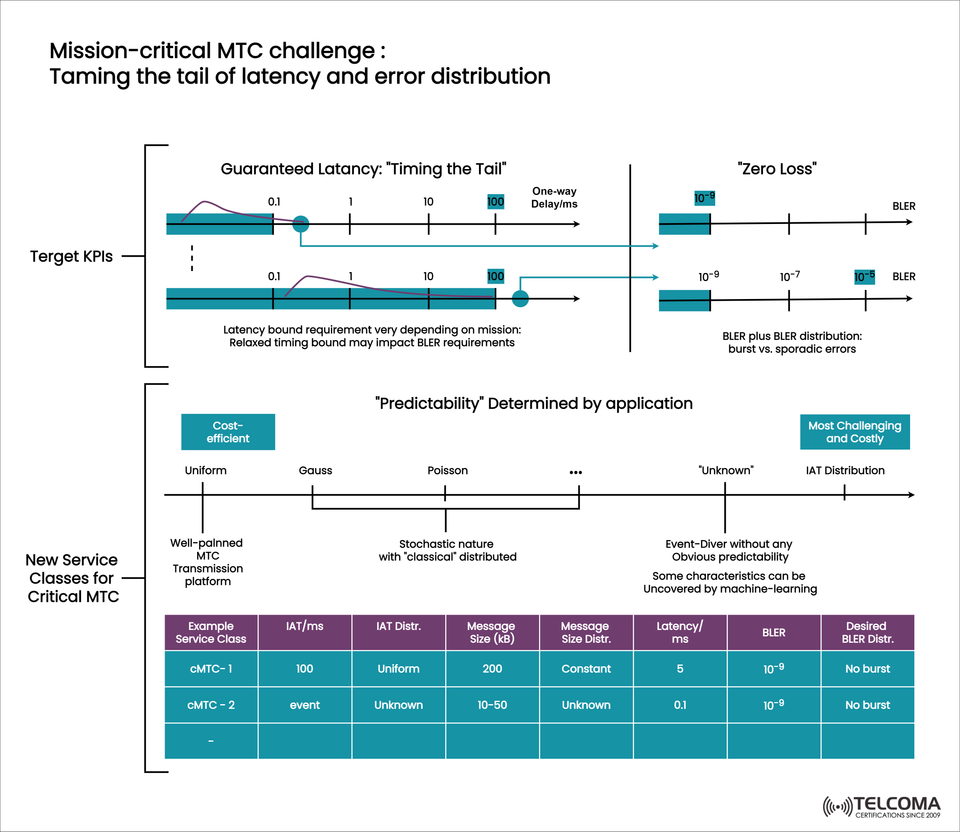

Tackling the MTC Challenge: Managing Latency and Error Distribution
In the fast-changing world of telecom, Mission-Critical Machine Type Communication (MTC) is becoming essential for 5G and what's next. It's crucial for applications that need super-reliable connections, near-zero packet loss, and strict latency guarantees—think industrial automation, driverless cars, healthcare, and emergency services.
But here’s the catch: keeping communication performance consistent goes beyond just looking at average latency or error rates. The “tail” of latency distribution and error bursts present significant challenges. Mission-critical systems can’t tolerate unexpected errors or unreliable delays.
This blog will take you through the complexities of managing latency and error distribution in mission-critical MTC, diving into key performance indicators, factors for predictability, and new service classes that will shape the future of ultra-reliable telecom.
Guaranteed Latency: Understanding the Tail
When we discuss latency, averages can be misleading. A network boasting a 5 ms average latency can still occasionally hit 50 ms or more. For real-time control systems, those occasional spikes can be disastrous.
The accompanying image illustrates this idea as “timing the tail”—where the focus is on the extreme ends of delay distribution instead of just the average.
Key Insights:
Latency Bound Varies by Mission:
Certain applications (like remote surgery or self-driving cars) need strict, bounded latency.
Others (like smart grids) might handle some leeway in timing but then reliability (Block Error Rate or BLER) becomes a bigger concern.
Trade-Offs Exist:
Easing latency requirements may shift the burden onto error control.
Tightening latency guarantees could require more bandwidth and increase costs.
So, we need to design networks that can consistently guarantee ultra-low delays across every transmission scenario, not just under average conditions.
Zero Loss: Going Beyond Simple BLER
In mission-critical settings, achieving zero packet loss is the target. In reality, Block Error Rate (BLER) is a more nuanced measure.
The graphic brings out two key points:
Sporadic Errors vs. Burst Errors:
Sporadic errors can often be managed with retransmission strategies.
Burst errors, on the other hand, can overwhelm recovery systems.
BLER Distribution Matters:
It's not only about hitting a low BLER (like 10^-9).
The distribution pattern (sporadic versus bursty) is what really dictates if mission-critical reliability is achieved.
This means MTC requires in-depth control over error patterns, rather than just focusing on averages.
Predictability: Understanding Traffic Distribution
Not every MTC application creates traffic in the same way. Some have predictable intervals, while others generate communication in irregular, event-driven bursts.
The image sorts predictability from cost-efficient to the most challenging:
Uniform Distribution (Well-Planned MTC)
Easy to anticipate.
Cost-effective in terms of resource allocation.
Gaussian / Poisson (Stochastic Nature)
Classic distribution types.
Need more adaptive resource planning.
Unknown / Event-Driven
The toughest category.
Lacks clear statistical predictability.
Demands AI and machine learning to uncover hidden patterns.
Why Predictability Matters:
Predictable traffic leads to efficient resource allocation.
Unpredictable traffic increases costs and complexity.
For telecom operators, finding a balance between predictability and resource optimization is crucial to deliver mission-critical services on a large scale.
New Service Classes for Critical MTC
The 3GPP has identified service classes for critical MTC, each designed for distinct use cases. The accompanying table illustrates two examples:
Example Service Class | IAT (ms) | IAT Distribution | Message Size (kB) | Message Size Distribution | Latency (ms) | BLER | Desired BLER Distribution
cMTC-1 | 100 | Uniform | 200 | Constant | 5 | 10^-9 | No burst**
cMTC-2 | Event-driven | Unknown | 10–50 | Unknown | 0.1 | 10^-9 | No burst
Key Observations:
cMTC-1: Predictable, regular traffic with large, consistent messages. It’s more manageable and cost-effective.
cMTC-2: Event-driven traffic that's unpredictable in message size and timing. This requires advanced network intelligence and lightning-fast response times.
This shows that different mission-critical services need different network designs—ranging from deterministic scheduling to AI-driven traffic predictions.
The Technical Balancing Act
To make mission-critical MTC work, telecom operators have to balance three interrelated factors:
Latency: Keeping one-way delays consistently below strict limits.
Error Control: Minimizing BLER to near-zero while steering clear of burst error patterns.
Predictability: Efficient traffic management by understanding or predicting traffic patterns.
Not getting the balance right could lead to network outages, operational issues, or even jeopardize human safety in applications like connected healthcare or autonomous driving.
Practical Takeaways for Telecom Professionals
For network engineers and telecom strategists, these points are key:
Differentiating Quality of Service is a Must
Not all critical applications have identical needs.
Service classes like cMTC-1 and cMTC-2 require tailored approaches.
Focus on Error Distribution Over Average Metrics
Pay attention to bursts and tail latency, not just averages.
AI and Machine Learning Will Be Key Players
Especially for handling unpredictable, event-driven traffic.
Weighing Cost Against Reliability is Important
Greater predictability lowers costs.
Unpredictable or bursty traffic increases costs and complicates resource allocation.
Wrapping Up
The future of Mission-Critical MTC hinges on mastering the tail of latency and understanding error distribution nuances. While average metrics, like mean latency or overall BLER, offer a starting point, real reliability demands a deeper dive—ensuring no unexpected spikes, no burst errors, and no unpredictable outages.
Telecom networks need to grow to support new service classes, leveraging predictability, AI, and smarter resource allocation to achieve both cost-efficiency and unmatched reliability.
As we progress into 5G and 6G, this balancing act will be crucial for the success of mission-critical services that drive industries, safeguard lives, and enable an autonomous future.