
Model for Non-IP Prototyping Over Radio: Architecture, Components, and Benefits for 5G and 6G Networks
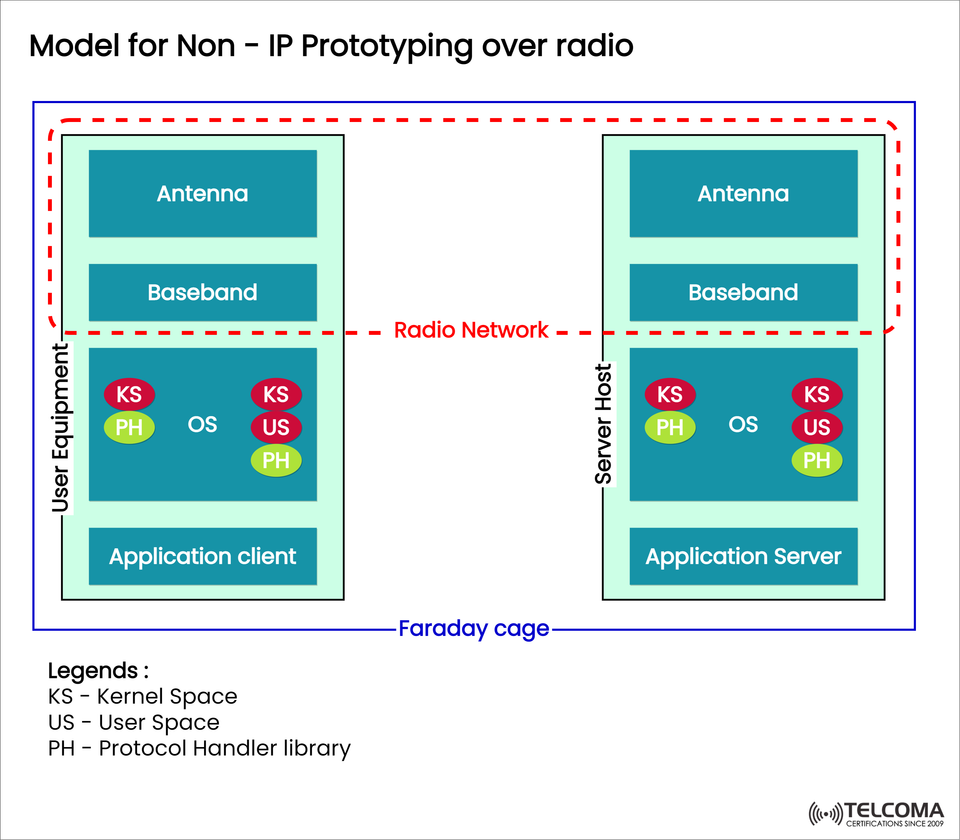

Model for Non-IP Prototyping Over Radio
As 5G tech continues to develop and we start laying the foundation for 6G communication, traditional IP-based networking is facing some serious limitations—especially in cases where ultra-low latency, precise responses, and high reliability are necessary. To tackle these issues, researchers are looking into Non-IP communication models that don't rely on TCP/IP stacks.
The Model for Non-IP Prototyping over Radio, which you can see in the image above, sets up a test environment to investigate direct communication over radio channels between devices—without needing Internet Protocol. This setup allows for faster, more efficient, and reliable data exchange, which is perfect for real-time, mission-critical applications in 5G.
Understanding the Concept: What is Non-IP Prototyping?
Non-IP prototyping involves exchanging data directly between endpoints without using Internet Protocol (IP). Instead of traditional packet encapsulation with IP headers, communication happens through custom protocol handlers that work directly at the radio link layer.
In simple terms, it lets devices communicate over the air without the need for IP routing, addressing, or session management, resulting in less latency and overhead.
This model is crucial for:
5G URLLC (Ultra-Reliable Low-Latency Communication)
Industrial IoT (IIoT)
Autonomous driving and robotics
Tactile Internet applications
Next-generation 6G deterministic networks
Architecture Overview
The model is made up of two main entities:
User Equipment (UE) – the device that sends or receives data (like a sensor, robot, or vehicle).
Server Host – the endpoint that gets, processes, and might respond to the data (like a control server or edge computing node).
Both communicate through a Radio Network that's protected in a Faraday cage to ensure interference-free prototyping.
Key Components of the Architecture
This architecture consists of various layers and components, each serving a specific purpose:
- Antenna
The antenna is responsible for transmitting and receiving electromagnetic signals.
It connects directly to the baseband and converts electrical signals into radio waves and back.
Having antennas on both the UE and Server Host is important for real-world RF testing to validate prototypes.
- Baseband
The baseband module modulates and demodulates radio signals.
It handles encoding, decoding, error correction, and timing synchronization.
The baseband processes data frames from the Protocol Handler (PH) and gets them ready for transmission.
It also takes care of channel estimation and link adaptation, which are key for solid Non-IP radio communication.
Operating System (OS)
In both devices, the OS layer includes:
Kernel Space (KS)
User Space (US)
Protocol Handler Library (PH)
These components work together to manage how data flows between hardware, applications, and the radio interface.
Component Description
Kernel Space (KS): The OS's low-level part that directly interacts with the hardware, ensuring deterministic handling of packets, interrupts, and timing essential for Non-IP communication.
User Space (US): This is where applications and user-level processes run. It allows flexible management of the Non-IP stack, making testing and debugging quicker.
Protocol Handler Library (PH): A custom module that handles Non-IP data formats, defining how packets are created, parsed, and sent—replacing the usual TCP/IP stack.
Together, these layers enable low-latency, real-time radio communication without the complications of IP headers or routing.
- Application Client and Application Server
The Application Client on the UE side kicks off communication by sending data (like sensor info or control commands).
The Application Server on the host side processes the incoming data and may respond or take action.
Both link to the OS layer and use the Protocol Handler Library to format and understand Non-IP data.
This client-server setup mimics real-world machine-to-machine (M2M) interactions but is optimized for Non-IP transport.
Advantages of Non-IP Prototyping Over Radio
- Ultra-Low Latency
By skipping the IP stack, Non-IP communication cuts down on protocol overhead, making it perfect for real-time applications like industrial automation, robotics, and remote control systems.
- Deterministic Performance
Kernel-level control guarantees predictable timing behavior, which is crucial for mission-critical applications that need reliable response times.
- Simplified Architecture
Without the need for IP routing, communication becomes more straightforward and less complex, reducing:
Processing demands
Memory usage
Network configuration issues
- Better Energy Efficiency
Simpler processing means lower CPU load and power consumption, which is vital for battery-powered IoT devices.
- Enhanced Security in Controlled Environments
Working within a Faraday cage eliminates outside interference and allows secure testing of Non-IP protocols.
- Flexibility for Research and Prototyping
Researchers can quickly test new Non-IP protocols, tune data paths, and assess physical layer performance before standardization.
Use Cases of Non-IP Prototyping
Non-IP prototyping is already being applied or considered in various 5G and 6G contexts, such as:
Industrial IoT: Machine-to-machine communication on factory floors that need sub-millisecond latency.
Autonomous Vehicles: Direct vehicle-to-vehicle (V2V) communication to avoid collisions.
Tactile Internet: Real-time feedback systems for remote surgeries or robotics.
Defense Communication: Secure, non-routable connections for tactical use.
6G Research: Investigating AI-driven, deterministic, and energy-efficient communication methods.
Challenges and Considerations
While there's a lot of promise, Non-IP communication has some technical hurdles to clear:
Interoperability: Integrating with existing IP networks may need gateways or hybrid systems.
Security: New security models must be created since traditional IP-based encryption (like IPsec) isn't available.
Scalability: Managing large clusters of Non-IP devices calls for efficient addressing and synchronization strategies.
Standardization: The industry is still working on standards (with 3GPP, ETSI, and IEEE exploring new Non-IP frameworks).
Future Outlook: Non-IP and 6G Evolution
Non-IP communication is set to become a vital part of 6G architectures, where deterministic networking, AI-driven routing, and drastic latency reductions are top priorities.
New features in 6G, like network slicing, native AI, and joint communication-computation control, will rely heavily on Non-IP frameworks for precise, direct connectivity.
This Non-IP Prototyping model paves the way for those future advancements—helping researchers test real-world performance in controlled settings.
Conclusion
The Model for Non-IP Prototyping over Radio offers a progressive approach to future communication systems. By removing dependencies on IP and facilitating direct radio communication, it achieves unmatched levels of latency, reliability, and determinism—essential for upcoming 5G URLLC and 6G applications.
Integrating antenna, baseband, and protocol handler components in a controlled radio environment builds an ideal base for testing, innovation, and standardization of Non-IP communication systems.
As telecom moves toward smarter, real-time, and machine-centric networks, Non-IP prototyping is evolving from a research tool into a critical building block for the future of wireless communication.