
Multi-Access Edge Computing Explained: Bridging Fog, Edge, and Cloud

The rise of IoT devices, 5G networks, and digitalization in industries has led to a huge demand for low-latency, high-performance computing. Traditional cloud computing just can’t keep up because of issues like distance, latency, and bandwidth limits.
That’s where Multi-Access Edge Computing (MEC) comes into play. It’s a setup that brings computing power closer to where the data is generated, effectively connecting fog computing, edge computing, and cloud computing.
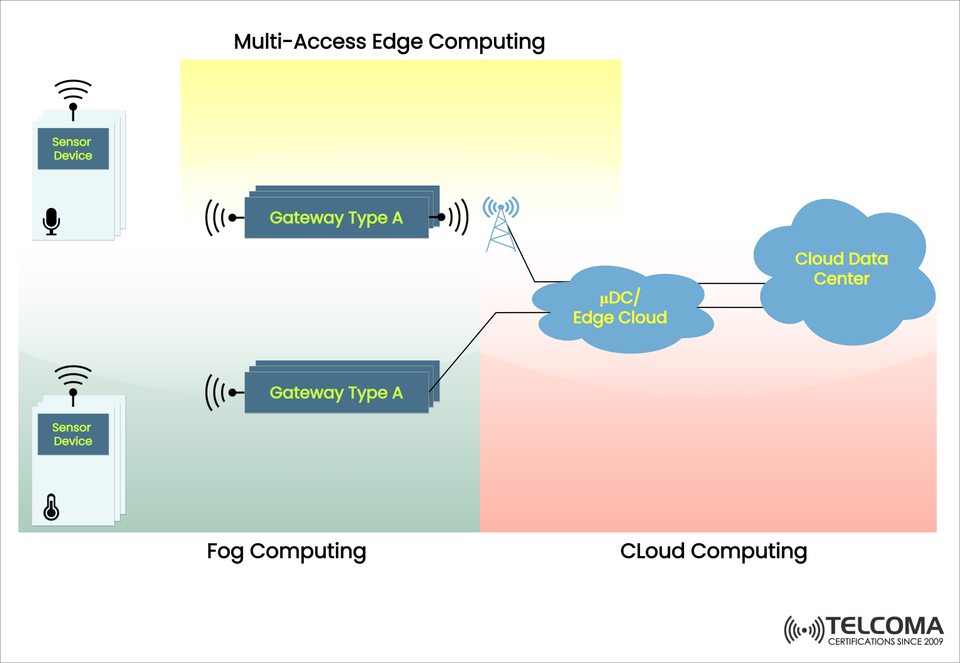
The diagram you uploaded gives a visual look at how sensor devices, gateways (Type A), edge cloud (µDC), and cloud data centers work together within the MEC framework. It shows that fog computing processes data on-site, while edge and cloud computing take care of broader analytics and centralized tasks.
What is Multi-Access Edge Computing (MEC)?
MEC is a setup that extends cloud capabilities right to the network edge, putting it nearer to end devices like sensors, IoT systems, and mobile apps.
Instead of sending all the data to faraway cloud servers, MEC allows:
Local data processing, meaning faster responses.
Lower latency, which is crucial for time-sensitive applications.
Better bandwidth management by filtering data at the edge.
Context-aware services powered by real-time local insights.
MEC is particularly important for 5G networks, where ultra-reliable low-latency communication (URLLC) is essential for things like self-driving cars, smart factories, and remote healthcare.
Breaking Down the Architecture
The diagram outlines three key, interconnected computing layers: fog computing, edge computing, and cloud computing.
- Sensor Devices
They collect raw data.
They gather metrics like temperature, sound, or motion.
Think of environmental sensors, IoT-enabled cameras, and microphones.
These devices usually don’t have much processing power and send data through gateways.
- Gateways (Type A)
They serve as intermediaries between sensors and the network.
They take care of initial data processing and routing.
They offer connectivity for IoT devices, whether wired or wireless.
They’re crucial for directing traffic to local fog or edge resources.
- Fog Computing Layer
This layer is closer to the devices.
Gateways do some local processing, handling tasks like filtering, aggregating, and preliminary analytics.
This minimizes the amount of data sent upwards, boosting efficiency.
- Edge Cloud / µDC (Micro Data Center)
Here’s where distributed edge computing infrastructure comes in.
It delivers more advanced processing capabilities compared to fog nodes.
Often found at telecom base stations, on-premises sites, or local facilities.
It supports real-time applications with low latency (1–10 ms).
- Cloud Data Center
This is the centralized, large-scale setup.
It deals with big data storage, training AI models, and large-scale analytics.
While it provides global reach and scalability, it comes with higher latency compared to fog and edge.
Fog vs Edge vs Cloud Computing
Comparison of the three layers:
Feature Fog Computing Edge Computing (MEC)Cloud Computing Location Close to devices Telecom edge / µDC Centralized, remote Latency Very low (<10 ms)Low (<20 ms)Higher (50–100 ms)Processing Power Limited Moderate to high Very high Data Storage Minimal Localized and temporary Large-scale and permanent Use Cases Device control, quick decisions AR/VR, autonomous drivingData lakes, global analytics, AI
Why Multi-Access Edge Computing Matters
MEC brings together the strengths of fog, edge, and cloud computing to offer well-rounded solutions:
Ultra-Low Latency: By processing data near where it’s generated, MEC cuts down on delays.
Bandwidth Efficiency: It filters out unnecessary data before it heads to the cloud.
Enhanced Security: Sensitive information can be handled locally without leaving the company's network boundary.
Scalability: It supports large IoT setups across smart cities and industrial environments.
Context Awareness: MEC allows for location-based services by analyzing data in real-time.
Use Cases of Multi-Access Edge Computing
- Smart Cities
Monitoring traffic in real-time using roadside sensors.
MEC helps make quick decisions for rerouting or controlling congestion.
- Industrial Automation
Machines with sensors send data to fog gateways.
Local decisions can prevent downtime by enabling predictive maintenance.
- Autonomous Vehicles
Vehicles create a ton of data from their sensors.
MEC ensures the ultra-low-latency responses needed for safe navigation.
- Augmented Reality (AR) and Virtual Reality (VR)
AR/VR apps need high bandwidth and low latency.
MEC processes graphics and computations closer to the user, enhancing performance.
- Healthcare & Remote Surgery
Patient monitoring sensors transmit real-time health data.
MEC ensures immediate feedback for critical health applications.
Benefits of MEC Over Traditional Cloud Models
Speed: Cuts down on reliance on distant cloud servers.
Resilience: Edge nodes can keep running even if the cloud link drops.
Cost Optimization: Reduces bandwidth costs by doing more processing locally.
Energy Efficiency: Shorter data routes mean less energy use.
Flexibility: Works for both enterprise-specific and telecom-driven setups.
Challenges in Deploying MEC
Even though MEC has great potential, there are challenges to deployment:
High Deployment Costs: Setting up edge data centers and gateways can be pricey.
Standardization Issues: Different vendors offer various solutions with limited interoperability.
Security Concerns: More distributed endpoints can lead to a bigger attack surface.
Management Complexity: Needs advanced tools to manage multiple layers.
Telecom providers and cloud companies are tackling these issues with orchestration frameworks, AI management solutions, and network slicing in 5G.
MEC and 5G: A Perfect Match
MEC really shines when paired with 5G networks:
Network Slicing: This customizes network resources for different use cases.
URLLC (Ultra-Reliable Low Latency Communication): Supports crucial services.
mMTC (Massive Machine-Type Communication): Makes large-scale IoT deployments possible.
Enhanced Mobile Broadband (eMBB): Provides high-speed experiences for AR/VR.
The combination of MEC and 5G is what will power the next generation of digital ecosystems.
Conclusion
The diagram you uploaded clearly illustrates how Multi-Access Edge Computing (MEC) links fog computing with cloud computing:
Sensor devices gather real-time data.
Gateways handle processing and forwarding.
Fog computing makes localized decisions.
Edge clouds (µDCs) provide low-latency services.
Cloud data centers manage big analytics and storage.
By merging these layers, MEC helps industries, smart cities, and telecom operators achieve quick responses, operational efficiency, and growth.
In the era of 5G and IoT, MEC is no longer just an option; it’s essential for building robust, smart, and future-ready networks.