
Multi-Access Edge Computing (MEC): How Fog and Cloud Converge for Next-Gen IoT

With the rapid pace of digital transformation, today’s applications require quick data processing, minimal latency, and the ability to scale in ways that traditional cloud models just can’t keep up with. Technologies such as autonomous vehicles, industrial automation, AR/VR, and smart cities all need immediate decision-making—something that centralized cloud data centers struggle to deliver due to issues with latency and bandwidth.
This is where Multi-Access Edge Computing (MEC) steps in. It brings computation closer to users by merging fog computing, micro data centers (µDCs), and centralized cloud resources into a unified framework.
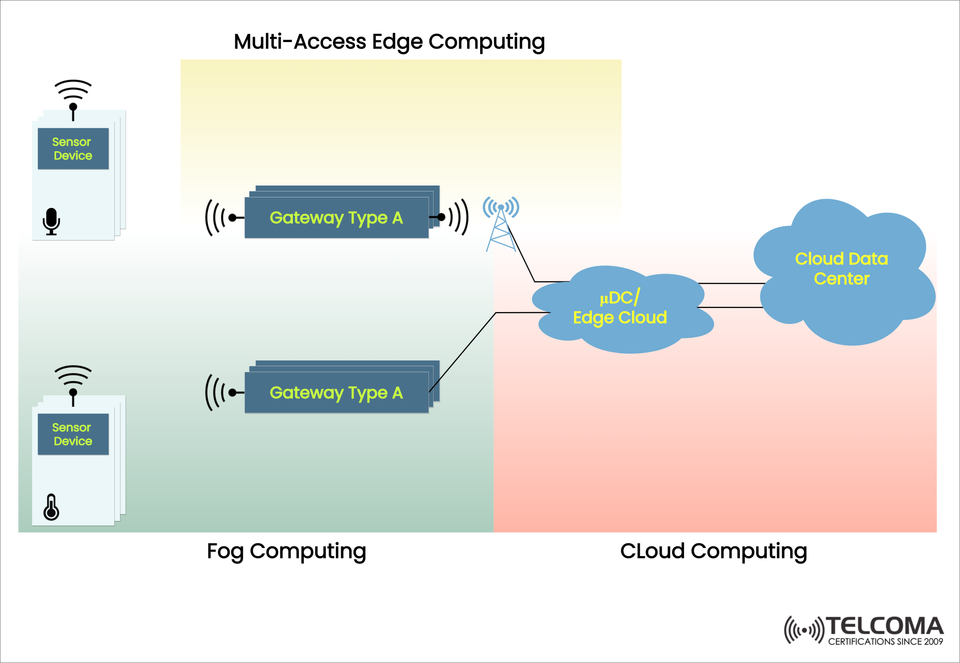
The image shared illustrates this layered model: sensor devices connect through gateways, fog computing manages local tasks, µDC/edge cloud oversees real-time analytics, and cloud data centers handle large-scale processing.
What is Multi-Access Edge Computing (MEC)?
Multi-Access Edge Computing (MEC) is a telecom architecture that pushes cloud-like services out to the edge of the network. By bringing computation, storage, and intelligence closer to the devices, MEC cuts down latency and boosts application performance.
MEC plays a crucial role in 5G networks, supporting various use cases like:
Autonomous driving, where decisions need to be made in microseconds.
Industrial IoT (IIoT), focusing on predictive maintenance and automation.
Healthcare monitoring, where immediate processing of life-critical data is essential.
AR/VR experiences, which demand minimal delays for immersion.
Understanding the Architecture
The diagram shows MEC’s layered structure. Here’s a closer look at each part:
- Sensor Devices
Gather data such as temperature, motion, video, or audio.
Have limited processing capabilities.
Depend on gateways for connectivity and data exchange.
Examples include cameras, microphones, and industrial IoT sensors.
- Gateways (Type A)
Serve as links between devices and networks.
Provide initial processing, compression, and filtering.
Cut down unnecessary data transfer to higher layers.
Ensure local responsiveness, even if cloud connections are weak.
- Fog Computing Layer
Sits close to devices (either on-site or in local environments).
Offers super-low latency processing (<10 ms).
Supports real-time control and decision-making.
An example is smart traffic lights that process vehicle sensor data locally.
- Edge Cloud / µDC (Micro Data Centers)
Delivers more computing power than fog nodes.
Positioned at telecom edge sites for regional processing.
Enables real-time analytics, AI model execution, and orchestration.
Vital for 5G capabilities like URLLC (Ultra-Reliable Low Latency Communication) and network slicing.
- Centralized Cloud Data Center
Manages tasks that aren’t time-sensitive.
Provides large-scale AI training, big data analytics, and long-term storage.
Ensures data synchronization across different networks.
Fog vs Edge vs Cloud: Key Differences
Aspect Fog Computing Edge (MEC / µDC)Cloud Computing Location Very close to devices (local gateways)Regional / telecom sites Centralized, remote Latency<10 ms<20 ms50–100 ms Processing Power Limited (basic analytics, filtering)Moderate to high (real-time AI)Very high (deep learning, big data)Storage Minimal Localized, temporary Large-scale, permanent Best For Device control, instant responses AR/VR, autonomous driving, IIoT Global coordination, data lakes
Why MEC Matters
The benefits of MEC span across various industries and applications:
Ultra-Low Latency: Almost instant responses.
Efficient Bandwidth Use: Filters data locally before it heads to the cloud.
Enhanced Security: Keeps sensitive data at the edge when needed.
Scalability: Can support billions of IoT devices worldwide.
Resilience: Local fog processing ensures continuity, even with weak cloud connections.
Context Awareness: Processes data with location-specific intelligence.
Real-World Use Cases
- Smart Cities
Sensors collect data on traffic and the environment.
Gateways filter this data, providing immediate traffic adjustments.
Edge clouds analyze city-wide data for planning and resource allocation.
- Autonomous Vehicles
These vehicles generate enormous amounts of data from sensors.
Fog computing ensures real-time navigation decisions.
Edge clouds help with fleet optimization and safety management.
- Industrial IoT (IIoT)
Machines fitted with IoT sensors provide health-related data.
Gateways process metrics like vibration and temperature.
The edge cloud supports predictive maintenance and automation.
- AR/VR Applications
MEC handles rendering at the edge.
This helps prevent lag in immersive AR/VR experiences.
It supports uses in entertainment, remote training, and gaming.
- Healthcare
Wearable tech monitors patients’ vital signs.
Fog nodes can initiate local alerts for any anomalies.
The edge cloud supports real-time diagnostics while the centralized cloud stores medical records.
Challenges in MEC Implementation
Even though MEC has a lot of potential, its deployment comes with hurdles:
High Infrastructure Costs: There's a need for investment in gateways, edge sites, and micro data centers.
Standardization Gaps: There’s a lack of interoperability among different vendors.
Security Concerns: Multiple endpoints can become targets for attacks.
Management Complexity: Orchestrating across these distributed layers can be tricky.
Telecom operators and standards groups like ETSI and 3GPP are tackling these challenges, while cloud providers integrate AI-driven orchestration platforms to make MEC operations smoother.
MEC and 5G: A Perfect Match
MEC and 5G are tightly intertwined. Together, they enable:
URLLC: Essential services such as remote surgery and autonomous driving.
Network Slicing: Customized virtual networks for businesses.
eMBB (Enhanced Mobile Broadband): High-speed AR/VR and 4K/8K streaming.
mMTC (Massive Machine-Type Communication): Large-scale deployments of IoT sensors.
Thus, MEC forms the backbone of the 5G-enabled digital economy.
Conclusion
The diagram you've seen lays out the layered structure of Multi-Access Edge Computing (MEC):
Sensor devices gather data.
Gateways manage local filtering and connectivity.
Fog computing provides instant, low-latency processing.
µDC/edge cloud facilitates real-time analytics and orchestration.
Cloud data centers ensure scalable storage and advanced AI capabilities.
By blending fog, edge, and cloud computing, MEC delivers the speed, efficiency, and scalability that today’s applications require. For telecom operators, businesses, and industries, MEC isn’t just an improvement; it’s the foundation of the next-gen digital networks.
In a world influenced by 5G, IoT, and AI, MEC guarantees that our networks remain intelligent, resilient, and ready for the future.