
Multi-Access Edge System Reference Architecture Explained: A Telecom Guide

Understanding Multi-Access Edge System Reference Architecture
As telecom networks progress with 5G, IoT, and super-low-latency services, Multi-Access Edge Computing (MEC) has emerged as a crucial part of today's network design. MEC places computing and storage resources right at the network's edge, which helps cut down on latency and supports applications that need real-time processing.
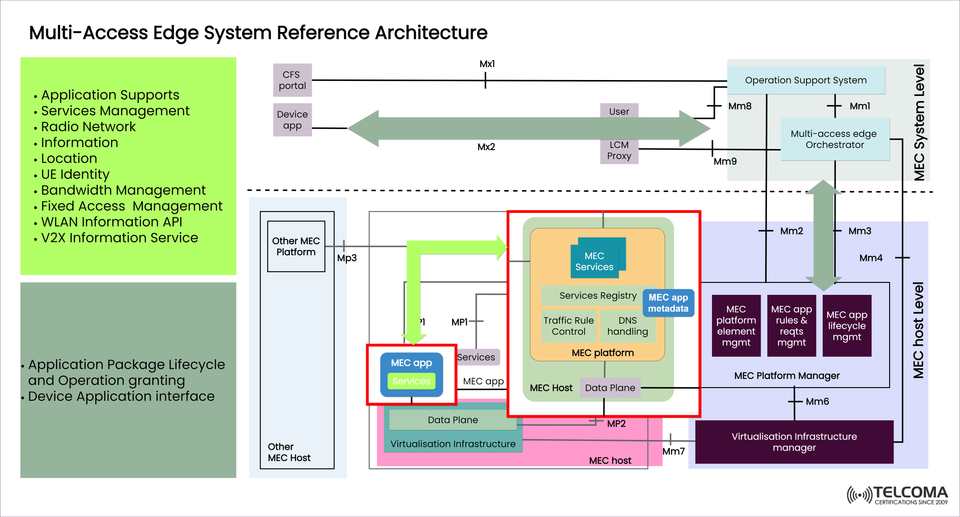
The MEC System Reference Architecture, illustrated in the image above, outlines the framework, interfaces, and functions necessary for a smooth MEC rollout. For those in the telecom industry and tech fans alike, grasping this architecture is essential for creating effective edge-cloud ecosystems.
What Exactly is Multi-Access Edge Computing (MEC)?
MEC is essentially a network architecture that brings cloud-computing closer to users by situating it at the edge of the network. Rather than relying entirely on centralized cloud data centers, MEC allows applications to:
Run directly within the operator’s network setup.
Provide low-latency, context-sensitive, and high-bandwidth services.
Open up new business avenues in IoT, AR/VR, V2X (vehicle-to-everything), and smart cities.
The ETSI (European Telecommunications Standards Institute) establishes MEC standards to guarantee interoperability and reliability.
Key Components of the MEC System Reference Architecture
The MEC reference architecture is divided into MEC System Level and MEC Host Level, with support from APIs, orchestration, and backend infrastructure.
- MEC System Level
This level manages MEC applications and platforms globally across the network. It covers:
Multi-Access Edge Orchestrator: * The central hub of MEC. * Oversees application placement, resource management, and lifecycle. * Makes sure MEC applications are optimally placed across hosts.
Operation Support System (OSS): * Links MEC orchestration with the operator’s current systems. * Offers service assurance, fault management, and system monitoring.
Device Applications (via APIs): * Applications on user devices engage with MEC services through specified interfaces (Mx1, Mx2).
- MEC Host Level
This level is where MEC applications run, representing the actual execution environment. It includes:
a. MEC Host
The physical or virtual setup that handles edge workloads. It features:
Data Plane: Responsible for traffic forwarding and routing.
Virtualization Infrastructure: Supports VM or container-based application deployment.
MEC Services: Offers foundational services like DNS management, traffic control, and service discovery.
b. MEC Platform
Middleware that lets MEC apps interact with network resources and edge services.
Service Registry: A list of MEC services that are available.
Traffic Rule Control: Ensures efficient routing for application traffic.
DNS Handling: Facilitates dynamic addressing for edge apps.
c. MEC Platform Manager
Oversees management of the MEC platform and applications:
Management of MEC platform elements (Mm2).
Rules and requirements for MEC apps management (Mm3).
Lifecycle management of MEC apps (Mm4).
d. Virtualization Infrastructure Manager (VIM)
Manages and controls virtualization resources in the MEC host, connecting with the platform manager through Mm6 and Mm7.
- MEC Applications
Applications running at the edge utilize MEC services and APIs. Some examples include:
AR/VR gaming.
Intelligent traffic and V2X systems.
Industrial IoT oversight.
Real-time video analysis.
These applications interface with both the MEC platform and outside networks through standardized links like Mp1, Mp2, Mp3.
MEC Reference Interfaces
The reference architecture specifies various interfaces for communication between its components. Some key ones are:
Mx1 / Mx2: Between device applications and the MEC system.
Mm1 – Mm9: Connecting the MEC orchestrator, OSS, and platform managers.
Mp1 – Mp3: Between MEC applications, services, and other MEC platforms.
Mm6 – Mm7: Between the platform manager and virtualization infrastructure manager.
These interfaces are essential for maintaining standardization and interoperability, which are especially important in telecom settings.
MEC Services and APIs
MEC offers a range of APIs and services that help make applications aware of their context and efficient in their network use.
Main services include:
Radio Network Information: Gives insights into network conditions.
Location Service: Allows applications to determine the geographical position of users/devices.
UE Identity: Guarantees secure user identification.
Bandwidth Management: Allocates and monitors bandwidth for each application.
Fixed Access & WLAN Information APIs: Cater to diverse network types.
V2X Information Service: Supports vehicle-to-everything communication for transport systems.
Use Cases for MEC Reference Architecture
The MEC reference architecture lays out a solid framework for real-world applications:
Domain Use Cases
Telecom Networks: 5G network slicing, mobile applications sensitive to latency.
Smart Cities: Real-time traffic management, analytics for surveillance, smart utility systems.
Transportation (V2X): Self-driving cars, connected vehicle systems, fleet oversight.
Industrial IoT: Predictive maintenance, robotics, automation of processes.
Media & Gaming: AR/VR, cloud gaming with extremely low latency.
Advantages of MEC System Architecture
Ultra-Low Latency: Essential for 5G, AR/VR, and crucial applications.
Efficiency in the Network: Better bandwidth use through localized data processing.
Context-Aware Services: Applications can use immediate network and location data.
Enhanced Security: Processing user data closer to its source lowers risks.
Scalability: Modular design promotes multi-vendor and multi-access deployments.
Challenges in Implementing MEC
Complex Integration: Needs to align with current OSS/BSS systems.
Standardization Issues: While ETSI provides guidelines, vendor interoperability can still be tricky.
Security Risks: Edge nodes may be more vulnerable to both physical and cyber threats.
Costs: Rolling out edge infrastructure requires substantial investment.
The Future of MEC in 5G and Beyond
MEC is set to be a key player in 5G, 6G, and IoT ecosystems, facilitating services that demand real-time responsiveness and high reliability. Pairing MEC with AI, cloud-native design, and edge orchestration can lead to breakthroughs like:
Autonomous transportation systems.
Immersive XR (Extended Reality).
Massive connectivity for IoT.
AI model distribution from edge to cloud.
The MEC system reference architecture makes sure these applications can be deployed efficiently and at scale, ensuring interoperability.
Wrapping Up
The Multi-Access Edge System Reference Architecture offers a clear roadmap for deploying and managing MEC applications. With defined system and host levels, standardized interfaces, and solid services, MEC provides the agility, efficiency, and scalability needed for industries driven by 5G and IoT.
For telecom professionals, embracing the MEC architecture is more than just enabling low-latency services; it’s about laying the groundwork for the next-gen digital ecosystem.