
Multi-Hop Mesh Topology in IoT: Sensor Devices & Gateways Explained

Introduction
The Internet of Things (IoT) is really taking off, and with that comes the need for efficient and reliable communication among billions of devices. Traditional configurations like star or point-to-point topologies often struggle in large-scale setups where sensor nodes need to talk to each other over long distances.
So, what's the answer? Mesh topology with multi-hop connectivity.
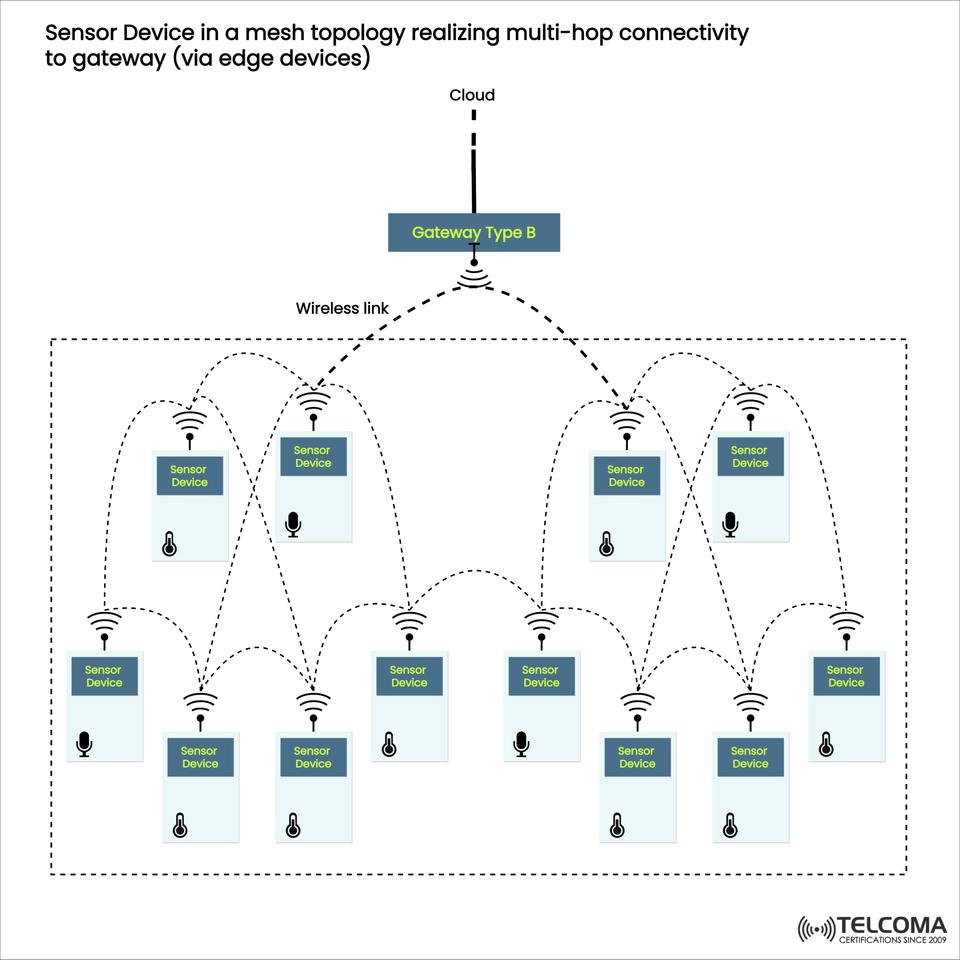
The diagram above shows how sensor devices work together in a mesh network to pass data along to a gateway, which then connects to the cloud. This method ensures great resilience, scalability, and cost-effectiveness for IoT and 5G systems.
In this article, we’ll break down how sensor devices, edge devices, and gateways interact within a mesh architecture, highlight its benefits, and look at how it’s being used in telecom and industrial settings.
What is Mesh Topology in IoT?
A mesh topology is a network setup where each sensor device (or node) connects to multiple nearby devices. Instead of sending data straight to a central gateway, nodes pass on information through other nodes until it gets to the gateway.
This multi-hop communication means:
Data can travel long distances without needing a lot of power.
The network stays strong even if one node goes down, since traffic can find other paths.
Connectivity can reach tricky spots.
Unlike star topology, where each sensor relies on a direct connection to the gateway, mesh networks share the communication load across all nodes, making them a lot more robust.
Key Components of the Architecture
The image highlights three key components in this ecosystem:
- Sensor Devices
These devices collect data like temperature, sound, motion, or humidity.
They’re designed to be low-power and small, allowing for continuous operation.
Think smart meters, microphones, or environmental sensors as examples.
- Edge Devices (Relay Nodes)
Some sensor devices double as edge devices, forwarding data from nearby nodes.
This dual role (sensor + router) supports multi-hop connectivity.
Edge devices lessen the reliance on direct connections to the gateway, which is especially useful in dense networks.
Gateway (Type B)
The Gateway Type B connects the mesh network to the cloud.
It gathers sensor data, performs protocol conversions (like Zig bee to IP), and sends it off to cloud servers or edge computing platforms.
In 5G setups, gateways often come with MEC (Multi-Access Edge Computing) features.
How Multi-Hop Connectivity Works
The idea behind multi-hop connectivity is pretty straightforward yet powerful:
Data Generation: A sensor node collects data (for example, temperature).
Local Relay: If the gateway is too far away, the node sends its data to the closest edge device.
Multi-Hop Transmission: The edge device passes the data through several nodes until it reaches the gateway.
Gateway Processing: The gateway then forwards the collected data to the cloud for analysis, AI insights, or storage.
This layered communication eases the load on the gateway while boosting the network's reach and reliability.
Advantages of Mesh Topology in IoT Networks
Mesh networking with multi-hop connectivity brings several key advantages:
Scalability: Can handle thousands of nodes without overloading central points.
Resilience: If one path fails, data can reroute through alternative nodes.
Energy Efficiency: Nodes transmit over shorter distances, saving battery life.
Extended Coverage: Perfect for wide-area and hard-to-reach setups.
Self-Healing: The network automatically adjusts when devices join, leave, or fail.
Mesh Topology vs Other Topologies
Here's a quick side-by-side comparison:
Feature Star Topology Tree Topology Mesh Topology Reliability Low (single point of failure) Moderate High (self-healing) Scalability Limited by gateway capacity Moderate Very high Energy Efficiency Gateway burdened Moderate Optimized (short hops) Coverage Limited to gateway range Extended Extended via multi-hop Complexity Simple Medium Higher (needs coordination)
Use Cases of Multi-Hop Mesh Connectivity
Mesh networks are powering a variety of real-world IoT applications, especially where reliability and coverage matter:
Smart Cities
Streetlight monitoring, waste management, and traffic control.
Sensor nodes spread across large areas can pass data seamlessly.
Industrial IoT (I IoT)
Factory automation and predictive maintenance.
Resilient networks keep a constant eye on equipment.
Agriculture
Soil moisture, weather, and crop monitoring sensors.
Mesh topology connects sensors in rural or remote farms.
Healthcare & Wearables
Patient monitoring systems with multiple sensor devices.
Ensures strong communication even in hospital settings.
Telecom & 5G Integration
IoT devices connect through gateways that work with 5G NR.
Supports low-latency applications like autonomous vehicles and smart grids.
Challenges of Multi-Hop Mesh Networks
Even with its benefits, mesh networking has its hurdles:
Complex Routing: Finding efficient paths needs advanced algorithms.
Latency: Multi-hop transfers can slow things down.
Energy Drain (Relay Nodes): Devices that act as relays may drain power faster.
Security Risks: More nodes mean more avenues for attacks.
Deployment Costs: Requires smart planning and device placement.
Solutions like optimized routing protocols (such as AODV, RPL), edge computing, and network slicing in 5G are helping to tackle these issues.
The Role of Gateways in 5G and IoT Integration
Gateways are the backbone of connecting local IoT mesh networks to broader platforms. With 5G integration, gateways enable:
Ultra-Reliable Low Latency Communication (URLLC) for critical IoT applications.
Network slicing, which allows for dedicated resources for IoT traffic.
Edge AI processing, where data gets analyzed closer to where it’s generated, cutting down on cloud reliance.
As telecom companies expand 5G, mesh topology paired with smart gateways will form the foundation of massive IoT (m IoT) deployments.
Conclusion
The diagram clearly shows how sensor devices in a mesh topology connect to a gateway through edge devices. This setup is central to modern IoT and 5G systems, allowing for scalable, resilient, and energy-efficient communication among thousands of devices.
From smart cities to industrial automation, mesh topology ensures that data consistently reaches gateways, no matter how complex the setup may be. Although challenges exist, advances in routing protocols, 5G, and edge computing keep improving its effectiveness.
In the fast-changing telecom world, multi-hop mesh networks aren’t just a choice—they're essential for the future of IoT connectivity.