
Multi-Radio Dual Connectivity (MR-DC) in 4G and 5G: Architecture, Benefits, and Use Cases

Multi-Radio Dual Connectivity (MR-DC): Making 4G and 5G Work Together
With 5G rolling out across the globe, service providers are tasked with delivering fast internet while ensuring consistent coverage. A key technology here is Multi-Radio Dual Connectivity (MR-DC), which links 4G LTE and 5G NR.
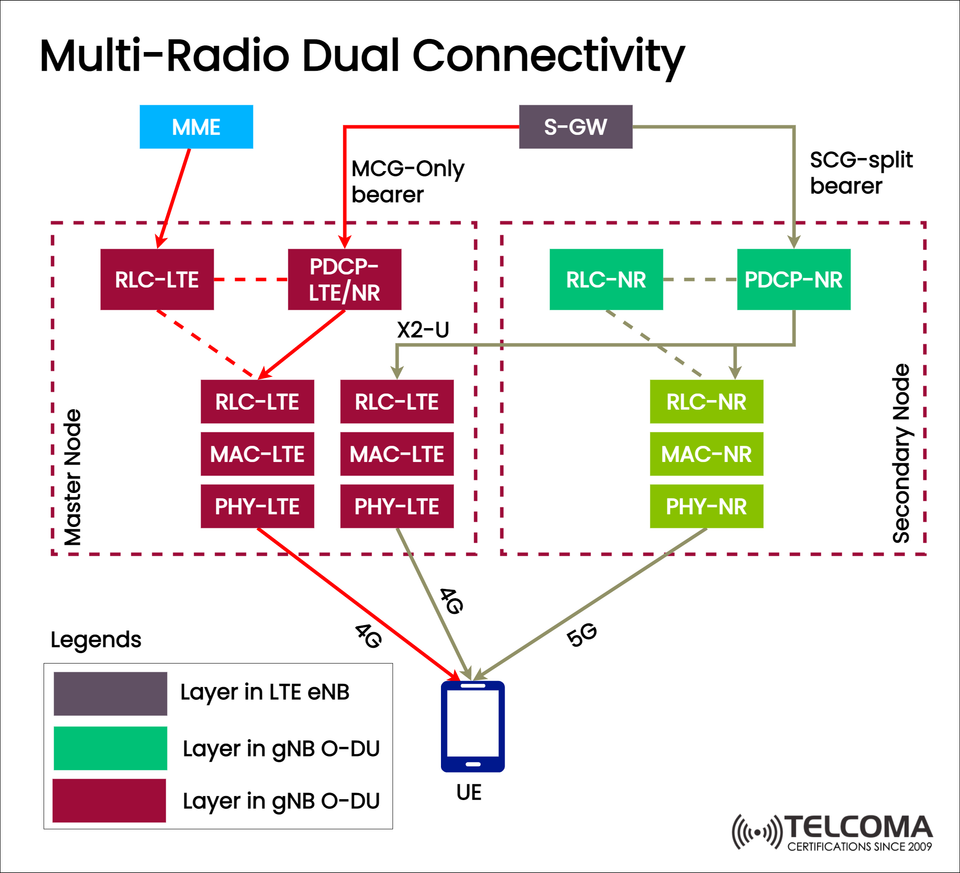
The diagram uploaded shows how MR-DC combines LTE (the Master Node) and 5G NR (the Secondary Node), allowing devices to tap into both technologies at once. This leads to greater speeds, improved reliability, and a smoother experience for users transitioning from 4G to 5G.
What Exactly is Multi-Radio Dual Connectivity?
Multi-Radio Dual Connectivity (MR-DC) is a feature defined by 3GPP that enables a User Equipment (UE) to connect to two distinct base stations:
The Master Node (MN), which is usually an LTE eNB.
The Secondary Node (SN), typically a 5G NR gNB.
This setup makes it possible for devices to send and receive data at the same time over both LTE and 5G links.
Breaking Down MR-DC Architecture
The diagram illustrates how LTE and 5G interact within MR-DC:
Master Node (LTE eNB)
Runs RLC-LTE, MAC-LTE, and PHY-LTE.
Manages control plane (RRC) functions.
Offers the anchor connection for mobile and reliable service.
Secondary Node (5G gNB)
Runs RLC-NR, MAC-NR, and PHY-NR.
Handles extra user-plane data to enhance throughput.
Higher Layers
PDCP (LTE/NR split): Manages header compression, reordering, and securing data.
MME (Mobility Management Entity): Controls signaling for LTE.
SGW (Serving Gateway): Directs user-plane traffic and manages bearer splitting.
UE (User Equipment)
Connects simultaneously to 4G (via LTE eNB) and 5G (via gNB).
Combines data from both networks for better speed and reliability.
Types of Bearers in MR-DC
MCG-Only Bearer (Master Cell Group)
Data flows only through LTE.
Ensures compatibility and smooth coverage continuity.
SCG-Only Bearer (Secondary Cell Group)
Data flows only through NR.
Ideal for applications needing super-high speeds.
Split Bearer
Data is split at the PDCP layer, with some sent over LTE and some over NR at the same time.
Promotes efficient bandwidth usage and low latency.
Benefits of Multi-Radio Dual Connectivity
MR-DC has a lot to offer both users and providers:
Increased Throughput
Merges LTE and NR spectrum resources.
Smooth Transition to 5G
Users get 5G speeds while still having LTE coverage.
Greater Reliability
Dual connections lower the chance of dropped services.
Effective Spectrum Usage
Combines LTE and NR spectrum resources efficiently.
Enhanced Mobility
Guarantees steady connectivity during moving and handovers.
MR-DC vs Carrier Aggregation
Although both MR-DC and Carrier Aggregation (CA) pool resources, they have key differences:
Feature Carrier Aggregation (CA)Multi-Radio Dual Connectivity (MR-DC)Anchor Node Single base station Two base stations (Master & Secondary)Technology Mix Same RAT (like LTE-LTE, NR-NR)Different RATs (LTE + NR)Layer of Operation MAC Layer PDCP Layer Use Case Boosting intra-RAT bandwidth Transitioning from LTE to NR
MR-DC Deployment Scenarios
LTE Anchor with 5G NR Secondary (EN-DC)
The most common setup today.
LTE takes care of control signals; NR boosts user data.
5G NR Anchor with LTE Secondary (NE-DC)
Handy when NR has strong coverage.
Control-plane signaling is via NR.
NR + NR Dual Connectivity (NR-DC)
Found in standalone 5G rollouts.
Two NR base stations provide both control and user data.
Real-World Use Cases for MR-DC
Video Streaming & Gaming
Dual connections ensure high speeds and low latency.
IoT and Smart Cities
MR-DC allows reliable links for numerous IoT devices.
Autonomous Vehicles
Dual connections add safety for critical applications.
Enterprise Networks
Factories and offices rely on MR-DC for stable services.
Challenges with MR-DC
Even with its advantages, MR-DC has some technical hurdles:
Complexity for UE
Devices must manage multiple radios at once.
Increased Power Usage
Keeping dual connectivity drains batteries quicker.
Coordination Between Networks
Needs careful synchronization between LTE and NR.
Cost of Deployment
Providers may need to upgrade their backhaul and core networks.
The Future of MR-DC in 6G
As we look towards 6G, MR-DC is set to evolve:
Multi-RAT Dual Connectivity
Incorporates Wi-Fi, satellite, and terahertz bands along with LTE and NR.
AI-Driven Resource Management
Smart algorithms will figure out when to use LTE, NR, or both.
Ultra-Low Latency Applications
Supporting immersive XR, holographic calls, and digital twins.
In Summary
Multi-Radio Dual Connectivity (MR-DC) is critical in the shift from 4G to 5G, allowing for the simultaneous use of LTE and NR to enhance speeds, reliability, and mobility.
By offering MCG, SCG, and split bearers, MR-DC maximizes how we use the spectrum and gives users faster, more reliable connections.
As networks transition to standalone 5G and future 6G systems, MR-DC will expand to accommodate multi-RAT dual connectivity across various networks, making it essential for the next generation of global connectivity.