
NB-IoT Downlink Channel Mapping: Logical, Transport, and Physical Channels Explained

Why NB-IoT Downlink Channel Mapping Matters
Narrowband IoT (NB-IoT) is a 3GPP standard aimed at supporting low-power, wide-area (LPWA) communication. It’s crucial for linking billions of devices across smart cities, agriculture, utilities, and industrial IoT applications.
Similar to LTE and 5G, NB-IoT uses a structured channel mapping approach to efficiently transport both control info and user data. The downlink (DL) communication — which happens from the base station (eNodeB/gNodeB) to the IoT device (UE) — involves three layers of channels:
Logical Channels → Specify what type of data is being transported (like broadcast, paging, or dedicated data).
Transport Channels → Indicate how the data is delivered over the radio interface.
Physical Channels → Define where and how the data is allocated on radio resources.
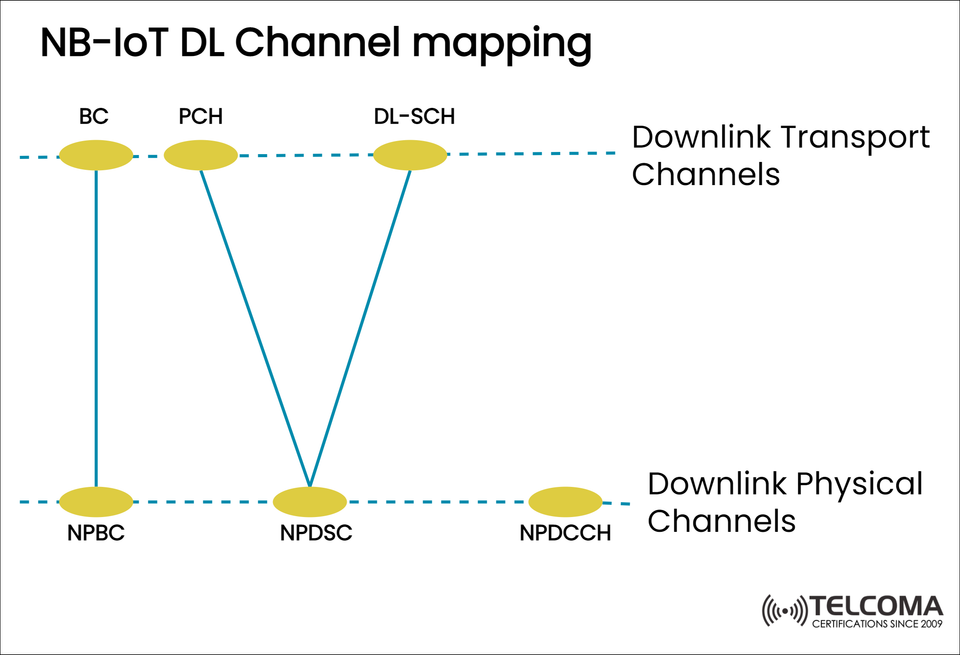
The diagram provided demonstrates the NB-IoT downlink channel mapping, highlighting the connection between the transport channels (BC, PCH, DL-SCH) and physical channels (NPBC, NPDSC, NPDCCH).
Let’s dive into this mapping in detail.
Overview of NB-IoT Downlink Channels
In contrast to LTE, NB-IoT is tailored for narrowband operations with a bandwidth of just 180 kHz and optimized signaling. The downlink channels are simpler but still keep the layered structure for clarity and efficiency.
Categories of Channels in NB-IoT
Logical Channels (What data is being transmitted?) – Carry both user and control information.
Transport Channels (How is the data transported?) – Define delivery attributes like multiplexing, error handling, and scheduling.
Physical Channels (Where does the data go on radio resources?) – Deal with actual modulation and transmission via OFDMA symbols.
Downlink Transport Channels in NB-IoT
From the diagram, three main downlink transport channels are identified:
BC (Broadcast Channel): – Carries system info needed by all devices in the cell and is crucial for network access and mobility management.
PCH (Paging Channel): – Sends paging messages to alert devices in idle mode about downlink data, SMS, or updates; it helps devices wake up efficiently without constantly listening to the network.
DL-SCH (Downlink Shared Channel): – This is the main channel for user data and dedicated control signaling, supporting unicast communication between the network and a specific IoT device.
Downlink Physical Channels in NB-IoT
The transport channels are mapped to physical channels that carry the actual radio signals. In NB-IoT, these consist of:
NPBC (Narrowband Physical Broadcast Channel): – Maps from BC and carries system info blocks (SIBs) that are vital for UE configuration.
NPDSC (Narrowband Physical Downlink Shared Channel): – Maps from PCH and DL-SCH, transmitting paging info and dedicated user data. It's the backbone of NB-IoT downlink communication.
NPDCCH (Narrowband Physical Downlink Control Channel): – Provides scheduling and control information, letting UEs know when and where to receive data on NPDSC. This is essential for synchronization and efficient resource usage.
NB-IoT Downlink Channel Mapping Explained
The diagram makes the mapping flow clear:
BC → NPBC: – System info from the broadcast channel is sent over NPBC, so every device in the cell can acquire basic network configuration.
PCH → NPDSC: – Paging info is mapped to NPDSC, allowing devices in idle mode to wake up only during paging occasions, which saves battery life.
DL-SCH → NPDSC: – User data and dedicated signaling travel via DL-SCH; NPDSC transmits this info to individual IoT devices.
Control Information via NPDCCH: – Even though it's not directly linked in the diagram, NPDCCH provides essential downlink control information (DCI) for managing scheduling and resource allocation.
This design ensures efficient, low-power, and dependable communication, which is at the heart of NB-IoT's framework.
Key Functions of Each Channel in NB-IoT
Here's a breakdown of how each channel plays a role in IoT communication:
NPBC (Broadcast): – Delivers the master information block (MIB) and system information blocks (SIBs) that include essential cell configuration, frequencies, and access parameters.
NPDSC (Shared Data): – Manages most of the downlink traffic, including paging and unicast messages, and supports error correction and retransmission for reliable delivery.
NPDCCH (Control): – Signals where and when data is scheduled and instructs devices on decoding NPDSC, minimizing unnecessary UE activity to improve power efficiency.
Comparison: NB-IoT vs LTE Downlink Mapping
While NB-IoT is based on LTE, it streamlines the channel structure to suit narrowband and low-power operations.
Feature LTE Downlink NB-IoT Downlink Bandwidth Up to 20 MHz180 kHz Physical Channels PDSCH, PDCCH, PBCH, PCFICH, PHICH, PMCHNPDSC, NPDCCH, NPBC Control Overhead Higher, multiple physical channels Lower, minimal set Design Focus High throughput Energy efficiency, coverage, simplicity
This simplification makes NB-IoT perfect for IoT devices that need low data rates, long battery life (over 10 years), and excellent coverage (20 dB better than LTE).
Real-World Example: Smart Utility Metering
Think about a smart electricity meter using NB-IoT:
It starts off by reading system information from NPBC to connect to the network.
While in idle mode, the device checks NPDSC during paging occasions to see if there are any new instructions from the network (like firmware updates or demand-response signals).
Once data is scheduled, NPDCCH tells the device when to wake up and listen to NPDSC for the payload (like energy consumption data).
This whole process allows the meter to communicate reliably and efficiently, conserving battery life.
Advantages of NB-IoT Downlink Mapping
Energy Efficiency: Paging through NPDSC keeps devices in deep sleep most of the time.
Simplicity: Fewer physical channels make implementation straightforward.
Reliability: Error correction on NPDSC ensures robust data delivery, even in areas with poor coverage.
Scalability: Can support huge device deployments (up to 50,000 devices per cell).
Coverage: Optimized channels allow signals to penetrate into underground or remote areas.
Challenges in NB-IoT Downlink Mapping
Low Data Rates: NPDSC has limited throughput compared to LTE's PDSCH.
Latency: The intervals for paging and scheduling can prolong response times.
Coverage vs. Speed Tradeoff: Repetition mechanisms enhance reliability but can hamper spectral efficiency.
Summary Table: NB-IoT Downlink Channel Mapping
Transport Channel Physical Channel Purpose BCNPBC System information broadcast PCHNPDSC Paging messages DL-SCHNPDSC User data and dedicated signaling-NPDCCH Scheduling and control information
Conclusion
NB-IoT downlink channel mapping provides a streamlined and efficient communication framework that connects billions of IoT devices with minimal power use.
By mapping logical transport channels (BC, PCH, DL-SCH) to physical channels (NPBC, NPDSC, NPDCCH), the system guarantees the reliable delivery of system information, paging messages, and user data.
This structure is fine-tuned for the unique needs of IoT, ensuring long battery life, extensive coverage, and the ability to handle a dense number of devices — making NB-IoT one of the most significant technologies within the 5G landscape.