
NB-IoT Network Architecture Explained: Components, Interfaces, and Data Flow
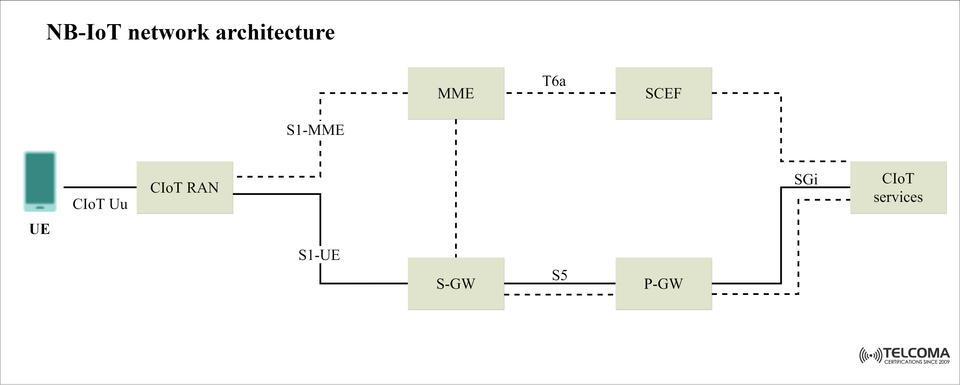

NB-IoT Network Architecture: An Overall Reference for Telecommunication Engineers
Narrowband IoT (NB-IoT) is a Low Power Wide Area Network (LPWAN) technology standardized by 3GPP to allow for mass IoT deployments. NB-IoT technology utilizes existing LTE infrastructure to enable extended coverage area without compromising device battery life as well as economically viable connectivity for billions of devices.
The image above shows the NB-IoT network architecture and shows the interaction between User Equipment (UE), Cellular IoT Radio Access Network (CIoT RAN) and Evolved Packet Core (EPC).
Components of NB-IoT Network Architecture
UE (User Equipment)
IoT devices that are generally referred to as sensors, trackers, smart meters etc.
Communicates with the network using the CIoT Uu interface.
CIoT RAN (Radio Access Network)
The NB-IoT base station. It could be a current LTE eNodeB with NB-IoT integrated or stand alone node.
Provides radio resource management, signal processing, and initial access functions for the UE to the network.
MME (Mobility Management Entity)
Controls signaling and session management.
Supports different elements of NB-IoT optimizations such as Control Plane CIoT EPS optimization.
S-GW (Serving Gateway)
Routes and forwards packets of user data from RAN to P-GW
P-GW (Packet Data Network Gateway)
Provides IP address allocation, packet filtering, and Quality of Service (QoS) enforcement.
Functions as the anchor point for connecting to external IP networks or IoT services.
Interface Function
CIoT Uu Connects UE with CIoT RAN for radio communication
S1-MME Control plane interface between RAN and MME
S1-U User plane interface between RAN and S-GW
T6a Interface between MME and SCEF for non-IP data delivery
S5 Link between the S-GW and the P-GW for forwarding data in the user plane
SGi Connects the P-GW or the SCEF with external IoT service platforms
Data Flow in NB-IoT
Control Plane Path: UE → CIoT RAN → MME → SCEF → CIoT Services
Used as signalling and non-IP data delivery.
User Plane Path: UE → CIoT RAN → S-GW → P-GW → CIoT Services
Used as IP based data delivery.
Key Benefits of NB-IoT Architecture
Extended Coverage: Up to 20 dB better than GSM offering deep indoor penetration.
Low Power Consumption: Battery life 10+ years.
Support for Massive Devices: Up to millions of devices per cell.
Flexible deployment options: Standalone, guard-band or in-band LTE modes.
Conclusion
The NB-IoT architecture allows for efficient, low-cost, and scalable IoT connectivity by leveraging existing LTE infrastructure and implementing IoT specific optimizations such as data delivery via SCEF. Understanding the different components, interfaces, and data flow to/from each of these modules is essential for telecom professionals.
NB-IoT Deployment Models in existing LTE Networks
NB-IoT can be deployed in three different models in existing LTE networks:
Standalone Deployment mode
Requires dedicated spectrum usually re-farmed from GSM.
Best for large rural/remote IoT deployments with maximum coverage.
Guard-band Deployment mode
Uses unusable guard bands in LTE networks so there is no interference with LTE traffic.
It is cost-effective approach since you don't have to allocate new spectrum.
In-band Deployment mode
Operates within the LTE carrier bandwidth with normal LTE traffic.
Easiest to ramp up and integrate with existing LTE/other services.
NB-IoT control plane vs user plane optimizations
NB-IoT supports two potential ways to deliver data that optimize performance on these dimensions:
Mode Path Key Benefit
Control Plane CIoT EPS Optimization UE → RAN → MME → SCEF No IP stack on the device reduces cost complexity and power consumption. Best for small and infrequent data packets.
User Plane CIoT EPS Optimization UE → RAN → S-GW → P-GW Full IP capability- can also be used when there is a regular frequency of small data exchange.
NB-IoT and SCEF (Service Capability Exposure Function)
The SCEF is an essential component of non-IP data delivery (NIDD).
It is used to run the IoT devices without requiring the UE to maintain an IP connection.
It utilizes secure RESTful APIs to expose the network services to the IoT platforms.
It has massive support for scalability for sensor networks and metering systems.
Security Elements of NB-IoT Architecture
NB-IoT builds on LTE's robust security features and includes IoT tailored improvements:
- Device authentication through SIM/USIM credential.
- Encryption of data from control both control and user plane.
- Secure API access for 3rd party IoT services via SCEF.
NB-IoT Use Cases Across Domains
Smart Cities - Smart parking and lighting control; waste management systems.
Utilities
- Smart metering units on electricity, gas, and water.
Agriculture
- Monitor soil conditions and moisture, control and monitor irrigation; track livestock.
Logistics
- Monitor and track assets, fleet management, cold chain monitoring.
Healthcare
- Remote patient monitoring and alert systems.
4 Reasons Manufacturers see NB-IoT as a Game Changer for Telecoms:
- Spectrum Efficient - NB-IoT can reuse the LTE spectrum effectively.
- Cost Savings - minimal infrastructure upgrades are needed
- New Revenue - It can cater to an array of verticals from industrial IoT and smart device consumer offerings.
- Prepare for the future - It fits into 5G's massive machine-type communication (mMTC) strategy.
EPC Architecture's End-to-End NB-IoT Data Path
Understanding the end-to-end data path of NB-IoT will help in the design, troubleshooting, etc. of the network.
Non-IP Data Delivery (NIDD) Path
UE (NB-IoT Device)
The MME will opt to send small amounts of data (e.g., meter readings) without IP protocol overhead.
CIoT RAN
The CIoT RAN handles the radio transmission of the data via the NB-IoT air interface based on LTE standards.
MME (Mobility Management Entity)
The UE sends data via the T6a interface directly to the SCEF from the MME.
SCEF
The SCEF exposes APIs for secure delivery of data to IoT application servers.
Benefits: allows for lower latency, lower complexity for device, and reduced power consumption.
Conclusion:
NB-IoT architecture has scalable, robust, and secure to connect billions of low power devices. Understanding NB-IoT architecture, options for deployment and the associations with LTE will position telecom professionals to help influence networks that will be required for smart cities, industry automation, and next-generation IoT device deployments. NB-IoT is easily situated by variants of deployment types and a lower cost of ownership than traditional mobile or cellular technology model making it one of the most appealing.