
NB-IoT Uplink Channel Mapping: UL-SCH, RACH, NPUSCH, and NPRACH

The Importance of Uplink Mapping in NB-IoT
The Internet of Things (IoT) is changing how industries operate by linking sensors, devices, and machines on a massive scale. To accommodate these advancements, 3GPP developed Narrowband IoT (NB-IoT), a low-power wide-area network (LPWAN) technology that’s tailored for high device density, long battery life, and extensive coverage.
While the NB-IoT downlink plays a crucial role in allowing devices to receive information and commands from the network, the uplink (UL) is just as vital. This aspect is what lets billions of devices send back sensor data, status updates, and control messages to the network.
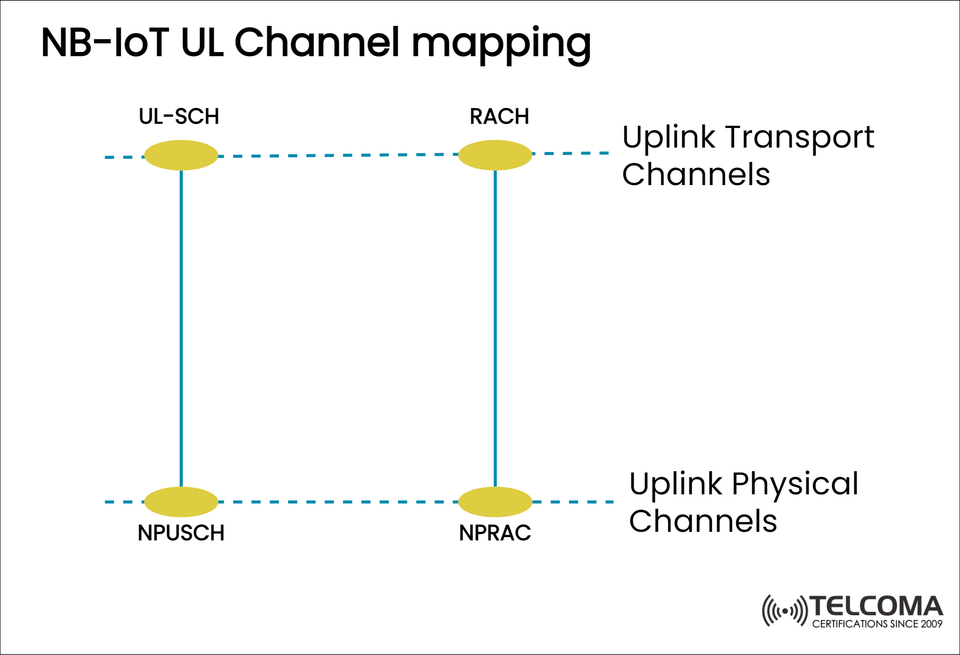
The provided diagram shows how NB-IoT uplink channel mapping connects the uplink transport channels (UL-SCH, RACH) to the uplink physical channels (NPUSCH, NPRACH).
Understanding NB-IoT Channel Mapping
NB-IoT uses the 3GPP layered channel architecture, breaking down radio communication into:
Logical Channels → Indicate the type of data being sent.
Transport Channels → Define how the data makes its way across the radio interface.
Physical Channels → Outline how signals are arranged on time-frequency resources for actual transmission.
Our focus here will be on the transport and physical channels for uplink communication.
Uplink Transport Channels in NB-IoT
Transport channels determine how data is sent to the physical layer. In the uplink, we have two main transport channels:
UL-SCH (Uplink Shared Channel): * This is the primary channel for user data transmission. * It carries application data, acknowledgments, and specific control signals. * It includes error correction, hybrid ARQ, and adaptive modulation features. * The channel is shared among multiple devices managed by eNodeB scheduling.
RACH (Random Access Channel): * This channel is used for initial access and synchronization. * It allows a device to connect with the base station. * It helps in processes like random access, timing alignment, and resource requests. * It’s essential, especially when a device wakes from sleep or re-enters the network.
Uplink Physical Channels in NB-IoT
Physical channels are where the actual radio resources for signal transmission are defined. For NB-IoT uplink, we have:
NPUSCH (Narrowband Physical Uplink Shared Channel): * This maps from UL-SCH. * It transmits user data and control signals. * It supports both single-tone and multi-tone transmission, allowing a balance between coverage and efficiency. * It's designed for low power use, with repeat functions for better coverage.
NPRACH (Narrowband Physical Random Access Channel): * This maps from RACH. * It carries random access preambles from devices trying to connect. * It’s optimized for extended coverage and makes sure devices can identify and synchronize even in challenging conditions.
NB-IoT Uplink Channel Mapping Flow
The diagram illustrates a straightforward yet effective mapping structure:
UL-SCH → NPUSCH * This channel carries all user data (like sensor readings, meter data, alarms) through UL-SCH to NPUSCH. * It guarantees reliable delivery thanks to repetitions, error checks, and effective resource management.
RACH → NPRACH * When a device needs to connect to the network, it sends a random access preamble on NPRACH. * The eNodeB then responds, completing the random access process and allocating resources on NPUSCH.
This two-path structure allows uplink communication in NB-IoT to be more straightforward than LTE, while remaining highly optimized for low data rates and extensive coverage IoT applications.
Key Features of Uplink Channels in NB-IoT
NPUSCH Features
Two Formats: * Format 1: Carries user data. * Format 2: Handles uplink control information (ACK/NACK, scheduling requests).
Subcarrier Spacing: Options of 3.75 kHz or 15 kHz.
Repetitions: Enhance coverage in poor signal conditions.
NPRACH Features
Single-tone transmission.
Preamble structure: Aimed at improving coverage.
Multiple repetitions: Help ensure successful network access, even in weak coverage areas.
Why NB-IoT Uplink Mapping Differs from LTE
The uplink in NB-IoT is simpler than LTE, which cuts down on complexity and conserves power:
Feature LTE Uplink NB-IoT Uplink Bandwidth Up to 20 MHz180 kHz Physical Channels PUSCH, PUCCH, PRACH, SRSNPUSCH, NPRACH Multiplexing High throughput, multiple layers Low-rate, narrowband single-carrier Coverage Designed for smartphones Designed for IoT (20 dB coverage gain)
This structure ensures that NB-IoT devices, like smart meters, trackers, and sensors, can last 10+ years on battery power.
Example: Smart Agriculture Sensor
Take a soil moisture sensor on a remote farm:
The device wakes up at intervals to send data.
It initially uses NPRACH to send a random access preamble.
The network assigns uplink resources.
Then the sensor sends its soil moisture data through NPUSCH.
The device goes back to deep sleep until it’s time to report again.
This setup allows for low-cost, long-range, and reliable communication — even in rural or hard-to-reach areas.
Advantages of NB-IoT Uplink Mapping
Simplicity: With fewer channels than LTE, it’s easier to design devices.
Energy Efficiency: The optimized NPUSCH formats and repetitions help extend battery life.
Extended Coverage: The narrowband NPRACH makes sure devices can connect even in tough environments.
Massive Scalability: Can support as many as 50,000 devices per cell.
Flexibility: Offers both single-tone and multi-tone options, balancing coverage and throughput needs.
Challenges with NB-IoT Uplink
Low Data Rates: It’s tailored for small payloads, which isn’t suitable for high-bandwidth uses.
Latency: The mechanisms for random access and repetitions can lead to delays.
Limited Uplink Control Options: With just NPUSCH and NPRACH, there's less flexibility compared to LTE.
Summary Table: NB-IoT Uplink Channel Mapping
Transport Channel Physical Channel Purpose UL-SCHN PUSCH User data, acknowledgments, uplink control RACHNPRACH Random access, synchronization, initial connection
Conclusion
NB-IoT uplink channel mapping is simple yet effective, designed to fulfill the specific needs of IoT communications. By connecting UL-SCH to NPUSCH and RACH to NPRACH, NB-IoT achieves efficient, reliable, and low-power uplink transmission.
This streamlined approach reduces complexity compared to LTE while ensuring the deep coverage, scalability, and battery efficiency needed for IoT applications like smart utilities, agriculture, logistics, and urban infrastructure.
For those in telecom, grasping uplink mapping is crucial for optimizing NB-IoT deployments. And for tech enthusiasts, it shines a light on the unseen framework that supports billions of connected devices globally.