
NEC’s IMS Products and VoLTE Service: The Backbone of Next-Generation Voice and Video Communication

NEC's IMS Products and VoLTE Service: Powering the Future of Voice and Multimedia Communication
As we move into the world of 4G LTE and 5G, Voice over LTE (VoLTE) is laying the groundwork for high-quality, IP-based voice and video communication. With operators stepping away from traditional circuit-switched networks, NEC’s IP Multimedia Subsystem (IMS) solutions are key to providing smooth and high-performing communication experiences.
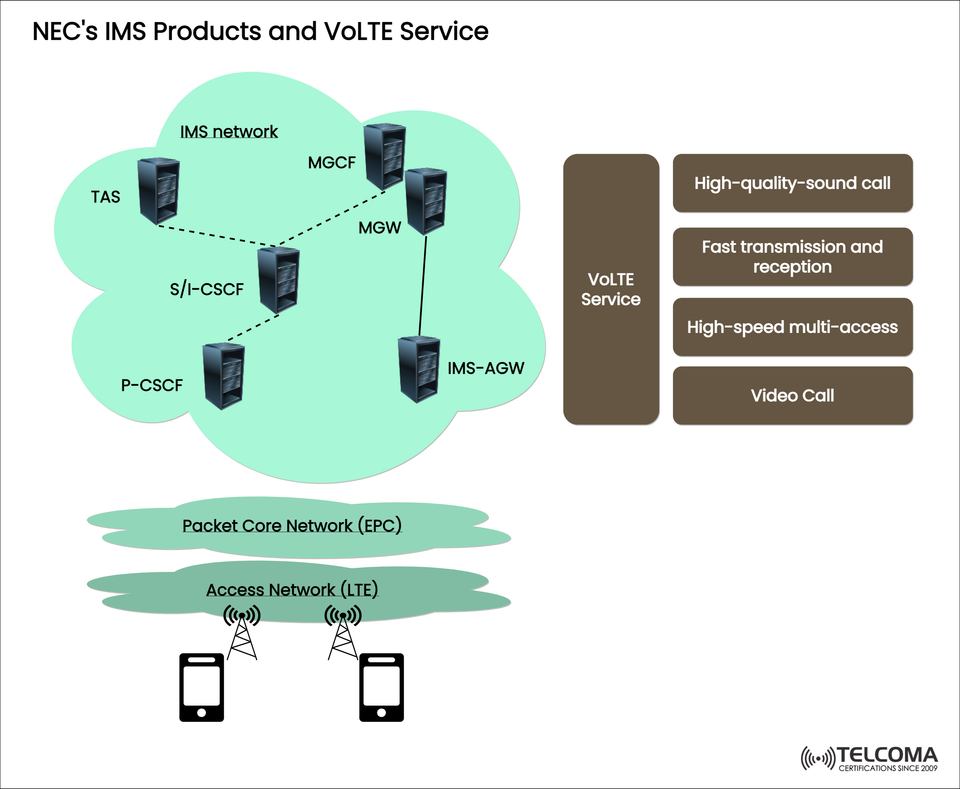
The diagram uploaded shows how NEC’s IMS architecture fits into LTE networks, enabling VoLTE services that offer HD voice, video calling, and quick multimedia transmission—all on an all-IP framework.
Understanding the Core Concept: IMS and VoLTE
Before we dive into NEC’s systems, let’s break down the basics.
What is IMS (IP Multimedia Subsystem)?
IMS is a standardized setup crafted by 3GPP (3rd Generation Partnership Project) aimed at delivering IP-based communication services such as:
Voice over LTE (VoLTE)
Video over LTE (ViLTE)
Rich Communication Services (RCS)
Multimedia conferencing
It provides a uniform service framework across both fixed and mobile networks, so operators can offer consistent, scalable, and interoperable services.
What is VoLTE?
Voice over LTE (VoLTE) is a technology that sends voice calls over the LTE data network, rather than relying on older 2G or 3G circuit-switched channels.
With VoLTE, you get:
High-definition voice calls
Faster call setup times
Ability to use voice and data at the same time
Better video and multimedia features
NEC's IMS Architecture: The Building Blocks of VoLTE
The image showcases NEC's IMS framework, which connects with the LTE Access Network and the Evolved Packet Core (EPC) to deliver VoLTE services from start to finish.
Component - Role - Function in VoLTE Service
P-CSCF (Proxy Call Session Control Function) - Acts as the first contact point for user equipment (UE) in the IMS network; takes care of registration and routing.
S/I-CSCF (Serving/Interrogating Call Session Control Function) - Manages user sessions, authentication, and call routing logic.
TAS (Telephony Application Server) - Provides voice and video call functions, plus extra services (like call waiting and forwarding).
MGCF (Media Gateway Control Function) - Controls media gateways and connects with legacy PSTN networks.
MGW (Media Gateway) - Converts voice streams between IP (VoLTE) and traditional TDM (PSTN) systems.
IMS-AGW (IMS Access Gateway) - Manages media routing and connects with LTE/EPC networks.
How NEC's IMS Architecture Connects VoLTE Services
Communication starts with the user’s mobile device, passes through the LTE access network, the EPC, and finally reaches the IMS core.
Step-by-Step Flow:
Access Network (LTE):
User devices connect to the LTE radio network, sending voice as data packets.
Packet Core Network (EPC):
Handles IP-based packet switching, ensuring Quality of Service (QoS) for voice traffic.
Sends data to the IMS network using secure tunneling and signaling protocols.
IMS Network:
The P-CSCF verifies the device and directs it to the S/I-CSCF for session control.
The TAS manages services like call setup, routing, and improvements in multimedia.
If needed, MGCF and MGW manage protocol translation for older networks.
The IMS-AGW makes sure data streams move efficiently between the IMS and EPC layers.
This fully IP-based path does away with the need for circuit-switched fallback (CSFB), boosting efficiency and quality.
Advantages of NEC's IMS-Powered VoLTE Services
NEC's IMS solution is geared toward improving network efficiency, call quality, and scalability while ensuring smooth interoperability across devices and networks.
Key Benefits of VoLTE (as seen in the image):
High-Quality Sound Calls
Uses wideband codecs like AMR-WB (Adaptive Multi-Rate Wideband) for crystal-clear voice quality.
Cuts down background noise and enhances speech clarity.
Fast Transmission and Reception
VoLTE’s all-IP approach ensures faster call setup times, generally taking under a second.
Allows for simultaneous voice and data usage, unlike 2G/3G systems.
High-Speed Multi-Access
With multi-access connectivity, users can enjoy uninterrupted voice service even during data-heavy activities.
Supports movement across LTE, Wi-Fi, and upcoming 5G access points.
Video Call Enablement
Integrates Video over LTE (ViLTE) to facilitate HD video communication right from the native dialer—no extra apps necessary.
Technical Advantages for Telecom Operators
NEC’s IMS platform delivers flexibility, scalability, and interoperability—key features for telecom operators moving from LTE to 5G.
- Simplified Network Integration
IMS supports fixed, mobile, and Wi-Fi networks under a single framework.
Operators can roll out unified services across various access technologies.
- Enhanced Service Agility
The TAS (Telephony Application Server) allows operators to quickly launch new voice, video, or IoT communication services.
Built-in APIs help integrate with OTT (Over-The-Top) and enterprise applications.
- Reduced Operational Costs
An IP-based setup simplifies maintenance and cuts down reliance on outdated systems.
Virtualized IMS solutions lower CAPEX and OPEX through cloud-native deployment.
Improved Quality of Experience (QoE)
Real-time monitoring and adaptive codecs guarantee consistent call quality even with fluctuating network conditions.
Integration with EPC QoS mechanisms helps prioritize voice packets.
VoLTE in the Context of 5G Evolution
While VoLTE is primarily a 4G tech, it sets the groundwork for Voice over New Radio (VoNR)—the voice service made for 5G. NEC’s IMS architecture is future-proof, supporting both VoLTE and VoNR with software-based updates.
From LTE to 5G: IMS as the Common Core
IMS remains the central signaling and service platform for both VoLTE and VoNR.
Operators can easily transition to 5G Standalone (SA) mode while keeping legacy services going.
Network slicing in 5G can further enhance IMS resources for voice, video, or business use cases.
Use Cases and Deployment Scenarios
- Telecom Operators
Implement IMS as a centralized service platform for millions of VoLTE users.
Integrate with EPC and 5G Core for seamless interoperability.
- Enterprises
Use IMS-based private LTE/5G networks for secure internal communications.
Combine with UCaaS (Unified Communications as a Service) for voice, video, and collaboration tools.
IoT and M2M Applications
IMS can back voice-enabled IoT devices, ensuring secure and quick communication for smart cities and industrial systems.
Comparing IMS and Legacy Voice Architectures
Feature - Legacy (CS Network) - IMS/VoLTE
Call Setup Time: 6–8 seconds - <1 second
Voice Quality: Narrowband - Wideband (HD Voice)
Data & Voice Simultaneity: Not supported - Fully supported
Network Type: Circuit-Switched - All-IP
Scalability: Limited - Highly scalable
Future Readiness: 3G-dependent - 4G/5G-ready
Conclusion: NEC’s IMS — Enabling the Next Generation of Communication
NEC’s IMS products are the backbone of VoLTE and upcoming 5G voice services, providing high-quality, scalable, and reliable IP-based communication.
By bringing together voice, video, and data services over LTE and beyond, NEC allows telecom operators to deliver better customer experiences while improving network efficiency.
As the telecom industry moves towards 5G Standalone networks, NEC’s IMS-powered VoLTE solutions will continue to be a vital enabler—ensuring seamless connectivity, real-time multimedia communication, and a network that’s ready for the future.