
Network Architecture Evolution from 4G to 5G: From Distributed RAN to Network Slicing

Evolving Network Architecture from 4G to 5G — Telecom Network Professionals
Moving to 5G NR from 4G LTE is more than just faster throughput; it fundamentally changes the network architecture to incorporate a diverse set of application requirements, including ultra-fast mobile broadband and mission-critical IoT, through new architectural innovations.
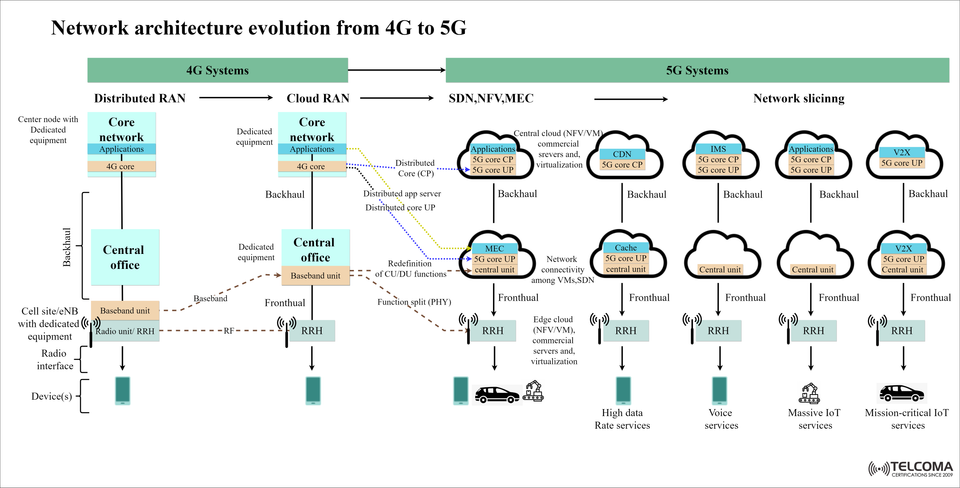
The uploaded diagram summarizes the evolution of architecture with at-a-glance reference to Distributed RAN, Cloud RAN, SDN/NFV/MEC, and Network Slicing, each represented here by a box and a label. Let's look at each evolution.
- Distributed RAN (4G Systems)
In the 4G architecture, typically:
Core Network: the applications, signaling, and user-plane functions.
Central Office: dedicated application/processing for baseband on center office equipment.
Cell Site/eNB: where the BBU & RU/RRH live, sharing the same location.
Backhaul: link for connecting the cell-site/enb to the core via the central office.
This architecture is very dependable but not flexible or cost-capable to scale and to provide multiple service requirements.
2. Cloud RAN (C-RAN)
Cloud RAN separates the functional aspects of a Radio Unit (RU), from the Baseband Unit (BBU). Centralized baseband processing can be achieved by enabling
Fronthaul Links: RRHs at the cell sites are connected to centralized BBUs using fronthaul links.
- SDN, NFV, and MEC (Early 5G Systems)
The next evolution involves virtualization and programmability:
SDN (Software-defined Networking): Divides the control plane from the data plane to dynamically manipulate the network.
NFV (Network Functions Virtualization): Runs network functions on COTS (commercial off-the-shelf) hardware instead of dedicated telecom hardware.
MEC (Multi-access Edge Computing): Bring compute and storage closer to the user to reduce latency.
This version enables functions to be distributed, moves applications to the edge-cloud, and achieves real-time processing for use cases such as autonomous vehicles and industrial automation.
- Network Slicing (Full 5G Systems)
Finally, network slicing allows the capability for multiple virtual networks to run on shared physical infrastructure. Each slice can be designed for different use cases.
Type of Slice Example Services Major Characteristics
High Data Rate Slice 4K/8K video streaming, AR/VR High throughput, moderate latency
Voice VoNR, VoIP Guaranteed QOS to ensure voice clarity across networks
Massive IoT smart city sensors, Automated Massive connectivity, low power
Mission Critical IOT Autonomous driving, remote Ultra-low latency, high reliability
surgery
Major Benefits include the following:
Service isolation to provide security and performance during operation.
Resource utilization so you can extract the best that you can for your expenditure.
Rapid commercialization to provide additional services to combat obsolescence.
Going from a Distributed RAN to a Cloud RAN → Lowering CAPEX.
Conclusion
The evolution from 4G to 5G network architecture has provided a varied journey from hardware based, to rigid systems to ultimately being software based, and service oriented networks. Understanding these changes in telecom should be on every telecom professionals horizon. This is not only important for companies deploying 5G, but to understand this as they embark on the innovation and reconstruction of telecommunications and connectivity infrastructure over the next ten years.
- Distributed RAN (Legacy 4G deployment)
a. Structure:
Core Network: Physical core with dedicated EPC (Evolved Packet Core) hardware.
Central (or regional) Office: Houses the Baseband Unit (BBU) and handles the signal processing.
Radio Unit (RU) or RRH: RF links from the BBU at the central office to the radio unit located at the cell site.
Backhaul: The link that provides connectivity and carries the aggregated traffic back to the primary core network.
b. Pain Points:
Labor and high equipment costs (per site).
Cannot utilize physical or wavelength resources (i.e. spectrum efficiency) across sites.
Limited support for ultra-low latency applications. - Cloud RAN (C-RAN) in Transitioning Networks
Key Developments:
Operator Efficiency:
Lower CAPEX by reducing site hardware.
Administrative ease of software updates for baseband processing.
Higher spectral efficiency through coordinated scheduling and better efficiency through MIMO optimization.
Technical Consideration:
Fronthaul latency usually needs < 100 µs for comparable performance.
Fronthaul requires significant bandwidth (10 - 25 Gbps for some 5G configurations).
- SDN, NFV, and MEC – The Virtualization Phase
SDN:
Decouples control from forwarding planes.
To simplify, centralized intelligence in the network that can adjust automatically to changes in the path through the network.
NFV:
Eliminates proprietary Network appliances with virtualized network functions (VNFs) on COTS servers.
Examples: virtual EPC (vEPC), virtual IMS (vIMS).
MEC:
Brings compute/storage to the edge for latency sensitive services.
Provides the ability to process data locally and then send it to the core, which saves backhaul capacity.
Network flexibility impact:
Services can be deployed only minutes after requesting it without physically disrupting the network.
Processing power can be allocated on-demand critically to specific network functions.
4. Network Slicing – The Capstone of 5G Architecture
Definition:
A logical end-to-end network that is virtually separated from the others, and is optimized for a particular service.
Examples from Diagram:
High Data Rate slice – For enhanced Mobile Broadband
- Separation of BBU and RRH functionality.
- Centralized baseband processing in a data or Central office.
- Fronthaul links (typically CPRI or eCPRI) that link RRHs to centralized BBUs.
Slice Management:
To be managed by Network Slice Management Functions (NSMF).
Can easily allow dynamic reassignment of resources as determined by demand.
Summary Table – Evolution Milestones
Phase Technology Benefits Limitation
Distributed RAN Dedicated BBU & RRH at each site Reliable and proven technology High CAPEX and less flexible.
Cloud RAN Centralized BBU to serve multiple sites or the entire RAN; Lower costs, includes more functional elements, improved coordination and organization.Reliance on high-speed fronthaul to transfer data from BBU to RRH.
SDN/NFV/MEC The ability to have a virtualized and programmable RAN environment Allows maximum flexibility and enables faster service rollout; More complexity due to the orchestration.
Network Slicing Many virtual networks that share physical architecture Specific network enhancements depending on the service; Require full 5G core implementation within the entire network infrastructure.
Conclusion
Moving from 4G to 5G was not a single movement but a multi-phase process of some gradual introduction of centralization, virtualization, and intelligent resource orchestration. Understanding each of these steps in the architecture transition allows telecom engineers and network operators to design, deploy and optimize networks that can satisfy the many expectations and demands of the 5G world.
In summary, Distributed RAN transitioned to Cloud RAN which transitioned to virtualized, software-defined, and then evolved into network slicing - the foundation of any service-specific 5G arrangements.