
Network Convergence and Topologies in Telecom: HPHT vs LPLT Explained

Network Convergence and Various Topologies Involved
Telecommunication networks are changing quickly to keep up with the demands of 5G, 6G, the Internet of Things (IoT), and ultra-reliable low-latency communication (URLLC). A big part of this shift is network convergence—bringing together different network technologies and architectures into a single, cohesive system.
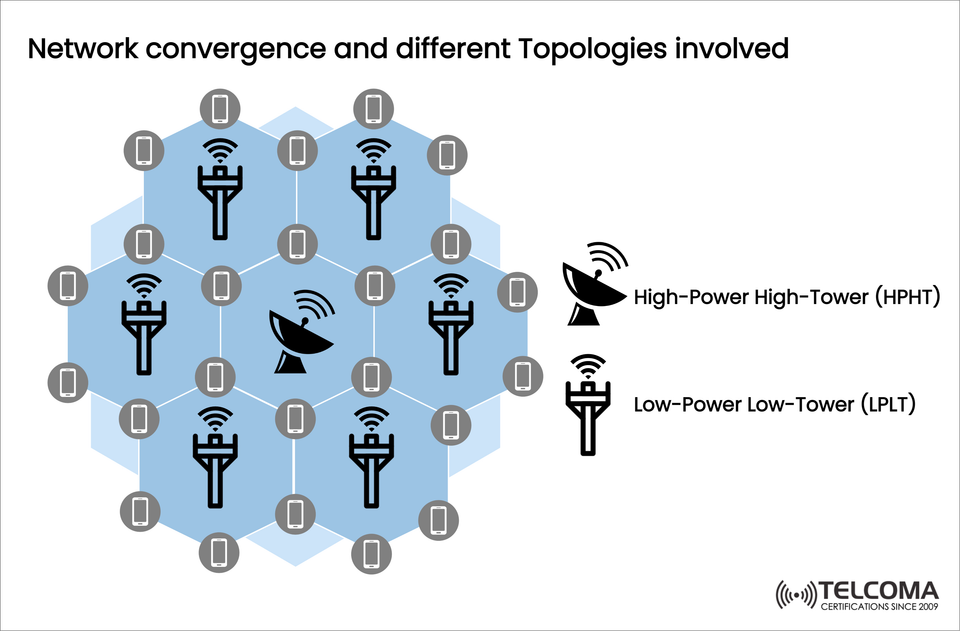
The image uploaded illustrates this concept by showing how High-Power High-Tower (HPHT) and Low-Power Low-Tower (LPLT) topologies can work together in a converged network.
In this blog, we’ll dive into the function of each topology, their pros and cons, and how convergence is shaping the future of telecommunications.
What is Network Convergence?
Network convergence is about merging multiple communication technologies, different types of infrastructure, and various service layers into one ecosystem. Instead of existing in silos, fixed, mobile, and satellite networks interconnect to provide seamless, efficient, and resilient connectivity.
In mobile and wireless communication, convergence is achieved through:
Integrating multiple topologies (HPHT, LPLT, small cells, satellite).
Efficiently utilizing spectrum to balance coverage with capacity.
Leveraging advanced technologies like Massive MIMO, beamforming, and dynamic spectrum sharing.
The end result is a heterogeneous network (HetNet) where different nodes work together for optimal performance.
The Two Key Topologies in Telecom Networks
- High-Power High-Tower (HPHT) Topology
The HPHT model relies on tall towers that transmit signals at high power levels.
Key Features:
Towers are spaced farther apart, covering large geographic regions.
Requires fewer towers to achieve coverage.
Best suited for rural and suburban areas with low population density.
Advantages:
Cost-effective for wide-area coverage.
Great for broadcasting services like TV, radio, and emergency alerts.
Helps reduce infrastructure duplication.
Limitations:
Lower capacity compared to denser networks.
Higher latency for edge services.
Might have coverage gaps in urban areas due to obstructions like buildings.
Best Use Cases:
Rural broadband access.
National broadcasting.
Public safety communications.
- Low-Power Low-Tower (LPLT) Topology
The LPLT model deploys many smaller towers or base stations that transmit at lower power levels.
Key Features:
Dense deployment in urban and high-traffic areas.
Built for high capacity and low latency.
Allows for detailed coverage and better spectrum utilization.
Advantages:
Can effectively handle a large number of users.
Supports 5G and 6G use cases like IoT, autonomous vehicles, and smart cities.
Reduces interference by limiting coverage areas.
Limitations:
High deployment costs due to the number of sites required.
Needs advanced coordination and backhaul infrastructure.
Less efficient for sparsely populated areas.
Best Use Cases:
Dense metropolitan areas.
Enterprise networks and campuses.
Edge computing and real-time applications.
Why Combine HPHT and LPLT?
No single topology can tackle the diverse needs of today's telecom systems, which is why merging HPHT and LPLT is so important.
Complementary Strengths
HPHT provides broad coverage for remote and sparsely populated areas.
LPLT ensures high data rates and low latency in more crowded environments.
Examples of Convergence
During the 5G rollout, a mix of macro cells (HPHT) and small cells (LPLT) is utilized.
For disaster recovery, HPHT ensures widespread communication, while LPLT nodes can quickly set up local support.
Next-gen networks like 6G will blend terrestrial (HPHT + LPLT) with non-terrestrial networks (satellites, HAPS).
HPHT vs LPLT: A Quick Comparison
Feature HPHT (High-Power High-Tower)LPLT (Low-Power Low-Tower)Coverage Area Wide (regional/national)Localized (urban, dense areas)Power Levels High Low Infrastructure Density Low (fewer towers)High (many towers)Deployment Cost Lower (fewer towers)Higher (dense infrastructure)Latency Higher Lower Best for Rural coverage, broad casting Urban capacity, 5G/6G applications
How Network Convergence Works
In a converged network:
Macro cells (HPHT) provide the main coverage.
Small cells (LPLT) fill in coverage gaps and boost capacity in high-demand areas.
User devices connect to the best tower based on signal quality and network conditions.
Advanced coordination algorithms manage load balancing, interference reduction, and spectrum efficiency.
Backhaul integration (fiber, microwave, or satellite) allows smooth communication between nodes.
This mixed design maximizes both coverage and performance, which is vital for future-ready telecom.
Benefits of Converged HPHT + LPLT Networks
Seamless Coverage: Users stay connected no matter where they are.
Optimized Costs: Balanced investments between wide-area coverage and dense local setups.
Scalable Architecture: Easily adaptable for 5G, 6G, and beyond.
Enhanced User Experience: High data rates, minimal latency, and reliable service.
Future-Proofing: Gets networks ready for IoT, AI-driven applications, and immersive tech (like AR/VR and the metaverse).
Real-World Applications
5G Urban Rollouts: Merges HPHT for broad coverage with LPLT for busy city hotspots.
IoT Networks: LPLT supports millions of low-power IoT devices in smart cities.
Public Safety & Emergency Services: HPHT ensures fast communication across wide areas.
Autonomous Mobility: LPLT provides low-latency support for connected vehicles.
Disaster Recovery: Converged systems offer resilience with backup connectivity.
Conclusion
The merging of HPHT and LPLT topologies is changing the way telecom networks are built and implemented. Rather than picking one over the other, modern systems combine coverage and capacity for an optimal experience.
As we move toward 6G and beyond, this convergence will grow even more, bringing together satellite systems, HAPS, and terrestrial topologies into a single streamlined architecture. For telecom experts, understanding the convergence of HPHT and LPLT is crucial for creating the resilient, high-performance networks of the future. Network Convergence and Various Topologies Involved
Telecommunication networks are changing quickly to keep up with the demands of 5G, 6G, the Internet of Things (IoT), and ultra-reliable low-latency communication (URLLC). A big part of this shift is network convergence—bringing together different network technologies and architectures into a single, cohesive system.
The image uploaded illustrates this concept by showing how High-Power High-Tower (HPHT) and Low-Power Low-Tower (LPLT) topologies can work together in a converged network.