
Network Function Virtualization Infrastructure (NFVI) Explained

The telecom sector is quickly shifting from hardware-centric networks to ones that are powered by software and cloud technology. At the core of this shift is Network Function Virtualization Infrastructure (NFVI). This enables telecom companies to swap out specialized hardware for Virtualized Network Functions (VNFs), which helps cut costs, enhances agility, and makes it easier to scale operations.
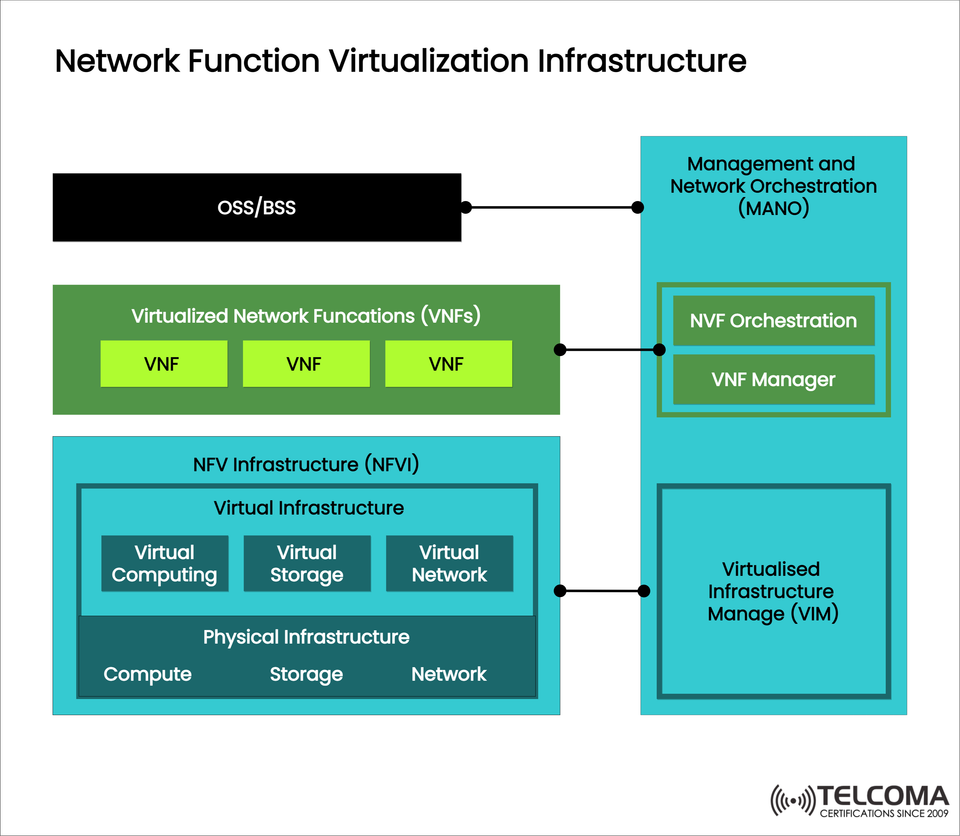
The image you uploaded shows the end-to-end NFV architecture, highlighting VNFs, NFVI layers, and the Management and Network Orchestration (MANO) framework. Let’s dive into the details.
What is NFV Infrastructure (NFVI)?
NFVI is basically the hardware and software setup that allows VNFs to run. Instead of needing separate hardware for each function—like firewalls, routers, or load balancers—NFVI lets these services operate as software on virtualized or cloud-based infrastructures.
Typically, NFVI runs on general-purpose servers, storage systems, and networking gear, making it vendor-neutral and cost-effective.
Key Components of NFV Infrastructure
The NFVI framework consists of three main components:
- Virtualized Network Functions (VNFs)
VNFs represent the software versions of traditional network functions.
Examples include virtual firewalls, virtual routers, EPC (Evolved Packet Core), and IMS (IP Multimedia Subsystem).
They separate software from hardware, which allows for better scalability and portability.
Multiple VNFs can coexist on shared infrastructure, boosting efficiency.
NFV Infrastructure (NFVI)
NFVI is the base where VNFs are set up, and it’s split into two layers:
a. Physical Infrastructure
This includes compute, storage, and network hardware.
Using commodity servers and COTS (Commercial Off-The-Shelf) hardware keeps capital expenditure (CAPEX) low.
It guarantees performance and reliability through redundancy.
b. Virtual Infrastructure
Made up of Virtual Computing, Virtual Storage, and Virtual Networking.
This layer allows for resource abstraction and pooling via hypervisors, containers, and virtualization platforms (like KVM, VMware, OpenStack).
It creates the flexibility to scale VNFs whenever needed.
Management and Network Orchestration (MANO)
The ETSI MANO framework manages the lifecycle of VNFs and the underlying infrastructure. This includes:
VNF Manager (VNFM): Oversees individual VNFs, dealing with scaling, configuration, and updates.
NFV Orchestrator (NFVO): Coordinates services across multiple VNFs, ensuring connectivity and service chaining.
Virtualized Infrastructure Manager (VIM): Manages NFVI resources (compute, storage, and networking). OpenStack is a common example of a VIM.
Role of OSS/BSS in NFV
Operations Support Systems (OSS) and Business Support Systems (BSS) work together with MANO to provide:
Service provisioning and assurance
Billing and payment management
Customer support
Performance tracking
The integration of OSS/BSS allows telecom operators to deliver reliable services while keeping their business agile.
Benefits of NFV Infrastructure
NFVI has a lot of advantages compared to traditional networking:
- Cost Efficiency
Lowers reliance on specialized hardware.
Takes advantage of commodity servers and virtualization tools.
Significantly reduces both CAPEX and OPEX.
- Agility and Flexibility
VNFs can be quickly activated or scaled down as needed.
Allows for faster introduction of new network services.
Supports environments with multiple vendors.
- Scalability
Scale horizontally by adding more virtual resources.
Cloud-native VNFs can operate on container platforms (like Kubernetes).
- Service Innovation
Operators can quickly test and launch new services.
Service chaining makes it possible to combine different VNFs for tailored offerings.
- Automation and Orchestration
MANO automates resource allocation, scaling, and service assurance, which cuts down on manual work and boosts efficiency.
NFV Infrastructure in 5G Networks
NFVI is a key player in 5G deployments, which require ultra-low latency, high scalability, and dynamic resource management. Here’s how NFVI supports 5G:
Network Slicing: Creating several virtual networks on a single physical network.
Cloud-Native VNFs (CNFs): Container-based functions that enhance efficiency for 5G core services.
Edge Computing Integration: NFVI extends to edge data centers to keep latency low.
Automation with AI/ML: Improves orchestration, helping with predictive scaling and self-healing.
NFV vs. Traditional Networks: A Quick Comparison
Feature Traditional Networks NFV Infrastructure Hardware Dependency Dedicated appliances Commodity servers Flexibility Low High Service Deployment Slow (weeks/months)Fast (minutes/hours)Scalability Limited Dynamic, on-demand Cost High CAPEX/OPEX Reduced costs Innovation Vendor-locked Open, agile
Challenges in NFVI Adoption
Even with its many benefits, telecom companies encounter some roadblocks when adopting NFVI:
Interoperability Issues: Multi-vendor VNFs might not standardize well.
Performance Overhead: Virtualization can add latency compared to using bare-metal appliances.
Security Concerns: Virtual setups can widen the attack surface.
Complex Management: Managing large-scale VNFs needs robust MANO systems.
Future of NFV Infrastructure
As networks progress toward 5G, 6G, and beyond, NFVI will keep evolving:
Moving from VM-based VNFs to containerized CNFs.
More integration with cloud-native orchestration platforms like Kubernetes.
Higher adoption of AI-driven automation for smarter operations.
Further expansion into enterprise and IoT networks for enhanced agility and scalability.
Network Function Virtualization (NFV) Infrastructure – The Backbone of Modern Telecom
The telecom sector is shifting away from expensive hardware systems and is turning towards software-based, virtualized infrastructures. At the heart of this transformation is NFV Infrastructure (NFVI).
What is NFVI?
It’s basically the backbone that enables Virtualized Network Functions (VNFs)—like firewalls, routers, EPC, and IMS—to operate on general-purpose servers, storage, and networks.
Key Components:
VNFs – These are software versions of the traditional network functions we used to rely on.
NFVI – This combines both physical and virtual infrastructure (think compute, storage, and network).
MANO – This stands for Management and Orchestration, which includes the NFV Orchestrator, VNF Manager, and VIM.
OSS/BSS – These systems help ensure everything runs smoothly and integrates well with business operations.
Why it Matters:
It helps lower CAPEX and OPEX.
Increases service agility and speeds up deployments.
Adapts easily to meet the demands of 5G and IoT.
Supports network slicing and cloud-native functions for enhanced 5G capabilities.
Conclusion
The Network Function Virtualization Infrastructure (NFVI) is essential for today’s telecom networks. By breaking away from dedicated hardware and allowing network functions to operate in flexible, virtualized settings, NFVI offers cost efficiency, scalability, and agility. With MANO handling orchestration and OSS/BSS keeping everything aligned for business, NFVI is changing how telecom operators deploy and manage their services.
As 5G and cloud technologies keep growing, NFVI will continue to be a critical driver of digital transformation in the telecom space, ensuring networks are equipped for the next wave of services and applications.