
Network Optimization Loop in Telecom: Self-Optimizing Networks Explained

Network Optimization Loop in Telecom
As mobile networks continue to grow with the demand for 5G, IoT, and ultra-low-latency applications, telecom operators are feeling the heat to maintain top-notch performance, efficiency, and user satisfaction. The old-school manual optimization methods just can’t keep up with the dynamic traffic flows and real-time service needs of the next-gen networks.
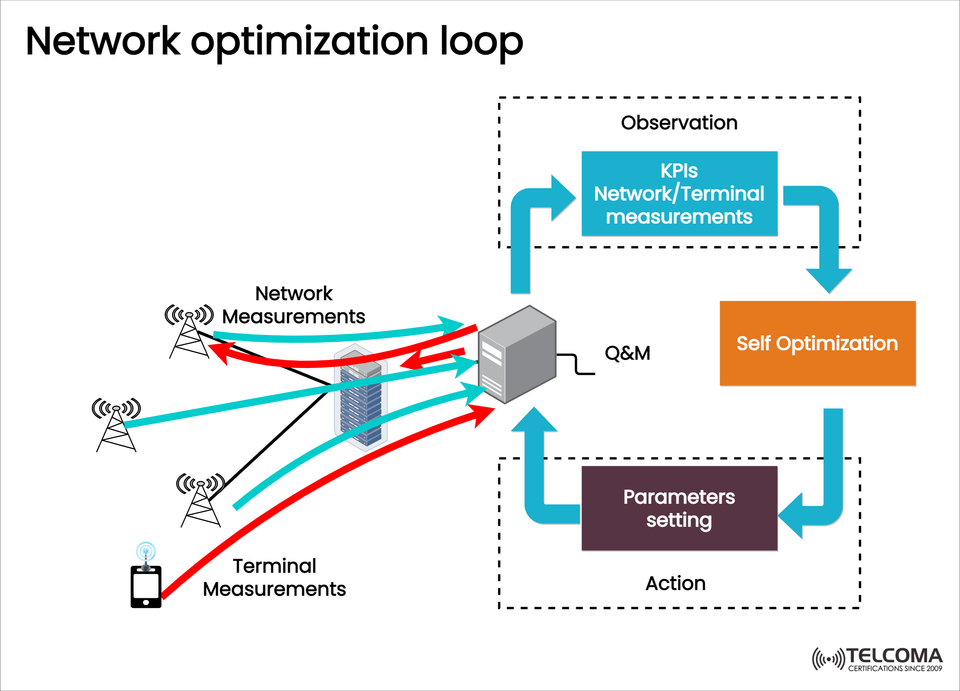
This is where the network optimization loop comes into play — it’s a closed-loop system that combines observation, self-optimization, and action. By constantly collecting data, analyzing KPIs, and applying automated settings, these networks start to self-optimize, adjusting to the real-world conditions on their own.
The diagram we’ve uploaded shows this concept clearly, highlighting the connections between network/terminal measurements, KPIs, and the self-optimization cycle. In this blog, we’ll dive into each part of the loop, discuss its advantages, and talk about how it’s shaping the future of intelligent telecom operations.
Understanding the Network Optimization Loop
At the heart of the network optimization loop is a feedback system that keeps an eye on network conditions, makes smart decisions, and takes corrective measures.
We can break this process down into three key stages:
Observation
Collecting KPIs (Key Performance Indicators) and measurements from both the network and the terminals.
This includes metrics like throughput, latency, handover success rates, coverage quality, and error rates.
Self-Optimization
Utilizing algorithms and AI analytics to interpret the KPIs.
Automatically pinpointing bottlenecks and performance issues.
Action
Making optimized parameter adjustments to the network.
Ensuring real-time changes to enhance service quality.
This loop keeps running, allowing the network to adapt to new challenges in a dynamic way.
Key Components in the Loop
Terminal Measurements
User devices (UEs) are constantly sending feedback to the network, which includes:
Signal strength (RSRP, RSRQ, SINR).
Handover measurements.
Latency and jitter metrics.
Application-specific QoS reports (like for video streaming or gaming).
These readings help networks gauge the end-user experience (QoE) in real time.
Network Measurements
Base stations and core elements of the network collect data on:
Cell load and congestion levels.
Packet loss rates.
Handover failures.
Spectrum use.
This data helps operators manage resource allocation and capacity planning effectively.
KPIs and Observation
The Q&M (Quality & Management) system compiles all terminal and network measurements to generate KPIs such as:
Call Drop Rate (CDR)
Handover Success Rate (HSR)
Average User Throughput
Latency and Packet Delay Variation
Coverage and Capacity KPIs
These KPIs become the bedrock for making informed decisions.
Self-Optimization
With the help of AI, ML, and SON (Self-Organizing Network) technologies, the system takes action like:
Balancing loads between cells.
Optimizing handovers to minimize drops.
Enhancing coverage by tweaking antenna angles or power.
Managing interference for better spectral efficiency.
Action: Parameter Setting
After determining the best optimization strategies, parameter changes are implemented across the network. Examples include:
Adjusting handover thresholds.
Modifying transmit power levels.
Dynamically reallocating spectrum.
Fine-tuning QoS profiles for priority services.
Why the Optimization Loop Matters in 5G
With 5G networks, this optimization loop becomes even more vital because of:
Network Slicing: Different slices (like eMBB, URLLC, mMTC) need personalized optimization.
Ultra-Low Latency: Real-time self-optimizing reduces delays in critical services.
Massive IoT Connectivity: Billions of devices lead to a wide range of traffic patterns.
Heterogeneous Networks: The mix of 4G, 5G, Wi-Fi, and private networks adds to the complexity.
Without these automated loops, it would be impossible to optimize these networks manually.
Example: Optimization Use Cases
Here are a few real-world scenarios where the loop shows its benefits:
Urban Congestion: Packed areas face cell overload, and optimization helps spread out traffic across adjacent cells.
Rural Coverage Gaps: Fine-tuning parameters boosts coverage by increasing signal strength in low-density areas.
Handover Failures: Self-optimization smooths out the mobile experience between 4G and 5G layers.
Energy Efficiency: AI-driven loops adjust power usage dynamically, lowering costs.
QoE for Streaming: Video buffering is reduced by reallocating resources as needed.
Closed-Loop Automation in SON
The idea shown in the diagram fits perfectly with Self-Organizing Networks (SON) in telecom:
Self-Configuration: Automatically setting up new cells.
Self-Optimization: Ongoing performance tuning.
Self-Healing: Automatically detecting and fixing failures.
The network optimization loop is the driving force behind SON, facilitating intelligent, autonomous operations.
Benefits of Network Optimization Loop
✅ Enhanced QoE: Users enjoy better connections, fewer drops, and faster speeds.
✅ Operational Efficiency: Automation cuts down on manual tasks and OPEX.
✅ Scalability: Supports countless connected devices in 5G and IoT environments.
✅ Real-Time Adaptability: Networks can instantly respond to changing conditions.
✅ Energy Savings: Dynamic power management reduces the carbon footprint.
Comparison: Manual vs Automated Optimization
Feature Manual Optimization Network Optimization Loop Speed Slow, reactive Real-time, proactive Scalability Limited Highly scalable Accuracy Prone to human error Data-driven, precise Cost High OPEX Reduced OPEX Adaptability Static Dynamic & adaptive
This comparison underlines why the transition to closed-loop automation is crucial in today’s networks.
Future of Optimization: AI and Machine Learning
The next phase of the optimization loop will harness AI and ML-driven analytics:
Predictive Optimization: Anticipating congestion before it strikes.
Context-Aware Tuning: Customizing performance based on user preferences, locations, or applications.
Anomaly Detection: Spotting network problems before they impact service.
Autonomous Networks (AN): Fully self-managing networks with limited human intervention.
As operators gear up for 6G, the optimization loop will integrate AI-native architectures, making networks completely self-learning.
Conclusion
The network optimization loop is fundamental to modern telecom operations. By leveraging terminal and network measurements, turning them into actionable KPIs, and employing self-optimization through parameter tuning, telecom networks can achieve:
A seamless user experience
Effective resource utilization
Lower operational costs
Preparedness for 5G and beyond
For telecom experts, getting to grips with and applying these loops is essential for staying competitive. As networks become increasingly complex, the self-optimizing, closed-loop method will shape the future of telecom automation and performance excellence.