
Network Slice Support in 5GS | 5G Network Slicing Explained

Moving from 4G LTE to 5G isn’t just about getting faster speeds; it’s about reshaping networks into customized service platforms. A key innovation driving this change is network slicing.
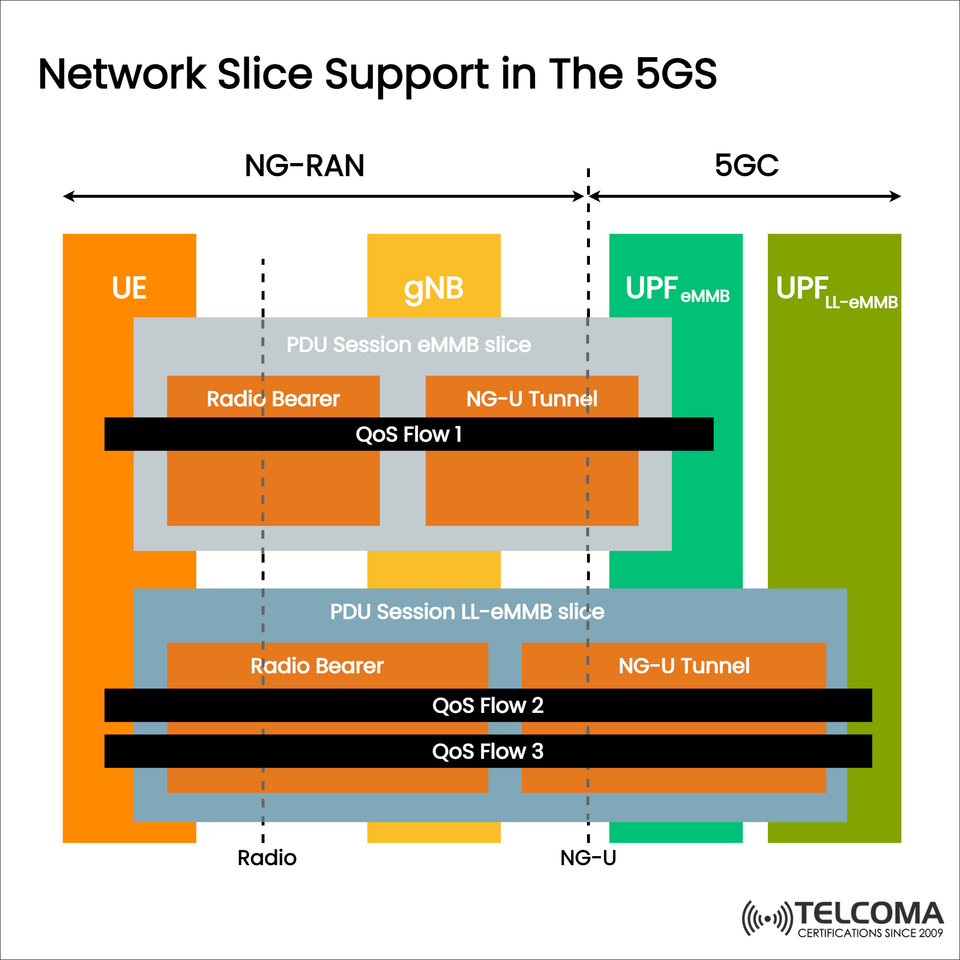
The diagram titled “Network Slice Support in the 5GS” illustrates how User Equipment (UE), Next Generation Radio Access Network (NG-RAN), and the 5G Core (5GC) work together to provide support for multiple PDU sessions, QoS flows, and slice-specific UPFs.
In this blog, we’ll take a closer look at the image, breaking it down step by step, explaining the architecture, pointing out the benefits, and showcasing how network slicing is facilitating various use cases across different industries.
What is Network Slicing in 5G?
Network slicing allows a single physical 5G network to be divided into several logical networks (slices), each tailored for specific services or industry needs.
For instance:
eMBB Slice (Enhanced Mobile Broadband): Provides high bandwidth suitable for video streaming and VR.
URLLC Slice (Ultra-Reliable Low-Latency Communication): Delivers extremely low latency for things like autonomous driving and industrial automation.
mMTC Slice (Massive Machine-Type Communication): Designed to be scalable and energy-efficient for IoT devices.
This lets telecom operators offer various services over one physical infrastructure, ensuring that each slice meets its performance guarantees.
Breaking Down the Diagram: Network Slice Support in 5GS
The image shows how UE, gNB, and 5GC components interact for slicing support. Let’s unpack each section.
- User Equipment (UE)
This includes devices like smartphones, IoT gadgets, or connected vehicles that start multiple PDU sessions.
Each PDU session can connect to a different slice.
- NG-RAN (gNB)
The Next-Generation NodeB (5G base station) links UEs to the 5G Core.
It manages Radio Bearers, which carry QoS flows from the UE to the Core.
- PDU Sessions
A PDU (Protocol Data Unit) session forms the logical connection between the UE and the data network.
Every session is tied to a specific slice.
In the image: * eMBB Slice PDU Session → designed for standard broadband services. * LL-eMBB Slice PDU Session → optimized for low-latency broadband services.
- QoS Flows
Illustrated by black lines (QoS Flow 1, 2, 3) in the diagram.
These define the required service levels (throughput, latency, reliability).
Examples include: * QoS Flow 1: For video streaming. * QoS Flow 2: For cloud-based gaming. * QoS Flow 3: For mission-critical applications.
- NG-U Tunnel
This tunnel connects the RAN to the 5GC’s UPF.
It makes sure that each QoS flow is handled in its own slice tunnel.
- User Plane Function (UPF)
This is where user plane traffic is managed within the 5GC.
Each UPF is specific to its slice: * UPF (eMBB) → for broadband traffic. * UPF (LL-eMBB) → for low-latency traffic.
This setup guarantees that each slice runs independently, providing both security and assured QoS.
Mapping Entities in 5GS
Here’s how the components in the diagram work together:
Layer Entity Function
UE Device Generates multiple types of traffic.
Radio (RAN) gNB, Radio Bearer Maps QoS flows onto bearers.
Transport (NG-U Tunnel) Tunnel Carries slice-specific flows.
5GC UPF Anchors traffic into the designated slice.
Example: A Single UE with Multi-Slice Support
Picture a smartphone on a 5G connection:
Video Streaming (eMBB Slice): Uses QoS Flow 1 → Radio Bearer → UPF (eMBB).
Cloud Gaming (LL-eMBB Slice): Uses QoS Flow 2 → Radio Bearer → UPF (LL-eMBB).
IoT Messaging App (LL-eMBB Slice): Uses QoS Flow 3 → Radio Bearer → UPF (LL-eMBB).
This guarantees that each service receives the right network conditions without overlaps.
Benefits of Network Slice Support in 5GS
- Service Customization
Tailored networks for various sectors: healthcare, automotive, manufacturing, etc.
- Guaranteed QoS
Each QoS flow comes with its own set of parameters for latency, throughput, and reliability.
- Resource Optimization
Shared infrastructure enables multiple virtual networks.
- Security & Isolation
Each slice keeps interference from others at bay.
- Multi-Service Capability
A single UE can run multiple services at the same time, all performing optimally.
Use Cases of Network Slice Support
- eMBB (Enhanced Mobile Broadband)
Perfect for 4K/8K video streaming and AR/VR applications.
Needs high data rates and extensive coverage.
- LL-eMBB (Low-Latency Broadband)
Best for cloud gaming and real-time interactive apps.
Requires latency under 10ms.
- URLLC (Ultra-Reliable Low-Latency Communication)
Essential for autonomous vehicles and industrial automation.
Demands <1ms latency with 99.999% reliability.
- mMTC (Massive IoT)
Supports smart cities, logistics, and connected sensors.
Offers high scalability while consuming minimal energy.
4G vs 5G: How Slicing Changes the Game
Feature4G (LTE)5G (5GS)Network Design One-size-fits-all EPC Flexible 5GC with slicing QoS Handling Bearer-based Fine-grained QoS flows Service Isolation Minimal Full isolation via slices Supported Use Cases Broadband only IoT, URLLC, eMBB, enterprise verticalsLatency30–50ms<1ms possible
Challenges in Deploying Network Slicing
Complex Orchestration: Requires automation via NFV, SDN, and ONAP.
Resource Conflicts: Slices need to be isolated to maintain performance levels.
Security: Must ensure that if one slice is attacked, others remain unaffected.
Standardization: Global frameworks are being worked on by 3GPP and GSMA.
Future of Network Slicing in 5G & Beyond
As we look ahead to 6G, network slicing will continue to evolve with:
AI-powered orchestration for managing slices in real-time.
Dynamic on-the-fly slices for emergencies or special events.
Cross-operator collaboration to ensure global slice continuity.
This positions slicing not merely as a 5G feature, but as the bedrock of future connectivity.
Conclusion
The Network Slice Support in the 5GS diagram illustrates how elements like QoS flows, PDU sessions, NG-U tunnels, and UPFs work together to provide customized, isolated, and reliable services.
For telecom operators, this opens up new revenue opportunities by providing tailored slices for businesses and industries. For end-users, it ensures optimized experiences, whether they’re streaming videos, gaming, or running autonomous systems.
In the end, network slicing doesn't just enhance 5G; it redefines it as a platform for innovation, delivering not only speed but also service intelligence and adaptability.