
Network Slicing Architecture in 5G: A Zoom-In on Layers, Functions, and Management
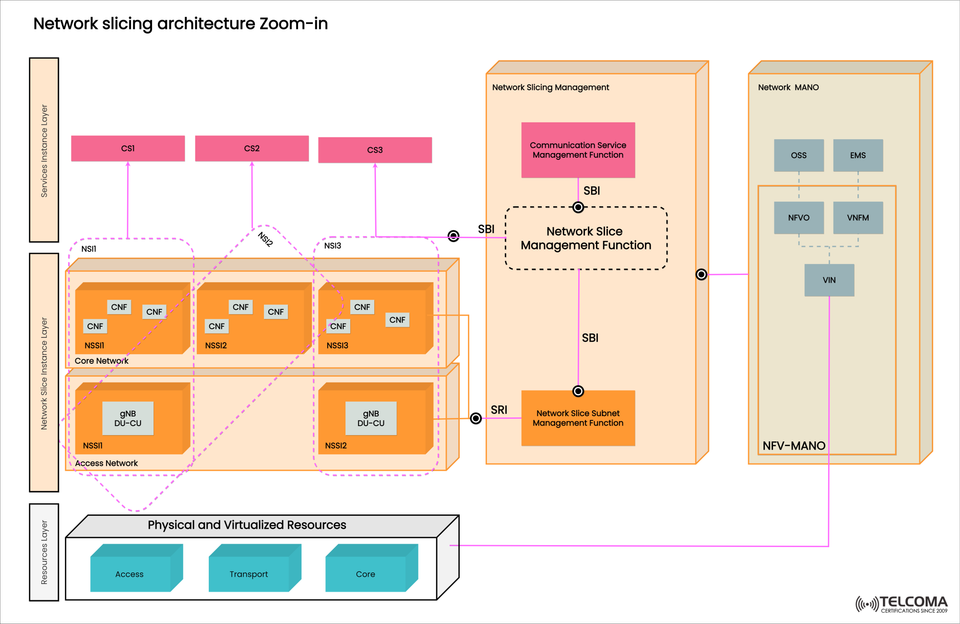

🧠 5G Slicing Architecture Zoom In:
A Telecom Professionals Technical View
Network slicing is a key element of 5G architecture that allows multiple logical networks to share physical infrastructure and operate in some cases on separate physical infrastructure for particular service requirements (e.g. eMBB, URLLC, mMTC). This blog post will take a technical view (zoom-in) on the 5G network slicing platform based on the shown zoom-in diagram and break it down by orchestration, layer, slice instances, and virtualization.
🧱 Layers in Slicing Architecture
The slicing architecture can be separated into four key layers.
Layer Definition
Services Instance Layer High-level services (CS1, CS2, CS3) that require network slices.
Network Slice Instance Layer The complete NSI (network slice instances) made up of one or more NSSI (subnets).
Resources Layer The physical and virtual infrastructure that physically or virtually underpins the services. Areas of Access, Transport, and Core.
NFV-MANO Management and orchestration layer, VNF and resource management.
🧩 Network Slice Instance Layer: Creating the Logical Network
Each Network Slice Instance (NSI) is made up of a few things:
Core Network Subnet (CNF): Cloud-Native Functions. The packet core element.
Access Network Subnet (gNB DU-CU): Distributed Unit (DU) and Centralized Unit (CU) of the gNB that provides radio access.
An example:
NSI1 consists of NSSI1 (Access) and NSSI1 (Core).
NSI2 consists of NSSI2 (Access + Core).
⚙️ Network Slicing Management Functions
- Network Slice Management Function (NSMF)
The NSMF is considered as the main orchestrator of any NSI:
It interfaces with the Communication Service Management Function (CSMF).
The NSMF oversees the lifecycle of the NSIs and their related policies.
It works with the NSSF (Network Slice Selection Function) to allocate the NSIs.
- Network Slice Subnet Management Function (NSSMF)
The NSSMF is responsible for managing subnet-related elements:
It handles subsets separately from the NSMF’s overall function (i.e. subnets for Access and Core Networks).
The NSSMF interfaces with the NSMF through the SBI (Service-Based Interface).
Their direct relationship allows for resource access to be managed closely, allowing for greater de-coupling of the access and core resources for more granular slicing.
📦 Integration with NFV-MANO
NFV-MANO (Management and Orchestration) is crucial to network function virtualization:
Component Role
NFVO Manages orchestration of virtual resource allocation
VNFM Manages lifecycle of the VNFs (Virtual Network Functions).
VIN Virtual infrastructure Node; the element in NFV enabling resource abstraction
OSS/EMS Downstream support systems managing monitoring, control and support of network operations.
This layer helps to ensure that the NSIs are not just logically/symbolically defined, but also deployed dynamically on virtualized resources across platforms.
🧱 Resources Layer: Physical & Virtual Infrastructure
The last layer is bottom-up, i.e.:
Access Network Resources: Physical elements such as base- stations, DU/CU nodes.
Transport OperResources: Routers, switches, fronthaul/midhaul/backhaul links.
Core Resources: Servers, data centers hosting cloud-native network functions.
Some of the resources are shared, promoting greater slicing without duplicating physical elements across Access/Transport/Core Infrastructure.
🚀 5G Network Slicing Practical Applications
5G limit slicing is not just academia or research pulling things together to tackle modern day challenges; it is being dealt with as a production scenario for real world ideas. Carson (2021) shares elementary use cases, where dedicated network slices provide individual performance:
📱 Enhanced Mobile Broadband (eMBB)
High throughput with massive capacity needs for applications that support either HD video, 4K or even 8K video streams, Virtual or Augmented Reality applications.
Slice Characteristics: High bandwidth with moderate latency.
⚙️ Ultra-Reliable Low-Latency Communications (URLLC)
All mission critical services that include autonomous vehicles and remote surgeries.
Slice Characteristics: ultra-low latency with high availability and strong isolation.
🌐 Massive Machine-Type Communications (mMTC)
Government smart city applications to support IoT sensors, sensor readings, and utility metering.
Slice Characteristics: High connection density with low bandwidth and energy efficiency.
Each of these applications still use separate NSI's, which also gives isolation, and tailored SLA enforcement and separation of resources.
🧠 Intelligent Slice Lifecycle Management
Slice lifecycle includes:
Stage Description
Instantiation (the slice) is created based on service request (through NSMF/CSMF)
Configuration Network Policy and VNFS are configured.
Activation Resources are assigned and the slice is active
Monitoring Ongoing discovery for KPI and SLA through OSS/BSS.
Termination The slice is no longer needed, resources freed.
This dynamic lifecycle management process will simple occur through the NSMF–NSSMF–NFV-MANO, newly providing and automating intent based orchestrating.
📌 Main Advantages of the 5G Network Slicing
Benefit Description
Multi-tenancy Offers a variety of services and industries on a common infrastructure.
Security Isolation No possibility of data leakage or threats to another slice via logical isolation
SLA Enforcement Each slice is catered for the specific needs of latency, throughput, or reliable reporting
Efficient Resource Utilization Resources are allocated where required, not over or under allocated improving CAPEX/OPEX.
Rapid Time-to-Market New services can be created very quickly without as much impact on the core network
These value propositions uniquely position the possibility of network slicing with respect to the monetization of the 5G infrastructure
🛠️ Challenges and Considerations with Slicing
During the implementation of the slicing platform, these don't mean that there aren't challenges to consider regarding slicing.
Inter-slice resource contention: You'll need slice aware scheduling and orchestration which will be done dynamically.
Slice SLA Monitoring: This will need to have integration with real time analytics and capabilities for closed loop automation consideration.
Standardisation: You'll need to navigate and coordinate across 3GPP, ETSI NFV, and even vendor ecosystems.
🧭 The Future: AI-enabled and Autonomous Slicing
As we are now actively talking about and creating 5G use cases, advancements from 5G to 6G will follow the development of smarter networks with automated slicing potentially be the norm defining:
📝 Conclusion
5G network slicing is a disruptive capability that transforms a single physical network into a framework for delivering bespoke, SLA-based services. By zooming down into its architecture - from the NSI/NSSI constructs to management via the NSMF/NSSMF and NFV-MANO - we can see how the Operators can:
Achieve service differentiation
Mitigate operational complexity
Maximize infrastructure return
Deliver mission-critical use cases accurately