
Network Slicing for eMBB and uRLLC Applications in 5G Explained

Understanding Network Slicing for eMBB and uRLLC in 5G
The 5th generation of mobile networks (5G) isn't just about faster data; it’s also about offering more flexibility. One major feature of 5G is network slicing, which means operators can create various virtual networks on a single physical setup. Each of these slices can be customized for different service needs, like enhanced Mobile Broadband (eMBB) or ultra-Reliable Low Latency Communications (uRLLC).
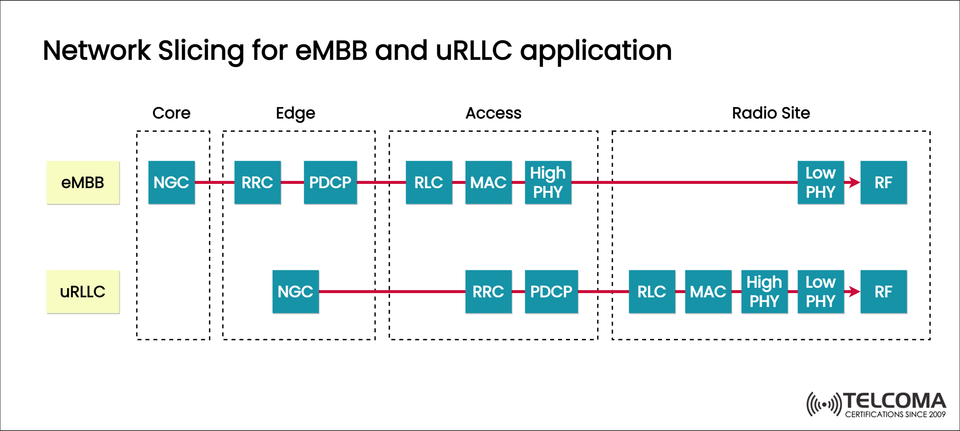
The diagram we’ve shared shows how network slicing moves through the different parts of the 5G architecture—specifically the Core, Edge, Access, and Radio Site layers—and it points out the differences in resource allocation between eMBB and uRLLC.
This blog post will take a detailed look at what the diagram conveys, what each component does, and why network slicing is such a big deal for telecom networks.
What is Network Slicing in 5G?
Network slicing is a virtualization approach in 5G that enables the creation of dedicated logical networks on top of a shared physical network. Each slice is kept separate and optimized for specific service demands.
eMBB Slice: Designed for high data rates to support things like 4K/8K video, VR/AR, and cloud gaming.
uRLLC Slice: Focuses on achieving ultra-low latency and high reliability, which is crucial for self-driving cars, remote surgeries, and industrial automation.
By dividing the traffic into these slices, operators can offer various services at the same time without any interference.
Key Components in the Diagram
The diagram details how both eMBB and uRLLC slices function across different levels:
- Core Layer (NGC)
NGC (Next-Generation Core): Responsible for separating control and user planes, orchestrating slices, and ensuring end-to-end connectivity.
For both eMBB and uRLLC, the NGC kicks off slice allocation and signaling.
- Edge Layer
RRC (Radio Resource Control): Manages connection setups, handovers, and quality of service parameters.
PDCP (Packet Data Convergence Protocol): Takes care of header compression, encryption, and reordering.
Edge processing helps keep latency low and manages traffic effectively close to users.
- Access Layer
RLC (Radio Link Control): Ensures error correction and in-order delivery.
MAC (Medium Access Control): Dynamically allocates radio resources.
High PHY (Physical Layer – Upper Functions): Handles data encoding and decoding for better transmission.
- Radio Site
Low PHY: Deals with modulation, coding, and the actual transmission of signals.
RF (Radio Frequency): Sends data over the air to devices.
How eMBB Network Slice Works
For eMBB, the slice is all about delivering high throughput, tolerating a bit more latency compared to uRLLC.
End-to-End Flow: NGC → RRC → PDCP → RLC → MAC → High PHY → Low PHY → RF
The complete protocol stack guarantees strong error correction, high data capacity, and reliable delivery.
Best suited for: * Video streaming (4K/8K) * Cloud VR/AR * Mobile broadband in crowded urban settings
How uRLLC Network Slice Works
For uRLLC, the emphasis is on achieving ultra-low latency (≤1 ms) and a reliability rate (≥99.999%). The flow is optimized to keep delays to a minimum.
End-to-End Flow: NGC → RRC → PDCP → RLC → MAC → High PHY → Low PHY → RF
Unlike eMBB, this processing path is streamlined to cut down on delays, often leveraging edge computing for faster response times.
Crucial for: * Self-driving vehicles (V2X communication) * Remote surgery and telesurgery robotics * Industrial automation and critical IoT applications
Comparing eMBB and uRLLC Network Slices
Feature eMBB Slice uRLLC Slice Objective High throughput Ultra-low latency & reliability Latency Acceptable ~10-20 ms Target <1 ms Reliability Moderate Extremely high (99.999%)Use Cases Video streaming, AR/VR, cloud apps Self-driving cars, remote surgeries, smart factories Flow Path Full protocol stack Optimized, latency-reduced path Edge Processing Optional Mandatory for latency reduction
Why Network Slicing Matters
Network slicing is essential because 5G needs to cater to a varied ecosystem:
A single 5G network has to support a wide range of services, from high-volume consumer broadband to enterprise needs and critical IoT applications all at once.
Without slicing, every service would compete for the same resources, which might lead to quality of service issues.
With slicing, resources are compartmentalized, ensuring that Service Level Agreements (SLAs) are satisfied for each individual application.
Challenges in Implementing Network Slicing
Even though it's promising, network slicing does come with its challenges:
Complexity in Orchestration * Needs AI-based automation for real-time slice management and scaling.
Interoperability * Ensuring that slices function properly across different vendors’ equipment and within hybrid cloud setups.
Security * Each slice has to stay isolated to avoid cross-slice attacks or data breaches.
Quality of Service Assurance * Ongoing monitoring is vital to keep those SLA guarantees intact.
Future Outlook
As 5G progresses toward 5G-Advanced (Rel-18 and further), network slicing will evolve to be more:
Dynamic: Real-time slice adjustments based on demand (think event venues).
AI-driven: Automated management for predictive scaling.
Monetizable: Operators will be able to provide slice-based services to businesses (like a specific uRLLC slice for a hospital).
Converged: Working alongside F5G (Fixed 5G) optical slicing to facilitate end-to-end services.
Conclusion
The diagram shows how eMBB and uRLLC slices move through the core, edge, access, and radio site layers of 5G. While eMBB is all about speed and capacity, uRLLC focuses on mission-critical reliability and ultra-low latency.
For those in the telecom industry, network slicing isn’t just a catchy term; it’s the foundation for service differentiation in 5G. By really grasping how slices like eMBB and uRLLC function, operators can build networks that are not only efficient and scalable, but also flexible enough to tackle the diverse needs of our digital future.