
Networking and Digital Twins: Bridging the Physical and Digital Worlds in Telecom

Networking and Digital Twins
Connecting the Physical and Digital Realms in Telecom As the telecommunications sector pushes forward into the realm of 5G, 6G, and future advancements, managing complex and widespread network infrastructures is becoming increasingly challenging. To tackle this, telecom operators are increasingly adopting Digital Twin technology, which essentially creates real-time virtual replicas of physical networks. This blend of networking and digital twinning is transforming how we approach network design and maintenance, while also opening doors to new avenues for automation, optimization, and predictive insights.
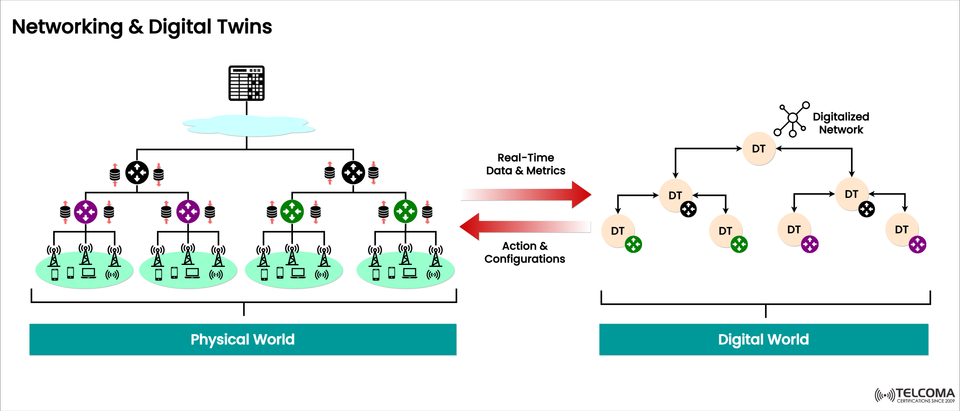
The diagram above illustrates this shift, depicting the seamless interaction between the Physical World of networks and the Digital World of digital twins, powered by real-time data exchange and smart control mechanisms.
Understanding the Physical and Digital Worlds At its foundation, the image represents two interconnected domains:
- The Physical World (Network Infrastructure) On the left side, the Physical World encompasses the tangible aspects of telecommunications infrastructure:
Core Network – This includes major data centers and centralized routing systems.
Transport Network – Backbone routers and servers that ensure smooth data flow across regions.
Access Network & Terminals – Base stations, antennas, and end-user devices such as smartphones, IoT sensors, and laptops.
Every layer plays a role in data transmission and overall network performance. These systems are constantly producing real-time operational data like bandwidth usage, latency, packet loss, and equipment health.
How the Two Worlds Communicate
The center of the image highlights the two-way communication bridge between the Physical and Digital Worlds:
Real-Time Data & Metrics (→) Physical devices regularly send operational data—like throughput, power usage, and traffic patterns—to their digital counterparts. This ensures that the Digital Twins are updated in real time, reflecting current network conditions accurately.
Action & Configurations (←) Based on insights from simulations or AI analytics, the digital environment can relay configuration commands back to the physical network. For instance, a Digital Twin might predict network congestion and automatically change routing paths or allocate more bandwidth.
This closed-loop system guarantees constant synchronization, facilitating predictive and adaptive network behavior.
Why Digital Twins Are Important in Telecom Digital Twins provide significant advantages in the areas of network design, deployment, and operation. Let’s break down the benefits:
Real-Time Network Monitoring
Offers a live, comprehensive view of the entire network system.
Identifies anomalies and potential failures ahead of time to prevent service disruptions.
Displays performance metrics across various network layers, from core to access points.
Predictive Maintenance
By analyzing real-time data and past trends, DTs can predict equipment wear and failures.
This proactive maintenance strategy minimizes downtime and boosts service reliability.
Intelligent Network Optimization
AI algorithms embedded in digital twins can dynamically adjust network settings for peak performance.
For example, load balancing, power optimization, and latency reduction can be fine-tuned automatically.
Accelerated Innovation and Testing
New network setups, technologies, or services can be tested in a virtual setting before rolling them out into the real world.
This approach lowers risks, cuts down deployment costs, and speeds up time-to-market for telecom innovations.
Enhanced Customer Experience
Digital Twins enable operators to predict and address Quality of Service (QoS) issues promptly.
This ensures reliable connectivity, enhancing the overall Quality of Experience (QoE) for users.
Key Elements of a Telecom Digital Twin Framework Component Function Examples
Physical Network Entities Real infrastructure components offering live data Routers, base stations, antennas, IoT devices
Data Acquisition Layer Gathers telemetry data from the physical network Sensors, monitoring agents
Communication Interface Links physical and digital layers APIs, IoT gateways, 5G network slices
Digital Twin Models Virtual copies of physical elements Network topology models, traffic simulators
Analytics & AI Layer Processes data to extract insights and enable automation Machine learning models, predictive algorithms
Control & Feedback System Sends optimized settings to the network SDN controllers, orchestration tools
Digital Twins and 5G/6G Development As 5G networks continue to grow and 6G research gains momentum, Digital Twins are becoming essential to the telecom landscape.
Here’s how:
In 5G, DTs assist operators in real-time monitoring of dynamic network slices and virtual infrastructure.
In 6G, they will be pivotal in creating self-optimizing, AI-powered networks that adjust instantaneously to shifts in demand and environment.
DTs will also facilitate network-as-a-service (NaaS) and autonomous network management, paving the way for smarter, energy-efficient, and sustainable connectivity.
Applications Beyond Network Management Digital Twins in telecom reach far beyond just operations:
Smart Cities: Real-time digital replicas of urban networks aid in managing traffic, public safety, and environmental sensors.
Industrial IoT: Factories utilize DTs for connected machines, predictive maintenance, and autonomous control.
Healthcare & Remote Services: DTs ensure dependable, low-latency networks for telemedicine and augmented reality applications.
This broad applicability highlights telecom networks as the digital backbone of our connected world.
Challenges and Considerations
Even though Digital Twin technology is promising, successful implementation comes with some challenges:
Data Integration: Aligning various data sources across networks from multiple vendors.
Scalability: Handling millions of digital entities as networks expand.
Security & Privacy: Safeguarding sensitive network and user data during digital simulations.
Standardization: Establishing common frameworks and APIs for seamless integration.
Ongoing collaboration among 3GPP, ETSI, and major telecom players is focused on overcoming these hurdles and setting robust DT standards for 6G.
Conclusion:
The Future is Digital and Connected The merging of Networking and Digital Twins is a key moment in the evolution of telecom. By connecting the physical and digital worlds, operators can reach new levels of visibility, automation, and efficiency.
From real-time monitoring to AI-driven optimization, Digital Twins stand at the cutting edge of smart network management—paving the way for fully autonomous, self-healing networks that will define the 6G era and beyond.
For telecom professionals and innovators embracing this shift, it’s clear that Digital Twins aren’t just a tech trend—they’re the pathway to the future of connectivity.