
NFV Architecture Explained: Components, Functions, and Telecom Applications
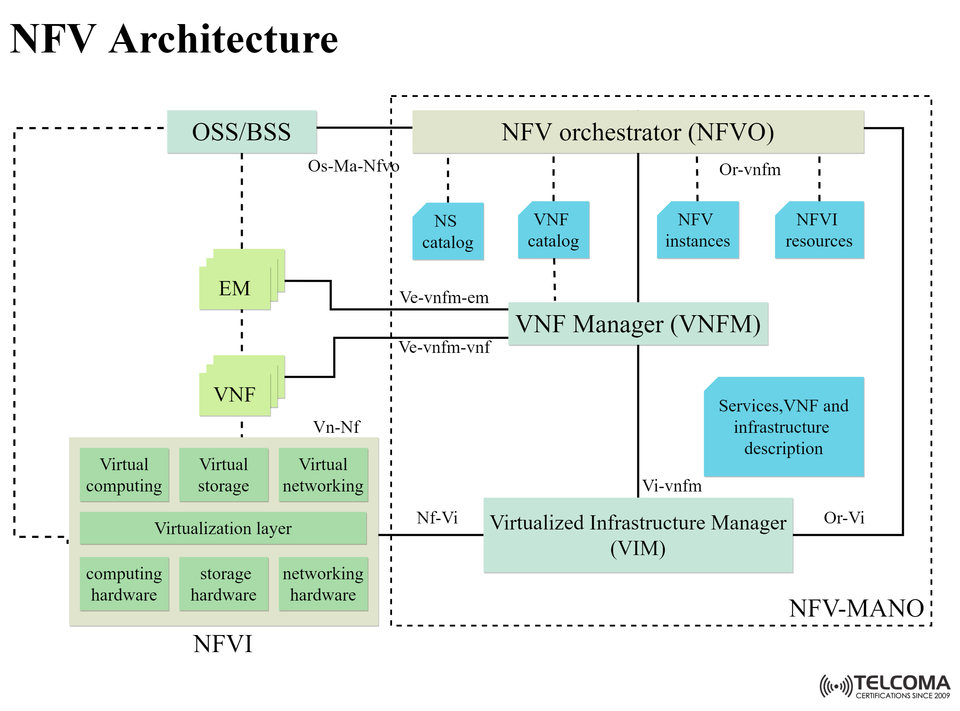

NFV Architecture: Enabling Telecom Virtualization
Network Functions Virtualization (NFV) is considered one of the most disruptive changes to a telecom infrastructure. It replaces dedicated hardware with software-based virtual network functions (VNFs) using commercial off-the-shelf (COTS) hardware. The ETSI NFV architecture organizes the implementation of,
- Deploying
- Managing
- Orchestrating NFV.
Your uploaded diagram illustrates three fundamental NFV domains:
- NFV Infrastructure (NFVI)
- Virtualized Network Functions (VNF) and Element Management (EM)
- NFV Management and Orchestration (NFV-MANO)
- NFV Infrastructure (NFVI)
The NFVI provides the foundation for NFV deployments, providing the compute, storage, and network resources needed to run VNFs.
Layers:
- Physical Resources: Physical computing hardware, physical storage hardware, and physical networking hardware.
- Virtualization Layer: The layer that abstracts the physical hardware and allows for pooling and allocating resources.
- Virtual Resources: The defined instances of virtual computing, virtual storage, and virtual networking.
Key Benefit: The core benefit is that it decouples the hardware from the software and allows accelerated scaling and hardware independence.
2. Virtualized Network Functions (VNF) and Element Management (EM) VNF:
- Function deployments of specific network function implementations (e.g., firewall, EPC, IMS).
- VNF instances run on the virtual resources provided by the NFVI.
Element Manager (EM). - FCAPS (Fault, Configuration, Accounting, Performance, Security) use case for the VNFs.
- Interacts with NFV-MANO components for lifecycle management of a given VNF.
- NFV Management and Orchestration (NFV-MANO)
NFV-MANO is the center of control and coordination for a portion of NFV deployment operations. It consists of service orchestration, resource management, and service lifecycle management. The NFV-MANO components are:
a) NFV orchestrator (NFVO)
The NFVO is responsible for orchestrating the service network, as well as management of resources across different VNFs.
As part of the service lifecycle management, the NFVO will manage the following catalogs:
Network Service catalog – templates to construct Network Services.
VNF catalog – descriptors and deployment information, and deployment information for VNFs.
The NFVO is also required to have interfaces with operational support systems (OSS) and business support systems (BSS) to ensure business/operations context.
b) VNF manager (VNFM)
The VNFM manages the lifecycle of the VNF only. This includes instantiation of the VNF, scaling, updating, and terminating the VNF.
The VNFM will have an interface with each EM for specific VNF configurations.
c) Virtualized Infrastructure Manager (VIM)
The VIM is responsible for controlling and managing the infrastructure resources of the NFVI. This could include IT resources (compute, storage, networking) that make up the NFVI.
The VIM manages all infrastructure resources of the NFVI as an inventory and exposes interfaces to provide concrete resource allocations to the VNFM and NFVO to deploy NFs.
4. NFV-MANO Interfaces and Data Flows
The NFV-MANO architecture provides specified interfaces so the devices/systems can interact and interoperate:
Os-Ma-Nfvo – OSS/BSS ↔ NFVO data communication
Or-Vnfm - NFVO ↔ VNFM service coordination
Vi-Vnfm - VNFM ↔ VIM resource requests
Nf-Vi - NFVI ↔ Virtualization layer
These interfaces will ensure multi-vendor compatibility, as well as modular deployment options.
Benefits of NFV to Telecom Networks
CAPEX/OPEX Reduction - Reduces dependence on proprietary hardware.
Agility - Will allow quick deployment of network services.
Scalability - Dynamically scale based on traffic based signalling patterns.
Automation - Support closed-loop orchestration to perform self-healing networks.
Vendor Flexibility - Support vendor ecosystems by providing standard interfaces.
Table – NFV-MANO Component Roles
Component Main Role Key Interfaces
NFVO Service orchestration, catalog management Os-Ma-Nfvo, Or-Vnfm
VNFM VNF lifecycle management Ve-vnfm-em, Ve-vnfm-vnf
VIM Resource allocation and control Vi-vnfm, Nf-Vi
Conclusion
The NFV architecture improves upon earlier telecommunications hardware dependency by removing several one-to-one hardware constraints and moving to a software-defined structure. Network service needs are able to be delivered quickly, flexibility in network service delivery and operational needs are enhanced, and there is better integration with information technology (IT) and decreased operational overhead. NFV as the underpinning of next-generation network service delivery directly addresses and meets increasingly dynamic 5G and Internet of Things (IoT) business requirements.
From 4G to 5G: the Role of Network Evolution, NFV Architecture, and KPI Considerations
- Introduction
The shift from 4G LTE to 5G is much more than a radio technology change; it is the result of a complete upheaval of the telecommunications ecosystem. With the introduction of such new architectural principles as Network Functions Virtualization (NFV), Software-Defined Networking (SDN), and cloud-native design, the industry needs to balance expectations. There are drivers of expectation which include:
↑ ultra-low latency demands for autonomous capability.
↑ massive IoT connectivity requirements.
↑ enhanced broadband experiences for augmented and virtual reality (AR/VR) and streaming.
As telecommunications networks evolve toward cloud-native architectures using containerized network functions (CNFs), the architectural principles of NFV architecture will be as equally important as the operators transition from the current virtualized solutions to all software defined networks.
- Transition from 4G to 5G Architecture
4G was largely based on purpose-built hardware and monolithic architecture. Though virtualization existed in some areas, the Evolved Packet Core (EPC) was a hardware-based platform and there was little room in the way of scaling.
In contrast, 5G is built upon:
Service-Based Architecture (SBA) for the core.
NFV and SDN to separate the software from hardware.
Edge computing to perform some processing closer to the edge.
Key differences:
Feature 4G EPC 5G Core
Control-User Plane Separation Limited Full separation (CUPS)
Architecture Node-based Service-based
Virtualization Partial Fully virtualized / cloud-native
Latency ~50ms <1ms possible
Scalability Manual, hardware-based Automated, elastic
3. NFV Architecture for 5G networks
Overview
The NFV architecture defined by ETSI is an important aspect of 5G as it will enable network operators to deploy VNFs on shared Commercial-Off-The-Shelf (COTS) infrastructure. In theory, this should reduce costs, and increase flexibility and capabilities around network slicing.
NFV- MANO Components
NFV Orchestrator (NFVO) - Responsible for network service orchestration and manages the VNF & NS catalog.
VNF Manager (VNFM) - Responsible for VNF lifecycle management (instantiation, scaling, termination).
Virtualized Infrastructure Manager (VIM) - Responsible for managing NFVI computing, storage and networking resources.
NFVI Layers
Physical Hardware - Computing, storage, networking.
Virtualization Layer - Plays the role of abstraction and resource pooling.
Virtual Resources - Virtual computing, storage, networking.