
NFV Architecture Zoom-in: Detailed Breakdown of Layers, Functions & Interfaces

🔍 Overview of NFV Architecture
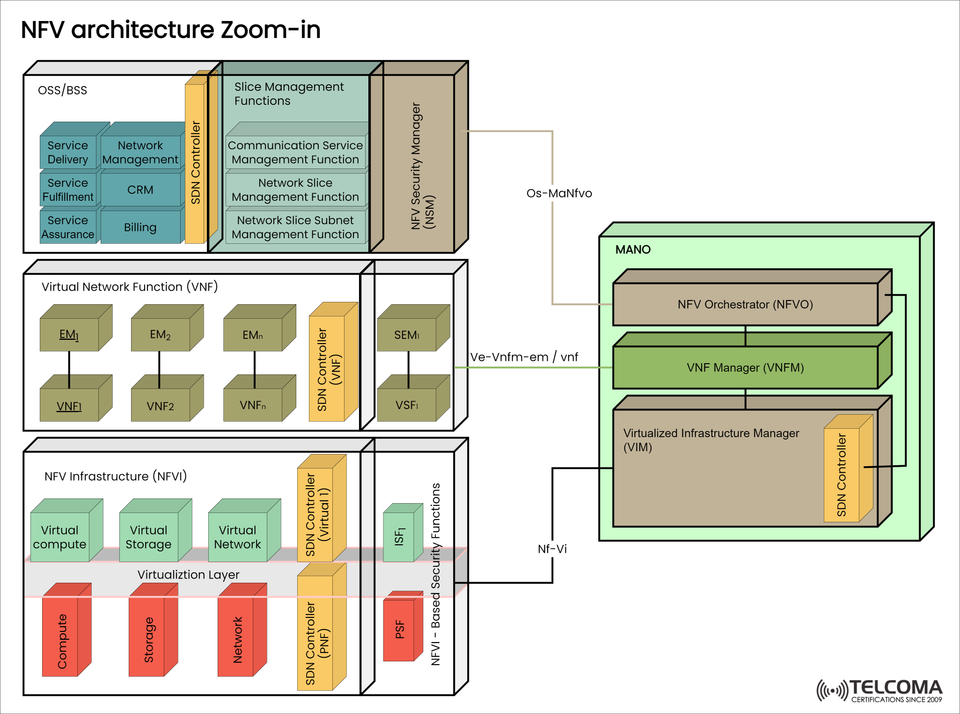
Network Functions Virtualization (NFV) is changing the telecom infrastructure landscape by replacing dedicated hardware appliances with software-based network functions that run on general-purpose hardware. The "NFV Architecture Zoom-in" image provides an overview of how these functions, layers, and orchestration systems interoperate.
NFV provides Communications Service Providers (CSPs), the ability to flexibly and cost-effectively deploy network services while reducing time to market.
🧱 Components of NFV Architecture
- Operations Support Systems / Business Support Systems (OSS/BSS)
These systems perform service delivery and fulfillment, network management, customer relationship management (CRM), and billing or assurance. They integrate with SDN Controllers as well as slice and network service management functions. - Virtual Network Functions (VNFs)
VNFs are software instances that perform traditional network functions, such as firewalls, load balancers, or EPC.
Sub-components:
EMs. Element Managers track each VNF, EM₁ to EMₙ.
SEM. Security Element Manager. VNF implementation in virtualization helps also with security aspects.
VSF. Virtualized Security Function. Mixed in that it has no real function per se, and is usable.
SDN Controller. Specific to the VNF, and used to help with programmable control at the VNF level.
- NFV Infrastructure (NFVI)
Describing all the physical and virtual resources:
Virtual Compute, Storage, Network
Virtualization Layer – Separated from physical vertical layers of Compute, Storage, and Network.
Described as including:
SDN Controllers for Virtual or Physical
ISF. Infrastructure Security Function.
- Management and Orchestration (MANO)
A major component of NFV, MANO handles end-to-end orchestration and lifecycle management.
MANO Components
Component Role
NFVO (NFV Orchestrator) Allocate resources across domains (e.g., network domain, compute domain, and user domain)
VNFM (VNF Manager) Manages the VNF lifecycle, which includes instantiating the VNF, scaling the VNF, updating VNF
VIM (Virtualized Infrastructure Manager) Manages and controls NFVI resources.
🔁 Summary - Where Does SDN Fit in NFV
SDN is vital to providing programmable control of the virtual and physical network components, as follows:
At the VNF level: Essentially the SDN provides an opportunity to change, for VNF specific network flow
In the virtual and physical drain layer in NFVI: Allows routing, switching, and QoS agility
In MANO: Provides end-to-end service orchestration of the VNF's in conjunction with NFVO and VIM
📊 NFV Architecture Layer Summary
Layer Key Elements
OSS/BSS Service Delivery , Customer Relationship Management (CRM), Billing, SDN, Slice Management
VNF Layer VNFs, Element Managers, Security VNFs, SDN Controller
NFVI Virtual Compute, Storage, Network, Security Functions, Virtualization layer
MANO NFVO, VNFM, VIM , SDN Controller.
👍 Proponents of This NFV Architecture
Flexibility in service deployment across a distributed infrastructure
Automation with integrated components of SDN and MANO
Scalability with on-demand service instantiations
Reduced CAPEX/OPEX with commodity hardware
Improved Time-to-Market for offering network services
🏁 Conclusion
The NFV architecture zoom-in illustrated how network functions, virtual resources, orchestration modules, and SDN controllers come together to achieve a scalable, flexible telecom context. The layer upon layer structure is a fundamental aspect to develop modern 5G and cloud-native networks, where agility, programmability, and automation are a necessity.
As networks are architected towards edge computing, slicing, and ultra-reliable low latency (URLLC), this architectural template will serve as the basis for next generation telecom deployments.
📌 Tags for WordPress
NFV architecture breakdown, MANO in telecom, SDN in NFV, NFV infrastructure, VNF lifecycle, telecom orchestration
🌐 Real-World Uses of NFV Architecture
Telecom operators and enterprises around the world using NFV to virtualize network services and reduce reliance on general hardware appliances. Here are some NFV strategies in play:
- 5G Network Deployment
Dynamic Network Slicing using VNFs on an unspecified number of 5G services (eMBB, URLLC, mMTC)
🚧 Concerns Regarding the Implementation of NFV Architecture
Although NFV provides clear advantages in implementation, the reality of NFV implementation provides several challenges:
Challenge Description
Interoperability Issues It will be a challenge to take VNFs from different vendors across a common NFVI or MANO stack
Performance Overheads The performance of the virtualized environment may not be as efficient as bare-metal performance.
Complex Lifecycle Management Requires complex coordination of VIM, VNFM, NFVO, and OSS/BSS to achieve optimal NFV performance.
Security Concerns By using shared infrastructure, you increase the attack surfaces and you must expect strong isolation in your NFV architecture.
Resource Orchestration Orchestration of dynamic resources in a distributed logic is still in development.
🔮 The Future of NFV: Trends and Directions
🔁 NFV Complements SDN
Feature NFV SDN
Focus Virtualization of network functions Centralization and programming of network control
Benefits Flexibility, agility, cost efficiency Traffic engineering, automation, scalability.
Integration Point VIM and VNFM integrate with SDN Controller SDN dynamically orchestrates flows to VNFs
As networks evolve in to fully virtualized, and cloud-based ecosystems, NFV will converge with new paradigms:
- Cloud-Native Network Functions (CNFs)
Containerized versions of VNFs
Replace VIM with Kubernetes for orchestration purposes.
- AI/ML-Driven MANO
AI Models will predict resource demands and scale VNFs before it needs to be actioned.
Enhanced intelligent fault management, and SLA assurance will take place.
- Zero-Touch Automation (ZTA)
We will reach a point of fully automated VNF onboarding, service creation, and service healing.
📘 Final Thoughts
The zoomed-in NFV architecture illustrates how virtualization, orchestration, and SDN relate to evolving the delivery of network services. The modular, standards-based framework of NFV provides telecom providers with the foundation to build dynamic, scalable, and intelligent networks, supporting capabilities such as 5G, slicing, etc.
Although adopting NFV is about more than just reducing costs, it represents a critically important strategic shift toward agility, automation, and preparedness for the future of networks. It is important for everyone in telecom and IT who is responsible for leading the next evolution of telecom-driven digital transformation to have a strong understanding of NFV concepts and architectures.
📌 Recap and Key Takeaways
Here is a consolidated view of the NFV Architecture Zoom in:
Layer Key Components Purpose
OSS/BSS Billing, CRM, Service Assurance Support for business and services
SDN Controller Virtual + Physical SDN Controllers Flow and network path control
VNFs VNF1…VNFn, VNF Managers Virtualized network services
NFVI Virtual Compute, Storage, Network Hardware abstraction for VNFs
MANO NFVO, VNFM, VIM Orchestration and life-cycle management
📣 Final Thoughts IT and Telecom Professionals
In short, NFV is not a one-off trend. While it is an important step in the evolution of a cloud-native telecom network, it is really a fundamental layer. This knowledge of NFV and its principles going forward and supporting relationships between VNFs, NFVI, and MANO will keep the IT and Telecom professional in the driver’s seat for next generation 5G network infrastructure.