
NFV Cloud and Resource Orchestration: How Clusters, VNF, and Closed-Loop Management Transform Telecom Networks

NFV Cloud and Resource Orchestration: The Backbone of Modern Telecom Automation
Telecom infrastructure is rapidly changing as it shifts towards 5G, IoT, and cloud-native networks. This evolution is moving us away from traditional hardware-based systems to virtualized, software-driven environments. At the heart of this change lies Network Function Virtualization (NFV) and its orchestration frameworks, which allow telecom operators to manage network functions, resources, and services in real-time and more flexibly.
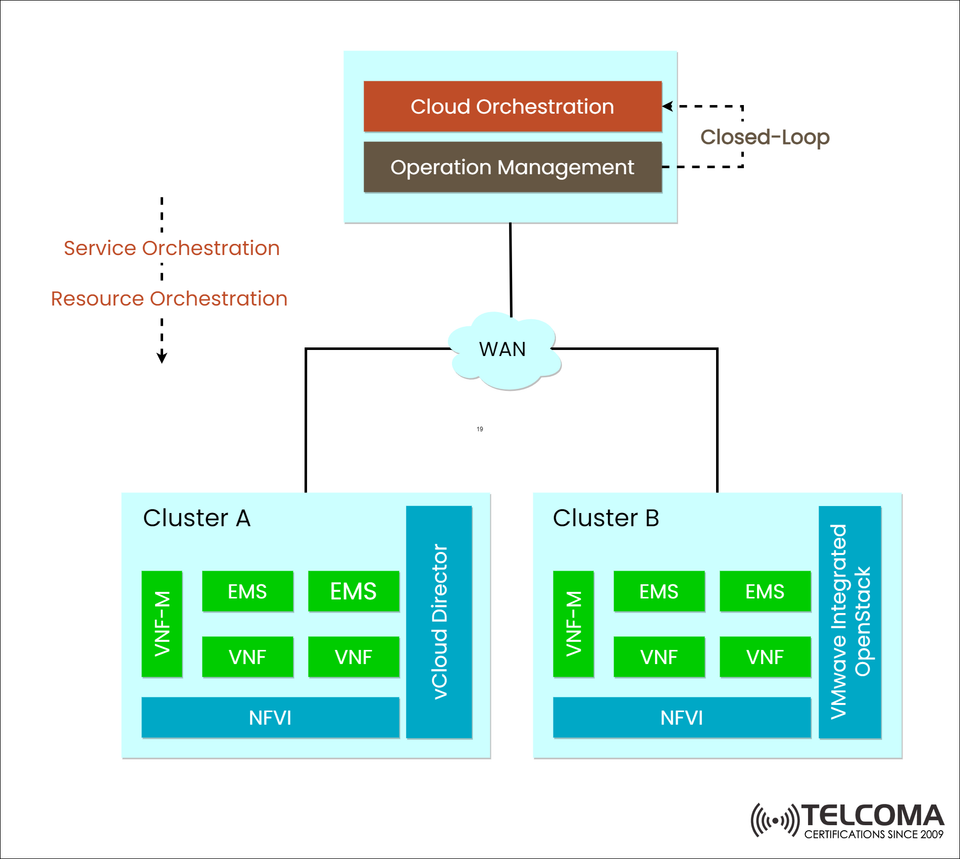
The uploaded image — “NFV Cloud and Resource Orchestration” — visually illustrates how cloud orchestration, operation management, virtualized clusters, and closed-loop automation all work together to create an agile, scalable, and resilient telecom cloud.
Understanding the NFV Cloud Orchestration Framework
At its essence, the image presents a multi-cluster NFV architecture with centralized orchestration and management layers that connect via a Wide Area Network (WAN). This design conforms to the ETSI NFV reference architecture, which guarantees compatibility, automation, and efficiency across various data centers and clusters.
The system revolves around three main components:
Cloud Orchestration and Operation Management (Centralized Control)
Distributed NFV Infrastructure (Clusters A and B)
Closed-Loop Automation for Continuous Optimization
Cloud Orchestration and Operation Management
At the top of the diagram is the Cloud Orchestration and Operation Management layer. It acts as the intelligent control plane, coordinating, monitoring, and automating virtualized network operations across several clusters.
Cloud Orchestration
It handles service orchestration (creating, modifying, and deleting services end-to-end).
It dynamically allocates resources across VNFs and clusters.
It ensures multi-domain coordination, letting distributed networks work seamlessly together.
It oversees inter-cluster communication through the WAN.
Cloud Orchestration interfaces with the infrastructure via resource orchestration, optimizing the use of computing, storage, and network resources in NFV settings.
Operation Management
This focuses on monitoring, analytics, and lifecycle management of virtualized resources.
It offers real-time insights into performance, faults, and resource usage.
It enables closed-loop automation by feeding operational data back into orchestration for proactive adjustments.
These two layers together help the telecom cloud function smoothly, adapting to changing service demands with minimal human involvement.
Service and Resource Orchestration: Dual-Level Coordination
On the left side of the diagram, you see Service Orchestration and Resource Orchestration, represented by vertical dashed lines.
Service Orchestration dictates how end-user services (like VoLTE, VoWiFi, and 5G slices) are deployed, scaled, and maintained across the network.
Resource Orchestration ensures that the essential compute, storage, and network resources are provisioned and optimized to support these services.
These layers operate in tandem:
Service Orchestration requests specific functions or performance levels.
Resource Orchestration meets these requests by efficiently allocating resources across clusters.
This multi-layer orchestration offers a service-focused yet resource-effective approach, which is crucial for 5G and NFV-based networks.
Cluster Architecture: Distributed NFV Environments
Just below the orchestration layer, the diagram shows two distributed clusters (Cluster A and Cluster B) connected via the WAN. Each cluster represents a data center or NFV node that accommodates numerous virtualized network functions (VNFs).
Both clusters have a similar setup but differ a bit in orchestration platforms:
Cluster A: Powered by vCloud Director
Cluster A works with VMware vCloud Director, a cloud management platform that enables:
Multi-tenant virtualization
Automated VNF provisioning
Network and resource segmentation
Inside Cluster A:
VNF-M (VNF Manager) manages the lifecycle of VNFs.
EMS (Element Management System) takes care of individual network functions and keeps an eye on operational health.
VNF (Virtual Network Functions) are the software-based versions of traditional network devices, like routers and firewalls.
NFVI (Network Functions Virtualization Infrastructure) provides the underlying compute, network, and storage resources to run these VNFs.
Cluster B: VMware Integrated OpenStack
Cluster B operates using VMware Integrated OpenStack (VIO), an NFV infrastructure manager based on the OpenStack framework. It offers:
Open-source cloud orchestration
API-driven automation
Easy integration with VNFs
Similar to Cluster A, it features:
VNF-M, EMS, VNF, and NFVI, creating a modular and interoperable environment for hosting network functions.
Both clusters operate independently but remain under centralized control via the Cloud Orchestration and Operation Management system. This setup ensures redundancy, scalability, and geo-distributed resilience, which are vital for reliable telecom services.
WAN Connectivity: The Inter-Cluster Fabric
The Wide Area Network (WAN) shown in the center serves as the communication backbone, linking both clusters and the orchestration layer.
Key roles include:
Ensuring low-latency interconnectivity between data centers.
Facilitating service migration and workload balancing across sites.
Supporting redundant paths for failover and resilience.
Providing the transport layer for orchestration signaling, telemetry, and closed-loop feedback.
This WAN connection enables telecom operators to create geo-redundant NFV clouds, improving service continuity and disaster recovery capabilities.
Closed-Loop Automation: Self-Optimizing Networks
One of the most impactful features of this architecture is the Closed-Loop Automation mechanism, represented as a feedback loop between the Operation Management and Cloud Orchestration layers.
How It Works:
Monitor: Operation Management consistently tracks VNFs, NFVI resources, and network performance metrics.
Analyze: The collected data is scrutinized to identify any performance dips, anomalies, or resource constraints.
Decide: Based on established policies or AI-driven insights, orchestration determines corrective measures — like scaling VNFs or reallocating resources.
Act: Cloud Orchestration implements these adjustments automatically, without needing manual input.
This closed-loop process enables self-healing, auto-scaling, and proactive optimization, paving the way for zero-touch network operations (ZTO) in telecom settings.
Advantages of NFV Cloud and Resource Orchestration
The orchestration architecture depicted in the image provides several significant benefits for telecom operators:
Elastic Scalability: Automatically adjusts VNFs based on traffic needs.
Operational Efficiency: Cuts down on manual tasks through automation and smart policy management.
Multi-Cluster Redundancy: Guarantees high availability and fault tolerance through geo-distributed clusters.
Vendor Independence: Promotes interoperability among VMware, OpenStack, and other NFV platforms.
Closed-Loop Optimization: Continually enhances performance through self-learning and automated fixes.
Cost Reduction: Lowers both CAPEX (by using virtualized resources) and OPEX (by minimizing manual operations).
The Bigger Picture: Toward Fully Autonomous Telecom Networks
This NFV orchestration model is a crucial step towards autonomous, self-managing telecom networks. By merging cloud-native orchestration, AI-driven analytics, and closed-loop control, operators stand to gain the agility they need for 5G, edge computing, and IoT-driven services.
Future Extensions:
Integration with MANO (Management and Orchestration) frameworks for 5G slicing.
AI-based predictive orchestration to foresee failures ahead of time.
Hybrid-cloud NFV deployments combining private and public clouds for broader scalability.
Conclusion
The image really captures the essence of NFV Cloud and Resource Orchestration by showcasing how service orchestration, resource management, and closed-loop automation all come together to build a resilient and intelligent telecom environment.
Utilizing platforms like vCloud Director and OpenStack, telecom operators can enjoy flexibility and vendor neutrality, all while centralized orchestration ensures cohesive control.
In an era where 5G, IoT, and real-time applications require ultra-reliable, low-latency services, such orchestration frameworks establish the digital backbone for future-ready telecom networks, allowing operators to offer smarter, faster, and more efficient services.