
NG-RAN Protocol Stack Explained: 5G User Plane & Control Plane Functions
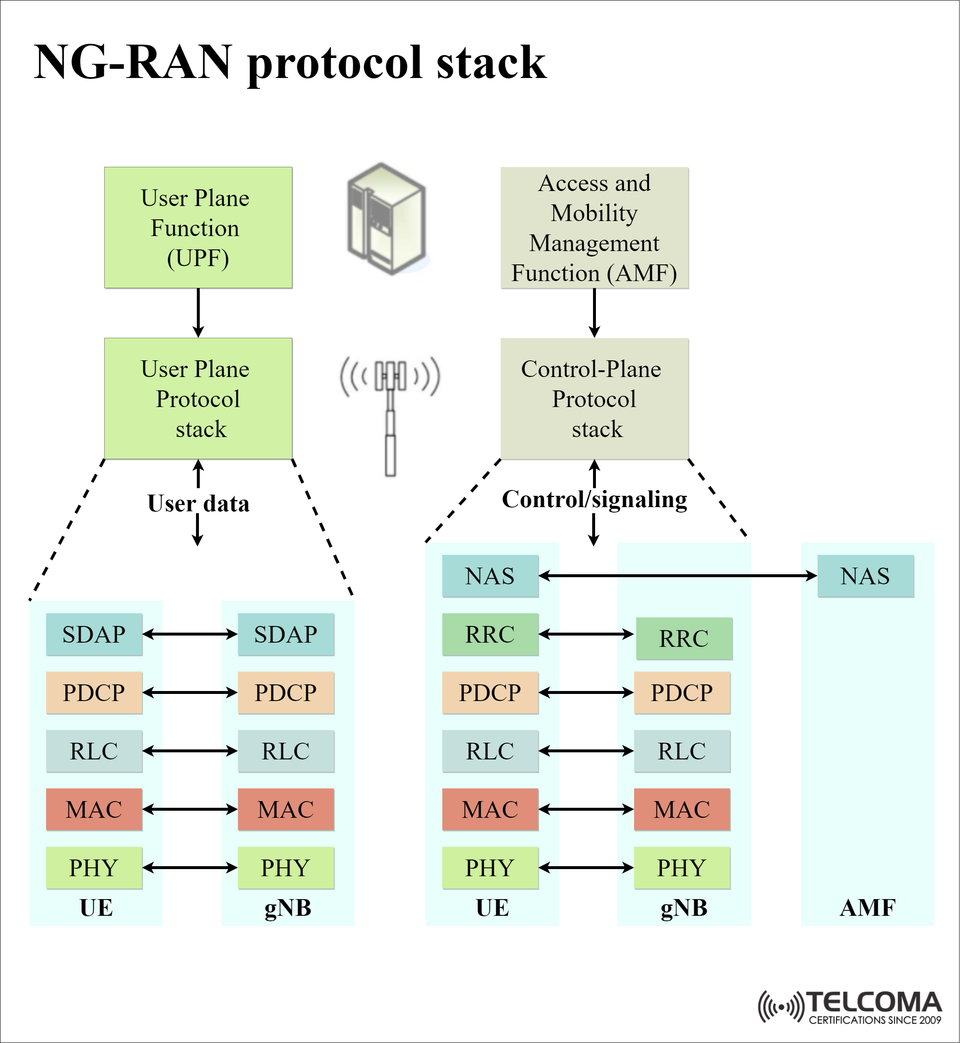

NG-RAN Protocol Stack: Detailed Technical Overview
The Next-Generation Radio Access Network (NG-RAN) is the driving force behind 5G connectivity, allowing high-rate data transfer and signaling for signalling between User Equipment (UE) devices, gNB (Next-Generation NodeB) and the 5G Core.
The NG-RAN protocol stack involves two different protocols:
User Plane Protocol Stack - the User Plane carries user data traffic.
Control Plane Protocol Stack - the Control Plane looks after signalling and mobility control.
- User Plane Protocol stack in NG-RAN
User plane is user data - user data can include Internet browsing, video streaming, App traffic - anything that goes from a User Equipment (UE) device to a User Plane Function (UPF) within the 5G Core.
User Plane Protocol Layers:
Layer Function
SDAP (Service Data Adaptation Protocol) Mapping of QoS flows to data radio bearers is a key function, allowing 5G to differentiate how users get QoS.
PDCP (Packet Data Convergence Protocol) Provides header compression, security (ciphering) and packet sequencing/re-ordering.
RLC (Radio Link Control) Splits packets for transmission and rejoins packets, as well handles retransmission.
MAC (Medium Access Control) Bottom of layer of the user plane. Scheduling, multiplexing of logical channel and correction of error using HARQ.
PHY (Physical Layer) Transmitting and receiving modulated signals over the air interface.
- The NG-RAN control plane protocol stack
The control plane is responsible for signaling relating to mobility, session creation, and resource management. Signaling is done between the UE, gNB, and the Access and Mobility Management Function (AMF) in the core.
Control plane protocol layers:
Layer Function
NAS (Non-Access Stratum) Direct signaling between UE and AMF for sessions, registrations and authentications.
RRC (Radio Resource Control) Achieve or configure radio bearers, mobility control, security setup.
PDCP Same as with user plane, but just for control messages.
RLC, MAC, PHY Provides reliability and scheduling and are used for the data transmission for control messages.
- How NG-RAN Carries Data and Signaling
User plane path: UE → gNB → UPF
Control plane path: UE → gNB → AMF
User and control plane can operate in parallel: The user data path is sending data when the control plane is signalling the user and device is mobile, while also providing potential security management. - Key differences between user plane and control plane in NG-RAN
Feature User plane Control plane
Scope/What is transported Transports user application data Management of the signaling and mobility
Point of dispatch/point of contact with user UPF AMF
Protocol at the top layer SDAP NAS
Focus of transport Throughput, revised QoS (Quality of service) Transporting commands associated with session control, handovers, etc. - Rationale for 5G Network Engineers
Quality of service mapping of SDAP is key to providing necessary QoS to different services such as URLLC, eMBB and mMTC. - Importance for 5G Network Engineers
- Effective Quality of Service (QoS) mapping through the Session Data Adaptation Protocol for different services (e.g. URLLC, eMBB, and mMTC).
- Control and user planes help improve Scalability and flexibility in architectures.
- These layers (NG-RAN) have individual targeted Optimization to ensure 5G performance.
Conclusion
- The NG-RAN Protocol Stack is the foundation of the transport of 5G data and signalling. The separation of user plane and control plane allows 5G to be useful for substantial user application throughput while maintaining sufficient signalling capability for mobility and session control.
- From a telecom professional standpoint, everything described here on the Session Data Adaptation Protocol, Packet Data Convergence Protocol, Radio Link Control, Media Access Control, and physical layer, including how they work within the user and control plane of next-generation mobile networks, is very important to understand in order to design, deploy, and optimize mobile networks of the future.
- The NG-RAN Protocol Stack and the 5G Architectural Context
- Within the 5G network model, the NG-RAN is the segment of radio access connecting user devices to the 5G Core (5GC) network. The NG-RAN interacts with the core network constructed based on Service-Based Architecture (SBA), as an example for all real-time communication type use cases.
- The NG-RAN allows for (1) high bandwidth and low latency real-time communication; (2) dynamic network slicing (per user or application) based on a user's service requirements; and (3) flexible deployment models for core and edge (centralized, distributed, or hybrid).
- Moreover, the gNB is made up of a CU (Central Unit) and DU (Distributed Unit), for example, to optimize the base station performance:
- CU - completes the higher layer functions (Session Data Adaptation Protocol, Packet Data Convergence Protocol, and Radio Resource Control).
- DU - completes RLC, MAC and physical layer functions.
- Significance of Layered Design in NG-RAN
The layered architecture ensures that each protocol layer performs a defined function which provides:
Isolation of problems — facilitating service restoration and performance optimization.
Standardization — allowing interoperability across devices from various vendors. For example:
Scalability — enabling operators to scale capacity without negatively impacting other functionalities. For example, if you wanted to improve the quality of service (QoS) of ultra-reliable low latency communication (URLLC), you would need to manipulate SDAP and MAC layers while leaving NAS or PHY untouched.
- Typical NG-RAN Areas for Optimization by Engineers
Telecom engineers often focus on the optimization of:
SDAP tuning to provide QoS aligned with the type of application in use (e.g. video conferencing versus IoT telemetry).
Modifying PDCP compression to optimize throughput over limited bandwidth.
Choose RLC mode (Acknowledged Mode versus Unacknowledged Mode) in a manner that balances reliability with latency.
Optimizing MAC scheduling algorithms to ensure fairness and drive data efficiency across the connected UEs.
Improve PHY layer configurations that leverage, for example, MIMO and/or beamforming to enhance coverage and capacity.
- NG-RAN Protocol Stack in Live Environments
Consider a practical example:
User browsing the web: Data is routed from the user plane stack → UPF → Internet.
User handover between cells: Control messages are transferred from control plane stack → AMF → to trigger RRC reconfiguration.
In 5G standalone (SA) mode, the signaling will always use both the user and control planes.
Conclusiion
The NG-RAN protocol stack is not simply a figure in a book. It is the operational protocol stack that dictates how 5G technology entails ultra-fast, low-latency, and reliable connections.