
Node Isolation in 5G Core: Enhancing Reliability and Performance with AMF, SMF, and UPF Separation

Introduction: The Role of Node Isolation in 5G
With the rapid global adoption of 5G, its cloud-native, service-based architecture is reshaping the way mobile networks are designed, deployed, and managed. Unlike the older systems, the 5G Core (5GC) consists of modular network functions that can work independently, scale efficiently, and connect easily.
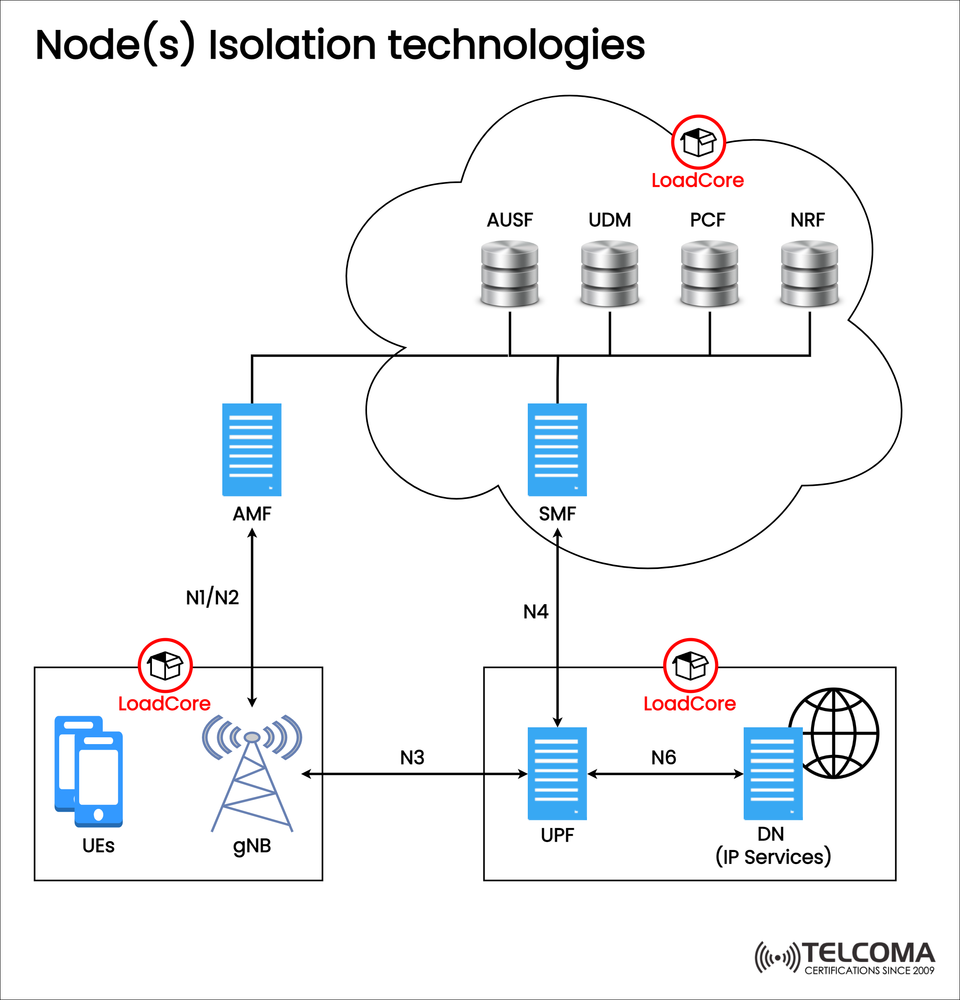
One of the major factors enabling this flexibility is node isolation—the separation of different network functions such as AMF (Access and Mobility Management Function), SMF (Session Management Function), and UPF (User Plane Function). The diagram provided shows how these components interact within isolated domains, which helps create a strong, secure, and high-performing network.
For telecom professionals and tech enthusiasts, getting a handle on node isolation is key to understanding how 5G achieves unmatched efficiency and reliability.
What is Node Isolation in 5G?
Node isolation is all about the logical and sometimes physical separation of network functions within the 5G Core. Instead of cramming multiple functions onto the same hardware, isolation allows each node to:
Run independently with its own resources.
Be scaled or upgraded without messing with other nodes.
Improve fault tolerance and security.
This principle embodies the cloud-native, containerized design of 5GC, where functions are rolled out as microservices and managed through virtualization platforms.
Key Components in the Diagram
a) Access and Mobility Management Function (AMF)
Takes care of user equipment (UE) registration, connection management, and handling mobility events.
Connects to the gNB (base station) using N1/N2 interfaces.
Passes session-related tasks over to the SMF.
b) Session Management Function (SMF)
Oversees session creation, modifications, and terminations.
Assigns IP addresses to UE.
Communicates with UPF through the N4 interface.
c) User Plane Function (UPF)
Manages user traffic flows between RAN and Data Networks (DN).
Handles packet routing, QoS enforcement, and traffic management.
Links to gNB via N3 and DN via N6.
d) Data Network (DN)
Provides external services like internet access, enterprise applications, or private 5G solutions.
e) Supporting Functions (AUSF, UDM, PCF, NRF)
AUSF: Authentication Server Function.
UDM: Unified Data Management.
PCF: Policy Control Function.
NRF: Network Repository Function.
These functions run in the control plane cloud and interact with AMF and SMF.
The diagram also shows LoadCore, a testing tool used to simulate traffic and validate isolation technologies.
Why Node Isolation Matters in 5G
a) Performance and Scalability
Heavy user-plane workloads, like video streaming, can be scaled at the UPF without needing more AMF or SMF resources.
Helps avoid bottlenecks by separating signaling load from data traffic.
b) Reliability and Fault Tolerance
If the UPF fails, it doesn’t directly disrupt AMF’s signaling tasks.
Keeps services running smoothly by confining failures within isolated domains.
c) Security and Compliance
Reduces the risk since if traffic nodes (UPF) are compromised, it doesn’t easily affect signaling nodes (AMF/SMF).
Meets enterprise and regulatory needs for sensitive applications, such as IoT and critical services.
d) Edge Deployment Flexibility
Isolated UPFs can be positioned closer to users for ultra-low latency.
Centralized AMF/SMF continue to handle signaling efficiently.
- Interfaces Explained
Interface | Connects | Role
N1/N2 | UE/gNB ↔ AMF | Signaling and mobility management
N3 | gNB ↔ UPF | User-plane data forwarding
N4 | SMF ↔ UPF | Control of data paths
N6 | UPF ↔ DN | Access to internet or private data networks
This modular interface setup is fundamental to isolation, allowing each node to communicate through standardized APIs.
- Practical Applications of Node Isolation
Enhanced Mobile Broadband (eMBB)
High-throughput applications like streaming gain from scalable UPFs.
AMF/SMF remain stable without being overloaded with signaling.
Ultra-Reliable Low-Latency Communications (URLLC)
UPFs at the edge ensure that latency-sensitive applications, like autonomous vehicles, run smoothly.
Centralized AMF manages mobility effectively.
Massive Machine-Type Communications (mMTC)
Millions of IoT devices connect through lightweight UPFs designed for small data bursts.
AMF efficiently manages massive signaling.
- Benefits of Node Isolation
Independent Scaling: Allocate resources where needed.
Reduced Latency: Place UPFs at the edge.
Operational Agility: Upgrade AMF/SMF without disrupting UPF.
Improved Security: Less cross-node attack risk.
Resilient Architecture: Failures are contained.
Challenges in Node Isolation
Even with the benefits, node isolation brings several challenges:
Orchestration Complexity: Needs advanced MANO (Management and Orchestration) frameworks.
Signaling Overhead: More interfaces can add signaling traffic.
Vendor Interoperability: Multi-vendor environments must work together seamlessly.
Testing Requirements: Each isolated node needs separate validation and end-to-end testing.
Testing Isolation with LoadCore
The diagram mentions LoadCore, which plays a crucial role in validating isolation technologies:
Simulates UEs, gNBs, and DNs for realistic traffic testing.
Validates scalability by pushing high loads on UPF while monitoring AMF/SMF stability.
Ensures compliance with 3GPP standards for N1, N2, N3, N4, and N6 interfaces.
Detects bottlenecks early, paving the way for proactive optimization.
Through testing isolation scenarios, LoadCore makes sure networks are ready for deployment and resilient.
Future of Node Isolation in 5G and Beyond
Looking ahead, node isolation will continue to develop into more advanced forms:
Network Slicing: Groups of isolated nodes dedicated to specific services like eMBB or URLLC.
AI-Driven Automation: Predictive scaling and self-healing capabilities across isolated domains.
6G Roadmap: Even more detailed microservice-based isolation with a stronger focus on AI and quantum-safe security.
Conclusion
Node isolation technologies in the 5G Core mark a significant step forward in network design. By dividing functions like AMF, SMF, and UPF, operators gain flexibility, reliability, and scalability, which are crucial for supporting a variety of services—from IoT and enterprise connectivity to ultra-low-latency applications.
Thanks to standardized interfaces and thorough testing with tools like LoadCore, telecom professionals can roll out networks that are not only high-performing but also ready for the future.
As 5G continues to expand and pave the way towards 6G, node isolation will remain a key pillar of resilient, secure, and agile telecom infrastructure.