
Non-Roaming 5G Core Network with Trusted Non-3GPP Access Explained
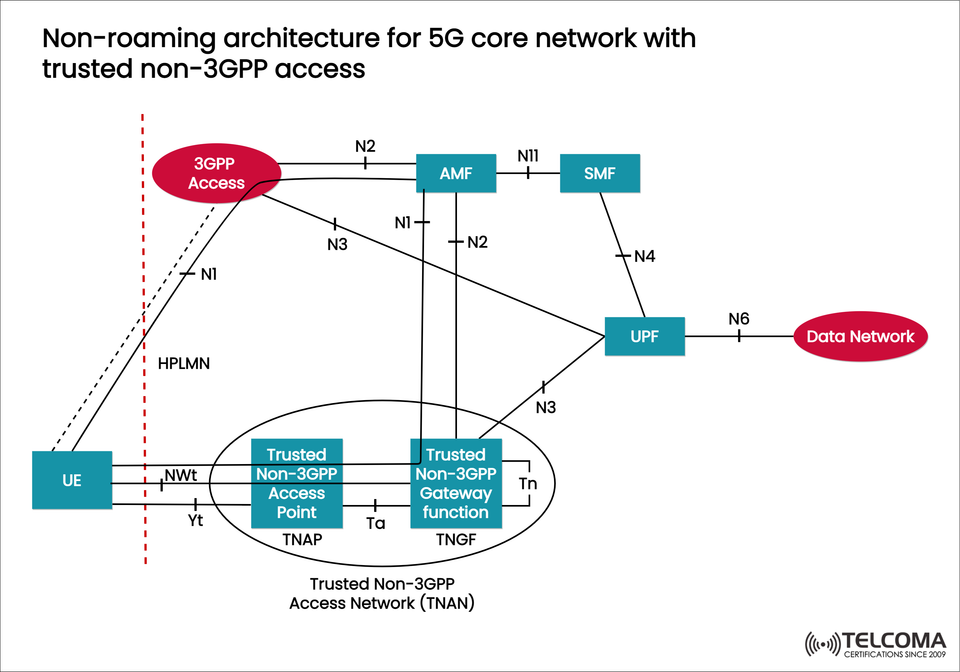

The 5G ecosystem aims to provide ubiquitous connectivity, going beyond just traditional 3GPP access (like cellular radio) to include non-3GPP access networks such as Wi-Fi, fixed broadband, or enterprise networks. To ensure secure, seamless, and high-performance service delivery, 3GPP has established a non-roaming architecture for 5G core networks with trusted non-3GPP access.
The diagram above shows how user equipment (UE), trusted non-3GPP access components, and the 5G Core (5GC) interact within this framework. Let’s take a closer look at each part.
What is Trusted Non-3GPP Access?
Non-3GPP access includes networks that don’t fall under 3GPP specs, like:
Wi-Fi (IEEE 802.11)
Fixed broadband (DSL, fiber)
Private enterprise networks
When these access networks comply with the security, authentication, and interoperability standards set by 3GPP, they’re known as Trusted Non-3GPP Access Networks (TNANs).
These trusted networks enable UEs (smartphones, IoT devices, laptops) to connect to the 5G Core while ensuring policy control, Q o S (Quality of Service), and security comparable to traditional cellular networks.
Key Components in the Architecture
The diagram highlights the following elements:
- User Equipment (UE)
This is the device used by the end-user.
It supports both 3GPP (cellular) and non-3GPP (like Wi-Fi) access.
It starts the session with the 5G Core.
- Trusted Non-3GPP Access Point (TNAP)
Serves as the entry point for UEs connecting over non-3GPP networks.
Provides a secure interface (NWt, Yt) for the UE.
Handles authentication and forwards traffic to the Trusted Non-3GPP Gateway Function (TNGF).
- Trusted Non-3GPP Gateway Function (TNGF)
Works as a gateway between TNAN and the 5G Core.
Manages security, QoS enforcement, and signaling.
Interfaces with the Access and Mobility Management Function (AMF) via the N2 interface.
Connects with the User Plane Function (UPF) through the N3 interface for data traffic.
- 5G Core Network Functions
AMF (Access and Mobility Management Function): Takes care of registration, authentication, and mobility.
SMF (Session Management Function): Handles session creation and resource allocation using the N11 interface with AMF.
UPF (User Plane Function): Directs user data packets to external networks through the N6 interface.
Data Network (DN)
Includes external services like the Internet, private enterprise apps, or cloud platforms.
UEs eventually connect to these networks through the 5G Core.
Interfaces in the Architecture
Here’s a summary of the key interfaces shown in the diagram:
Interface Function
N1 Control signaling between UE and AMF.
N W t/Y t Secure connection between UE and TNAP.
Ta Connection between TNAP and TNGF.
T n Interface between TNGF and 5GC.
N2 Control plane between TNGF/3GPP access and AMF.
N3 User plane between TNGF and UPF.
N4 SMF controls UPF for session management.
N6 Data forwarding from UPF to external networks.
This design aims to guarantee policy, Q o S, and security are upheld no matter if access is through 3GPP or non-3GPP networks.
How the Non-Roaming Architecture Works
UE Connects to TNAP: The UE authenticates with the Trusted Non-3GPP Access Point using secure protocols.
Traffic Forwarded to TNGF: TNAP sends UE traffic to TNGF for security and QoS enforcement.
Control Plane Signaling: TNGF communicates with AMF over N2 for registration, session, and mobility management.
Session Establishment: AMF works with SMF over N11 to set up sessions. SMF manages UPF via N4 for traffic anchoring.
User Data Routing: UE traffic goes through TNGF → UPF → Data Network (N6).
Benefits of Using Trusted Non-3GPP Access
Seamless Integration
The UE can switch between 3GPP (cellular) and non-3GPP (Wi-Fi, fixed broadband) without issues.
Improved Coverage
This enhances indoor coverage where cellular signals may struggle.
Cost Efficiency
It shifts traffic to Wi-Fi or fixed broadband, easing the load on mobile spectrum.
Security and QoS
Trusted non-3GPP networks ensure encryption, authentication, and QoS that match 3GPP access.
Support for Diverse Devices
This extends 5G services to IoT devices, laptops, and enterprise gear that often depend on Wi-Fi access.
Real-World Use Cases
Enterprise Networks: Businesses use Wi-Fi 6/7 networks as trusted access to broaden private 5G services.
Residential Broadband: Carriers shift mobile traffic to home broadband securely.
Smart Cities: IoT devices utilize Wi-Fi access points within the TNAN for collecting sensor data.
Public Hotspots: Locations like airports, malls, and stadiums set up TNAPs for trusted Internet offloading.
Challenges and Considerations
Authentication Management: Safeguarding secure UE authentication across various access technologies.
Interference and Q o S: Non-3GPP access (like Wi-Fi) can run into congestion issues.
Seamless Handover: Ensuring service continuity when switching between different networks.
Policy Enforcement: Aligning policies across different types of networks.
The Challenge
Not every device connects through cellular networks.
Wi-Fi, broadband, and enterprise networks are the go-to for indoor connectivity.
Operators are looking for a safe method to link these with 5G. (Include icons for a smartphone, IoT sensor, and laptop all connecting through Wi-Fi)
The Solution
Trusted Non-3GPP Access Architecture
TNAP: A secure access point for user equipment.
TNGF: The gateway to the 5G Core.
AMF/SMF/UPF: These manage sessions, policies, and data flow. (Show a simplified flow diagram illustrating TNAP → TNGF → 5GC → Data Network)
The Benefits
✅ Smooth handover between 5G and Wi-Fi
✅ Better coverage indoors
✅ Reduced network expenses through Wi-Fi offloading
✅ Secure experience that's focused on Quality of Service
✅ Compatible with IoT, enterprise, and consumer devices
Conclusion
The non-roaming 5G core network architecture with trusted non-3GPP access is key for enabling seamless connectivity across different access networks. By introducing TNAP and TNGF, this architecture makes sure that user experience, security, and QoS are consistently high, whether devices connect via cellular or trusted Wi-Fi/broadband.
For telecom professionals, this framework underscores that 5G isn't just about faster speeds—it's about flexible, secure, and unified connectivity. For tech enthusiasts, it’s exciting to see how trusted integration of Wi-Fi and other non-3GPP technologies broadens the scope of 5G services.