
NR Architecture Explained: Option 3, 3a, and 3x in 5G NSA
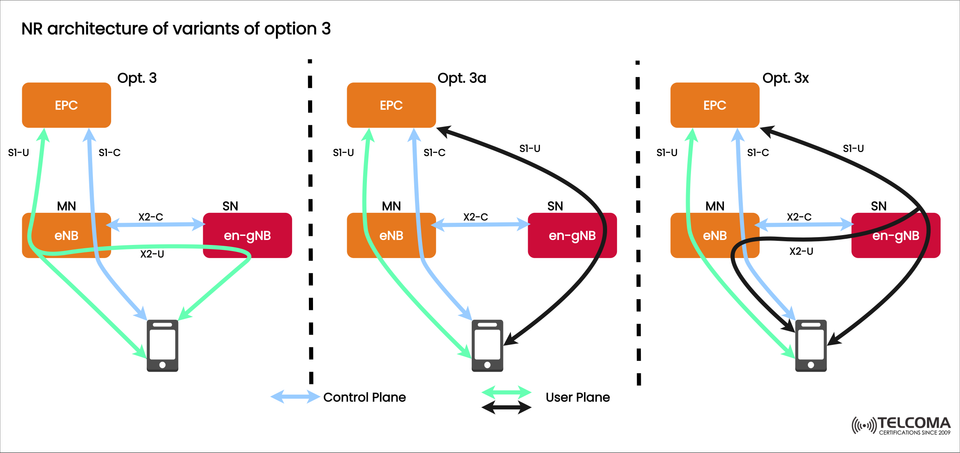

Moving from LTE (4G) to 5G New Radio (NR) is quite a complicated journey. It involves blending existing infrastructure with the latest technology. To facilitate a hassle-free transition, 3GPP has laid out several deployment options under the Non-Standalone (NSA) architecture, where 5G NR works alongside the current LTE core (Evolved Packet Core, EPC).
The most popular choices are Option 3 and its variants (3a and 3x). They allow for quicker deployments by making use of the existing EPC and LTE eNodeB (eNB) setup.
The diagram we uploaded gives a visual of these architecture variants, showing how data and control planes flow. This helps clarify the interaction between LTE and NR nodes. In this article, we'll dive deeper into each option, looking closely at their architecture, functionality, and benefits.
What is Option 3 in 5G NSA?
Option 3 is the first dual connectivity model that designates an LTE eNodeB (eNB) as the Master Node (MN), while the NR gNB (referred to as en-gNB) acts as the Secondary Node (SN).
EPC (Evolved Packet Core): The legacy LTE core network.
eNB (LTE base station): Master Node (MN) managing control-plane signaling.
en-gNB (5G base station): Secondary Node (SN) that adds capacity for user-plane data.
Control Plane:
All signaling between the UE (User Equipment) and EPC is routed through the eNB.
The eNB directs the en-gNB via the X2-C interface.
User Plane:
User data can flow through both eNB and en-gNB, with aggregation happening at the UE.
The eNB can serve as a traffic anchor for user-plane data via EPC (S1-U) while also forwarding additional data through en-gNB (X2-U).
✅ Key Point: Option 3 supports dual connectivity but keeps control signaling anchored in LTE, ensuring good backward compatibility and stability.
Option 3a Architecture
Option 3a tweaks how the user plane is managed compared to Option 3.
Control Plane: Stays the same as Option 3 – the EPC only connects to the eNB through S1-C, and the eNB manages the en-gNB via X2-C.
User Plane: Unlike Option 3, here, the EPC connects directly to both eNB and en-gNB for user data (S1-U interfaces).
This adjustment cuts down on the eNB's role in forwarding user-plane data, resulting in:
Lower latency (data doesn't always pass through the eNB).
Improved throughput (thanks to parallel data paths).
✅ Key Point: With Option 3a, the EPC's direct connection to en-gNB for user-plane traffic enhances performance while keeping control-plane signaling anchored in LTE.
Option 3x Architecture
Option 3x blends features from Option 3 and 3a, offering flexibility and efficiency.
Control Plane: Mirrors Options 3 and 3a – the eNB acts as the Master Node, with EPC connecting via S1-C.
User Plane: Data can either be anchored through the eNB or sent directly from EPC to en-gNB.
The EPC holds S1-U links with both the eNB and en-gNB.
It can also dynamically distribute user-plane traffic between both nodes.
This setup allows for:
Flexible load balancing between LTE and NR.
Optimized throughput and latency through dynamic resource management.
Future readiness since it resembles how fully standalone 5G operates with direct NR anchoring.
✅ Key Point: Option 3x gives EPC the ability to connect to both eNB and en-gNB for user traffic, while keeping control signaling centralized at the LTE eNB.
Comparing Option 3, 3a, and 3x
Here's a straightforward comparison:
Feature Option 3Option 3aOption 3xControl Plane EPC → eNB (MN) → en-gNB EPC → eNB (MN) → en-gNB EPC → eNB (MN) → en-gNB User Plane Path EPC → eNB → en-gNB → UEEPC → eNB + EPC → en-gNB EPC → eNB + EPC → en-gNB (flexible)Latency Higher Lower Lowest / Optimized Throughput Moderate High Highest Complexity Low (simple)Medium Higher (more interfaces)Adoption Widely adopted early Used in performance cases Preferred for flexibility
Why are Option 3 Variants Important?
Rapid Deployment of 5G:
They let operators roll out 5G quickly without waiting for full Standalone (SA) 5G core networks.
Cost-Efficient Transition:
They take advantage of the existing LTE EPC, lowering capital expenses (CAPEX).
Smooth User Experience:
Users enjoy consistent service, as signaling stays anchored in LTE while NR provides speed improvements.
Performance Enhancements:
Variants like 3a and 3x offer better latency and throughput compared to baseline Option 3.
Real-World Adoption
A lot of telecom operators around the world went with the Option 3 NSA architecture when they started rolling out their 5G services. This approach enabled them to:
Offer 5G speeds (in the Gbps range) while still utilizing the LTE EPC.
Ensure coverage stability with LTE, especially during the initial phases when NR coverage was limited.
Gradually transition toward Standalone (SA) 5G (using Option 2 architecture), which does require a 5G Core (5GC).
A Closer Look: Control Plane vs. User Plane in Option 3 Variants
Getting a handle on the differences between the control plane (C-plane) and the user plane (U-plane) is key to understanding how Option 3 architectures work.
Control Plane (S1-C, X2-C):
Responsible for managing session setups, mobility, and handovers.
In all the Option 3 variants, the EPC interacts only with the LTE eNB for signaling.
This setup means the C-plane is always anchored by LTE, which helps with backward compatibility.
User Plane (S1-U, X2-U):
Handles user data, like browsing and video streaming.
The specifics can change depending on the option:
Option 3: EPC → eNB → en-gNB → UE
Option 3a: EPC → eNB + EPC → en-gNB (in parallel)
Option 3x: EPC → eNB + EPC → en-gNB (for flexible distribution)
This division was intentional by 3GPP to keep major changes to the EPC minimal while still allowing operators to enhance user-plane traffic management down the line.
Conclusion
The NR architecture variants of Option 3 (3, 3a, and 3x) play a key role in early 5G deployments. By merging LTE EPC with 5G NR through different dual connectivity models, operators could introduce 5G services quickly without needing to replace their entire network infrastructure.
For those in the telecom field or simply interested in it, getting a grip on these deployment options is essential to understanding how 5G has progressed from its LTE roots to where we are now.