
NSA vs SA in 5G: Key Deployment Options Explained (Option 2, 3, 4, 7)
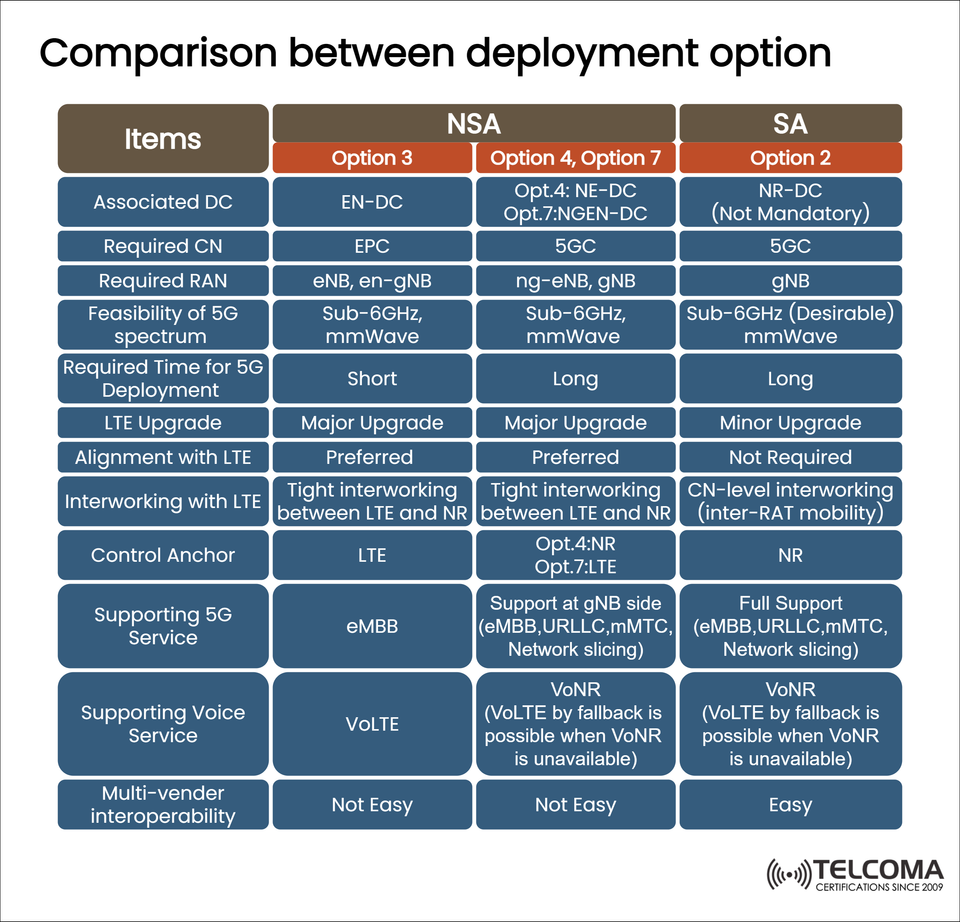

Moving from 4G LTE to 5G NR isn’t just about faster data speeds and lower delays; it’s also about how these networks are set up. Mobile operators around the globe have some decisions to make:
Should they opt for Non-Standalone (NSA) deployments that build on existing LTE networks for a quicker launch?
Or should they go with Standalone (SA) to create a pure 5G network based on a 5G Core (5GC)?
The chart we’ve shared makes it pretty clear how these options stack up, especially regarding NSA Option 3, NSA Options 4/7, and SA Option 2. In this post, we’ll dive into each option, weigh their pros and cons, and discuss what they mean for today’s telecom landscape.
What are NSA and SA in 5G?
NSA (Non-Standalone): This approach uses LTE as a foundation while 5G NR boosts capacity. It’s a way for operators to roll out 5G quickly by upgrading their LTE setups.
SA (Standalone): This utilizes 5G NR along with a 5G Core (5GC). It brings all the benefits of 5G, like super-reliable low-latency communication (URLLC), massive IoT (mMTC), and network slicing.
NSA Deployment Options
Option 3 (EN-DC)
Associated DC: EN-DC (E-UTRA-NR Dual Connectivity).
Core Network: EPC (Evolved Packet Core).
RAN Requirement: eNB and en-gNB.
Feasibility: Works with both Sub-6 GHz and mmWave spectrum.
Deployment Time: Short (the quickest option).
LTE Upgrade: Major upgrade needed.
Control Anchor: LTE.
Service Support: eMBB (Enhanced Mobile Broadband).
Voice Service: VoLTE.
Multi-vendor Interoperability: Can be tricky.
Use Case: A fast 5G launch with limited capital expenditures. It’s popular among the early adopters.
Option 4 & Option 7 (NE-DC / NGEN-DC)
Core Network: 5GC.
RAN Requirement: ng-eNB and gNB.
Deployment Time: Longer than Option 3.
LTE Upgrade: Major upgrade needed.
Interworking: Strong integration between LTE and NR.
Control Anchor: Option 4 → NR, Option 7 → LTE.
Service Support: Supports eMBB, URLLC, mMTC, and network slicing on the gNB side.
Voice Service: VoNR (with a fallback to VoLTE).
Multi-vendor Interoperability: Challenging.
Use Case: Mid-term deployment that’s a step towards SA while still using LTE for coverage.
SA Deployment Option
Option 2 (NR-DC, Standalone)
Associated DC: NR-DC (optional).
Core Network: 5GC.
RAN Requirement: gNB only.
Feasibility: Best with Sub-6 GHz and mmWave spectrum.
Deployment Time: Long.
LTE Upgrade: Minor upgrade required.
Alignment with LTE: Not necessary.
Interworking: CN-level interworking (inter-RAT mobility).
Control Anchor: NR.
Service Support: Comprehensive support (eMBB, URLLC, mMTC, Network slicing).
Voice Service: VoNR (with fallback to VoLTE).
Multi-vendor Interoperability: Easier than NSA.
Use Case: A fully-fledged future-proof 5G network with the potential to back IoT, smart cities, Industry 4.0, and critical communications.
Comparative Table: NSA vs SA
Criteria NSA Option 3 (EN-DC)NSA Option 4/7 (NE-DC/NGEN-DC)SA Option 2 (NR-DC)Core NetworkEPC5GC5GCRAN Requirement eNB + en-gNBng-eNB + gNBgNB only Deployment Time Short Long Long LTE Upgrade Major upgrade Major upgrade Minor upgrade Control Anchor LTENR (Opt 4) / LTE (Opt 7)NR Spectrum FeasibilitySub-6 GHz, mmWaveSub-6 GHz, mmWaveSub-6 GHz, mm Wave Interworking Tight LTE-NR Tight LTE-NRCN-level (inter-RAT)5G Service Supporte MBB onlye MBB, URLLC, mMTC, slicing Full (eMBB, URLLC, mMTC)Voice Service VoLT EVoNR (fallback to VoLTE)VoNR (fallback to VoLTE)Multi-vendor Interop Not easy Not easy Easier
Key Insights from the Comparison
Speed of Deployment: * NSA Option 3 enables the quickest 5G rollout using EPC. * SA takes longer but taps into the full 5G potential.
Service Capabilities: * NSA primarily focuses on eMBB. * SA opens the door to URLLC, mMTC, and slicing, which are key for IoT and critical applications.
Control Anchor: * NSA relies on LTE for its anchor. * SA is entirely anchored in NR, freeing it from LTE dependencies.
Interworking: * NSA needs tight LTE-NR integration. * SA simplifies things with core-level interworking, easing multi-RAT mobility.
Future-readiness: * NSA acts as a bridge technology for quicker adoption. * SA stands as future-proof, perfect for advanced 5G services.
Challenges of NSA and SA
NSA Challenges: * Complicated integration with LTE. * Limits service to eMBB. * Issues with vendor interoperability.
SA Challenges: * Longer deployment times. * High capital and operational costs. * Needs a solid business case for ROI (especially for IoT and URLLC).
Real-World Examples of 5G Deployment Strategies
Countries and telecom operators have taken various approaches to deploying 5G based on things like spectrum availability, the maturity of their infrastructure, and their overall business strategies.
USA (NSA-first approach): In the U.S., companies like Verizon, AT&T, and T-Mobile kicked off their 5G rollouts using NSA Option 3, which allowed them to leverage their existing LTE EPC for a quicker launch. Now, they're shifting their focus to investing in SA networks to take advantage of features like low latency and network slicing.
China (Fast transition to SA): On the other hand, Chinese operators—China Mobile, China Telecom, and China Unicom—have chosen a rapid migration strategy toward SA Option 2. With robust government backing and a wealth of available spectrum, they’ve built some of the largest SA networks worldwide.
Europe (Balanced strategy): Many European telecom providers initially opted for NSA deployments for their coverage needs but are aiming for a gradual shift to SA. This transition is especially important for supporting industrial IoT and private 5G networks in manufacturing zones.
SA Use Cases (Long-Term Benefits)
Ultra-Reliable Low Latency Communication (URLLC):
Remote surgeries
Autonomous vehicles
Critical industrial automation
Massive Machine-Type Communications (mMTC):
Smart meters
IoT in agriculture
Smart cities with millions of connected devices
Network Slicing:
Dedicated network slices for specific enterprises (like a bank, hospital, or factory).
Private 5G networks tailored for various industries.
Conclusion
The road to 5G isn’t a one-size-fits-all approach. Operators need to find a balance between time to market, investment costs, and long-term goals.
For those in telecom, getting a handle on these deployment choices is key for network planning, cost optimization, and readiness for the future. As networks advance, the industry is gradually moving from NSA-focused rollouts to SA-driven innovation, striving to make the most of what 5G can offer.