
O-RAN A1 Interface Explained: AI Policy, Model Management, and Enrichment in 5G Networks

Introduction: When AI Meets Open RAN
The telecom sector is experiencing a revolution fueled by Artificial Intelligence (AI) and Open RAN (O-RAN) technologies. As networks get more intricate and dynamic, conventional static control systems just can’t keep pace with the need for real-time optimization.
This is where the O-RAN A1 Interface comes into play — acting as a link between AI-driven decision-making and the RAN’s real-time control loops.
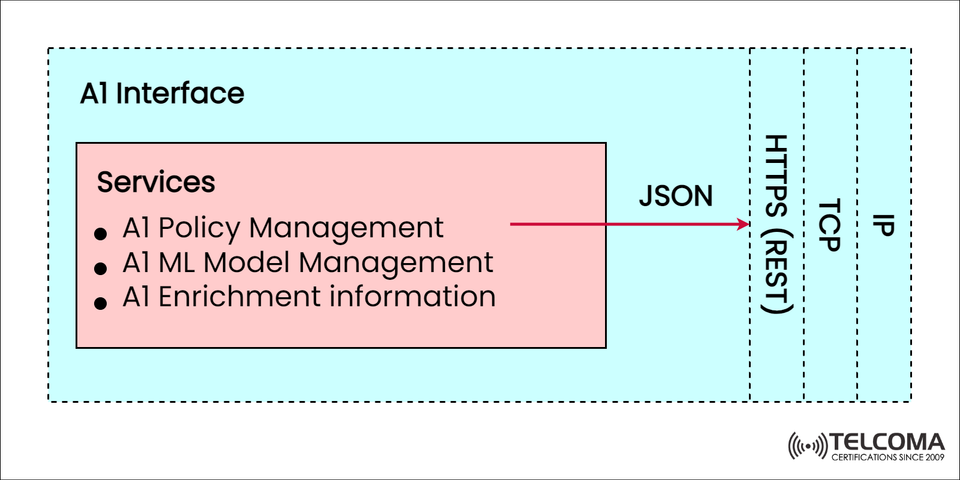
The image above shows how the A1 Interface works through standardized services and REST-based communication, making it essential for AI-enabled automation in 5G networks.
A Quick Look at the O-RAN Architecture
Before we dive into the A1 Interface, let’s briefly revisit the O-RAN functional architecture.
The O-RAN Alliance outlines three main control layers:
Layer | Function | Example Components
Non-Real-Time RIC (Non-RT RIC) | Policy control and AI/ML model management | Part of the SMO (Service Management and Orchestration) layer
Near-Real-Time RIC (Near-RT RIC) | Executes AI-driven decisions in near real-time (10ms to 1s) | RAN Intelligent Controller
O-RAN Nodes | The actual RAN elements (O-DU, O-RU) | Handles PHY and RF operations
The A1 Interface connects the Non-RT RIC and the Near-RT RIC, allowing AI-driven intelligence to flow into the real-time domain, where all the network optimizations take place.
What’s the O-RAN A1 Interface?
The A1 Interface is an open, standardized communication link set up by the O-RAN Alliance.
It facilitates coordination and knowledge sharing between:
The Non-RT RIC, which handles long-term analytics and training of AI/ML models.
The Near-RT RIC, which applies these insights for short-term control and optimization in the RAN.
What the A1 Interface Does
The A1 Interface primarily provides three services:
A1 Policy Management
A1 ML Model Management
A1 Enrichment Information Exchange
These services are delivered over JSON messages using HTTPS (REST) protocols on top of TCP/IP, as shown in the image.
The A1 Interface Communication Framework
The image illustrates the protocol stack of the A1 Interface, highlighting its simplicity and openness.
Layer | Protocol/Format | Purpose
Application Layer | JSON (RESTful APIs) | Defines AI-driven services and messages.
Transport Layer | HTTPS (REST) | Secure and reliable communication.
Network Layer | TCP/IP | Ensures packet delivery and routing.
This RESTful setup allows for easy integration with current cloud-native management platforms and promotes vendor interoperability, a core principle of the O-RAN philosophy.
Key Services of the A1 Interface
The A1 Interface offers three main service categories that enable intelligent, closed-loop network optimization.
4.1 A1 Policy Management
The A1 Policy Management service lays out policies that dictate how the Near-RT RIC should behave under various network conditions.
Purpose:
Enforces strategies for optimizing the network.
Balances trade-offs between KPIs (like throughput vs. energy consumption).
Supports dynamic and context-aware RAN behavior.
Example Use Case:
A policy could tell the Near-RT RIC to:
Give priority to low-latency users during peak hours.
Lower transmission power to save energy during times of low traffic.
Key Benefits:
Enhances QoE (Quality of Experience) with adaptive policies.
Centralizes control while distributing enforcement.
Simplifies lifecycle management of RAN optimization rules.
4.2 A1 ML Model Management
The A1 ML Model Management service oversees the lifecycle of AI and Machine Learning models used by the RICs.
Purpose:
Allows the Non-RT RIC to supply trained ML models to the Near-RT RIC.
Supports model registration, versioning, activation, and deactivation.
Enables continuous learning, where feedback on performance refines models over time.
Example Use Case:
A trained model that predicts user mobility patterns can be sent to the Near-RT RIC. The Near-RT RIC then puts it to work for proactive handover management, enhancing continuity and throughput.
Key Benefits:
Guarantees model interoperability across different vendors.
Facilitates faster adaptation to real-world network behaviors.
Supports AI-driven self-optimization of RAN functions.
4.3 A1 Enrichment Information
The A1 Enrichment Information service provides contextual data from external sources to boost the decision-making abilities of the Near-RT RIC.
Purpose:
Supplies environmental, network, or user data to enhance AI inference accuracy.
Connects non-RAN information (like weather, mobility, location) to RAN optimization decisions.
Example Use Case:
If weather data signals heavy rain, enrichment info can be sent via A1 so the Near-RT RIC adjusts beamforming parameters or handover thresholds ahead of time.
Key Benefits:
Improves AI prediction accuracy.
Enables multi-domain intelligence (across transport, core, and RAN).
Supports advanced scenarios like context-aware QoS management.
How the A1 Interface Uses JSON and REST
Communication over the A1 Interface relies on JSON (JavaScript Object Notation) messages via RESTful APIs over HTTPS.
Perks of This Setup:
User-friendly format that makes debugging and integration simpler.
Standardized web protocols guarantee compatibility with cloud and microservice architectures.
Security through HTTPS, ensuring encryption and authentication.
This approach aligns with modern cloud-native principles, making it easy to meld O-RAN with AI orchestration platforms, data lakes, and edge computing setups.
Security and Reliability in A1 Interface
By using HTTPS (REST), all communication between the Non-RT and Near-RT RICs is:
Encrypted (using TLS).
Authenticated to block unauthorized access.
Reliable, thanks to TCP’s guaranteed delivery.
Moreover, the O-RAN Alliance specifies solid error handling, policy validation, and model integrity checks to avoid misconfigurations that could affect RAN performance.
Advantages of the O-RAN A1 Interface
Benefit | Description
AI-Driven Automation | Enables data-driven optimization of RAN resources.
Vendor Interoperability | Open standards support multi-vendor integration.
Cloud-Native Integration | REST/JSON aligns with modern IT practices.
Enhanced Network Efficiency | AI policies and models dynamically boost performance.
Reduced OPEX | Streamlines network management, cutting down on manual intervention.
The A1 Interface thus empowers operators to build intelligent, adaptive, and efficient 5G networks.
Real-World Applications of the A1 Interface
The A1 interface is already being put to the test and rolled out in several O-RAN field trials and commercial networks.
Key Use Cases Include:
Dynamic Spectrum Allocation: Policies optimize spectrum use across cells.
Energy Efficiency: AI models tweak transmit power and scheduling based on traffic needs.
Traffic Steering: AI insights guide users to the best available cells.
Predictive Maintenance: Enrichment info helps foresee and prevent network failures.
These examples illustrate how A1 connects AI intelligence with network control for self-optimizing, self-healing RAN systems.
Conclusion: Driving Intelligent 5G with A1
The O-RAN A1 Interface isn’t just a communication link — it’s the AI control hub of the RAN. By standardizing policy management, ML model lifecycle, and enrichment information, it empowers operators to create networks that are self-optimizing, self-healing, and context-aware.
With open APIs, secure RESTful communication, and adaptable AI integration, the A1 Interface marks a significant leap toward intelligent, open, and future-ready 5G networks — setting the stage for a smarter, more autonomous wireless future.