
OFDMA Downlink Working Mode in Wi-Fi 6 and 5G: Resource Unit Allocation Explained

Decoding OFDMA Downlink Working Mode: Concurrent User Resource Allocation
Modern Wireless has to be able to communicate with multiple users at the same time with no degradation of speed, efficiency, and battery consumption. Enter OFDMA (Orthogonal Frequency Division Multiple Access) — the heart of Wi-Fi 6 (802.11ax) or 5G NR.
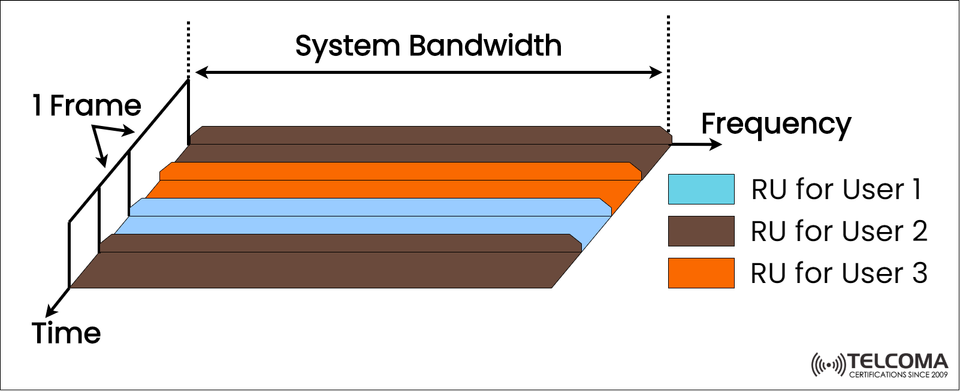
This post specifically considers the Downlink working mode of OFDMA as depicted in the picture above, where multiple users are fetching data at the same time from the same transmission frame and they are each given their own unique 'slice' of the system bandwidth.
📊 What the OFDMA Downlink Model Shows
The salient points of the OFDMA Downlink Transmission Model include the following:
The x-axis is frequency.
The y-axis is time (one frame).
The total width is the system bandwidth.
The colored bands represent the Resource Units (RUs) allocated to an individual user:
🟦 Light Blue = User 1
🟫 Brown = User 2
🟧 Orange = User 3
Observations:
All users are served simultaneously at the same time in the same frame.
The system bandwidth is only divided in frequency, not in time - each RU occupies the same time dimensions.
User 2 (brown) has multiple or larger RUs, meaning that User 2 is consuming more bandwidth because of higher data rates or because that user was given higher priority.
Advantages of OFDMA Downlink Functionality
- Multi-User Efficiency
Ability to serve a large number of users within a single transmission without having to serialize access.
Particularly useful in high-density population areas, e.g., airports, stadiums, and enterprise networks. - Better Spectral Efficiency
There is no wastage of bandwidth even some devices are very low in data-rate; the allocation of RUs is tailored to their transmission needs.
Ideal for mixed device types, smartphones, IoT, laptops with widely varying data-rate needs. - Stored Latency
Reduced waiting time, which is a key element of real-time applications like VoIP, or AR/VR. - QoS and fairness
APs or base stations can dynamically assign RU sizes using:
Channel quality,
Quality of service priority,
Volume of data being transmitted.
⚙ Technical Overview of OFDMA Downlink Operation
Term Description
RU (Resource Unit) Smallest allocatable unit of subcarriers available within the channel, e.g. - 26, 52, 106 tones
DL-MU PPDU - Downlink Multi-User Physical Layer Protocol Data Unit - physical (MAC) layer frame that contains the downlink data for all users.
AP/Base Station Central scheduler which is allocating RUs, and servicing all RUs simultaneously.
User devices (STAs/UEs) Receiver for their own RUs and ignores the rest.
📚 Comparison of OFDMA Downlink and Uplink
Feature Downlink Uplink
Control AP/Base Station (MLA) controls timing AP requires a trigger frame to synchronize on STAs
Data direction Downlink AP to device Uplink Device to AP
Typical use cases Web downloads, video streaming VoIP
🔍 Advanced Concepts in OFDMA Downlink
🧮 Variable Size RUs
Resource Units in OFDMA can be configured to different size enabling:
Channel bandwidth (20 MHz, 40 MHz, 80 MHz, or 160 MHz)
RU granularity:
26-tone RUs (for low-rate IoT)
52-, 106-, 242-, 484-, or 996- tone RUs (for higher-rate applications)
This variation enables an AP or base station dimensioning delivery to an individual device meeting it's true bandwidth demand.
🧠 Smart Scheduling Algorithms
Today's APs employ smart scheduling algorithms (using predictive traffic management techniques, machine learning, and channel state feedback) enabling them to:
Minimize collisions
Maximize throughput
Provide QoS guarantees
📡 Channel Access Coordination
To guarantee no overlap or contention, the Access Point provides:
Channel Sounding - measuring channel conditions per STA
RU allocation signaling - informing each device of RU allocation using DL-MU PPDU preambles
Power Control - adjusting power per RU to equalize SNR for all users
🔭 Preview: OFDMA in Wi-Fi 7 and Beyond
Although OFDMA appeared in Wi-Fi 6, OFDMA is enhanced in Wi-Fi 7 (802.11be) and will continue to improve with:
All RU allocation is based on RU allocation per user for both uplink and downlink traffic.
Multi-Link Operation (MLO) feature allows multiple channel usage for a single user.
Lower Latency Target Wake Time (TWT) with reduced scheduling period.
With the next generation of networks, expect to service more users concurrently with more fine-grained RU mapping, and AI enabled scheduling.
🧰 Useful Suggestions for Deployments
Network architects and telecom engineers should keep the following concepts in mind when deploying OFDMA:
✅ Good Practices
For meaningful RU granularity, use at least 20 MHz channels as a baseline.
Isolate IoT devices and higher throughput types of devices, on separate SSIDs or bands to gain positive RU utilization.
Ensure your AP firmware can run OFDMA scheduling logic.
Utilize air utilization monitoring so you are able to identify when RU's are congested or unbalanced .
⚠️ Bad Practices
Using ABs, where the APs are poor quality, is likely to lead to poor performance due to not implementing full OFDMA logic.
Older client devices (non-Wi-Fi 6) and far clients do not get the benefit of OFDMA - may trigger fallback situations / wishes to remain on new band.
Misconfigured QoS will override the priority of RU assignment.
🧾 Summary Table - OFDMA Downlink Attributes
Feature Definition
Core Concept Break spectrum into RU's to serve several users at one time
Key Benefits Very efficient, very low latency, energy savings
User Differentiators QoS, buffers, channel conditions
Technologies leveraging OFDMA Wi-Fi 6/6E, 5G NR, LTE Advanced
Framing Structure RU's turned on not via intervals (they're allocated/included in the back of every frame), otherwise consistent timeframe
AP Noted Role RU assignment, prioritization of traffic, transmission
Downlink Use Cases video streaming, gaming, updates for IoT devices, remote access desktop.
🔚 Conclusion
Taking OFDMA Downlink mode into account is a giant leap in the world of wireless communications, enabling connections for many more users effectively and reliably. Regardless of whether you are deploying the next-gen 5G networks, enterprise-grade Wi-Fi 6 infrastructure, or building an IoT ecosystem you need to understand how frequency-domain resource allocation is structured.
By understanding how RUs function and how devices interacts within a frame, telecommunication professionals can improve performance, reduce latency, and scale their network offers confidently.