
OMEC Evolution Toward 5G Core: Functions, Interfaces, and Architecture Explained

Introduction: The Journey from OMEC to 5G Core
The 5G Core (5GC) takes on a service-based architecture to improve scalavility, flexibility and performance. The shift from EPC to 5GC is influenced by initiatives like OMEC (Open Mobile Evolved Core) an open-source core network designed for disaggregation and deployment in the cloud.
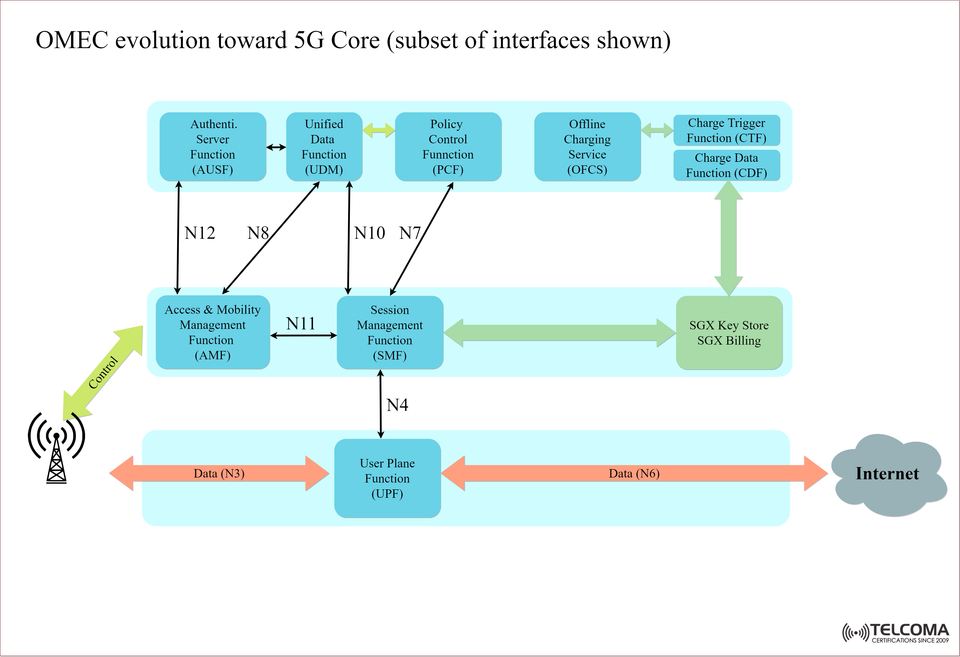
The image depicts the subset of interfaces and components involved in OMEC’s path towards 5G Core. This blog helps to demystify these items for the benefit of professionals in the telecommunications space and technology enthusiasts alike.
Important functions of a 5G Core Network in OMEC’s architecture
The architecture can be broken down functionally into Control Plane and User Plane which includes a number of logical network functions (NFs).
Function Abbreviation Role
Access and Mobility Management Function AMF Manages UE (user equipment) access and authentication, as well as mobility.
Session Management Function SMF Manages session establishment, Qos (Quality of Service) and packet routing.
User Plane Function UPF Forwards user traffic going to/from the internet or data network.
Authentication Server Function AUSF Manages authentication of the UE based on credentials saved in UDM.
Unified Data Management UDM Central data repository for both user profiles and policy rules.
Policy Control Function PCF Manages network policies and Qos.
Charging Functions CTF, CDF, OFCS Manages offline charging and real-time billing.
Core Interfaces of the OMEC in Future Transition to 5GC
The arrows in the figure indicate the standard 3GPP interfaces. Below you can see the descriptions:
Interface Between Function
N3 RAN ↔ UPF User Traffic (Data Plane)
N4 SMF ↔ UPF The SMF controls how the UPF handles packets
N6 UPF ↔ Internet Connects users with external networks or services
N7 SMF ↔ PCF Retrieves policies for the data session
N8 AMF ↔ UDM Pulls subscription data
N10 SMF ↔ UDM Provides user and session specific data
N11 AMF ↔ SMF Coordinates session and mobility management
N12 AMF ↔ AUSF Used for user authentication
Benefits of OMEC's Cloud-Native Designs
Transforming to 5G Core with OMEC principles offers real advantages:
✅ Microservices Architecture – Network functions are deployed as standalone services.
✅ Disaggregation – Control (signaling) and user (data) plane separation improves scalability.
✅ Kubernetes Orchestration – Automated deployment, scaling, and management
✅ Cloud Ready – Deployed on public/private cloud infrastructure.
✅ Open Interfaces – Vendor interoperability fosters innovation.
The SGX Role in Billing and Security
One addition to the architecture is the SGX Key Store/SGX Billing block which makes use of Intel SGX to create secure enclaves , enabling many activities that must be performed:
🔐 Secure handling of billing data
📄 Generation of verifiable Call Detail Records (CDRs)
🛡️ Protection against tampering when using a multi-tenant environment
Control and User Plane Separation (CUPS)
In this design:
The Control Plane consists of (AMF, SMF, AUSF, UDM, PCF) aye handles session logic, mobility, and policy.
The User Plane consists of (UPF) only handles forwarding of IP packets to and from users.
The concept of separating control and user planes makes sense in this case, as it allows us to independently scale and maintain both planes.
Visual Overview
To better represent the flow:
pgsql
Copy
Edit
User Equipment (UE)
|
[Radio Access Network]
|
| N3 (Data)
v
UPF <---------> SMF <---------> PCF (N7)
| | |
| N6 (Internet) | N4 |
| v v
Internet AMF <--> AUSF (N12), UDM (N8/N10)
Conclusion:
Towards a Cloud Native and Scalable 5G Core
The evolution of OMEC to 5G Core achieves a cloud-native, modular, programmable, and scalable mobile network. By using service-based architecture, open interfaces, and cloud-native deployments, the telecoms are able to offer next-generation services rapidly.
This transition is critical to realizing:
Ultra-low latency applications (e.g., AR/VR)
Edge computing, and MEC
Scalability in IoT
Advanced billing and policy models.
By adopting an OMEC-based 5GC design, operators will be preparing their networks for decades to come.
🔮 What Does the Future Look Like - The 5G Core Evolution?
Currently, the 5G Core transition is happening with the OMEC, but this is only the tip of the iceberg. Here are some important future trends and developments that telecom professionals should be aware of:
🔧 Enable Network Slicing
Supporting virtual networks that are customized for different services (e.g. IoT, URLLC, eMBB.
All slices have their dedicated SMF, UPF, and policy profiles.
🌐 Leverage Edge Computing
Deploying UPFs closer to the user will reduce latencies.
The UPFs can also support use cases that require immediate feedback loops, such as autonomous driving and real-time video analytics.
🤖 AI-Driven Network Automation
AI will enable predictive analytics, dynamic policy enforcement and fault detection.
AI will improve decision-making across AMF/SMF/PCF instances.
🔐 Zero Trust Security Architecture
Providing trust assurance that every interface, device and function is authenticated and monitored.
The SGX-based secure enclaves will play an important role in enforcing trust.
⚙️ Recommended Actions for Telecom Professionals
Here's a list of considerations for network architects and engineers:
Understand the purpose and context of each NF (Network Function): AMF to PCF, understanding their purpose and context will enable you to better troubleshoot and optimize performance.
Familiarize yourself with the 3GPP interfaces (N1–N16): this will be important for smooth interop with your vendors.
Be prepared for disaggregation and CUPS: allowing for horizontal scaling and agile deployment of your services.
Utilize open-source tools such as OMEC: speed up development and provide the flexibility to manage deployments.
Conclusion:
Future of Mobile Core Networks
The evolution of OMEC to 5G Core represents not only a technological shift, but an entirely new way for understanding core networks. With open-source software, cloud-native and virtualized platforms and standardized interfaces, telecommunications operators will gain:
More network control
Quicker time to market for new services
Cost savings on deployment with disaggregation and automation
An impressive foundation for innovative models of the future, such as 6G
As 5G matures, understanding and implementing architectures like that described in this blog will be important for any organization that wants to remain competitive in telecommunications.