
ONAP End-to-End 5G Service: Architecture, RAN, Core & Orchestration Explained

Introduction: The Role of ONAP in 5G Networks
5G isn’t just about faster speeds; it’s about making ultra-reliable, low-latency communication possible for things like self-driving cars, IoT ecosystems, and immersive technologies such as AR and VR. To meet these complex needs, service providers require automated, intelligent, and scalable orchestration platforms.
That’s where ONAP (Open Network Automation Platform) comes in. It’s essential for managing, automating, and handling the lifecycle of 5G services across RAN, Core, and Cloud infrastructures.
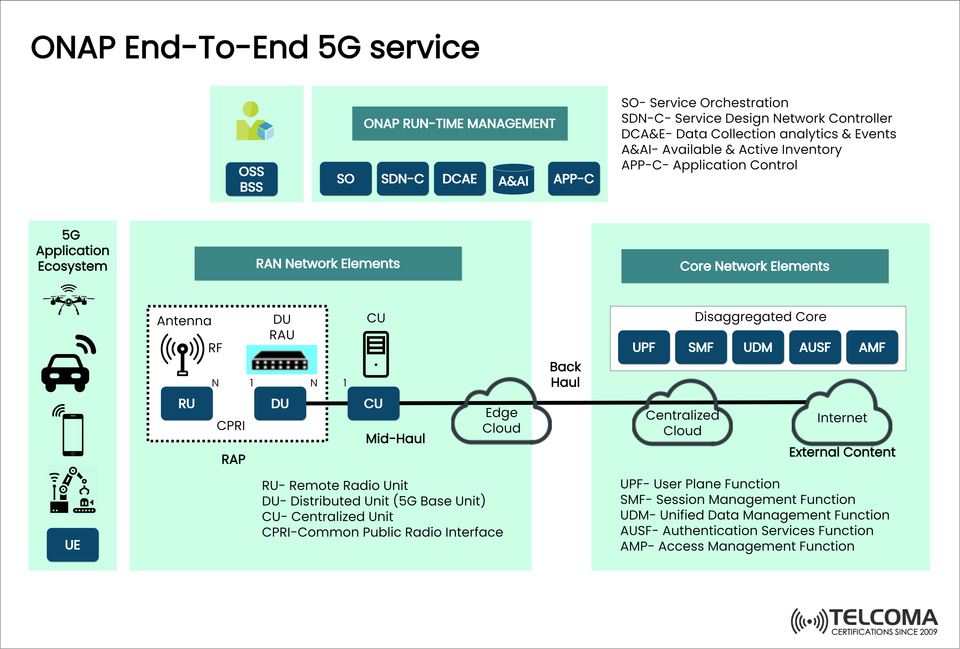
In the image attached, you can see how ONAP fits into the end-to-end 5G service management landscape, integrating various components including RAN elements, Core Network elements, and the 5G Application Ecosystem. Let’s break it down.
What is ONAP?
ONAP is an open-source platform backed by the Linux Foundation, geared towards providing:
Network automation for both physical and virtual setups.
Service orchestration covering everything from user devices to the application ecosystem.
Real-time analytics for better optimization and fault detection.
Policy-driven lifecycle management for network functions.
In the 5G world, ONAP helps telecom operators:
Cut down on operational complexity.
Speed up service deployment.
Scale network resources dynamically.
Support interoperability among different vendors.
ONAP End-to-End 5G Service Architecture
The architecture can be broken down into three main layers:
5G Application Ecosystem – This consists of applications and use cases (like IoT, self-driving cars, drones, etc.) that rely on network services.
RAN (Radio Access Network) Elements – These are the components that connect user devices to the 5G network.
Core Network Elements – These cloud-native functions manage authentication, data, and traffic routing.
ONAP operates on top of these layers, offering run-time management through orchestration, controllers, analytics, and inventory management.
5G Application Ecosystem
5G caters to a variety of sectors, and ONAP ensures service orchestration throughout.
Here are a few examples:
Self-Driving Cars – which need ultra-low latency and high reliability.
Drones – that require continuous connectivity for real-time control.
IoT Devices – connecting massive amounts of devices while efficiently using the spectrum.
Smartphones and AR/VR – which demand high throughput and mobility support.
ONAP enables dynamic slicing to ensure that each application has access to the network resources it needs.
RAN Network Elements in 5G
This is where 5G connectivity kicks off, particularly highlighted in the image of the disaggregated RAN architecture:
RU (Remote Radio Unit):
Manages RF (Radio Frequency) processing.
Located close to antennas.
Connects through CPRI (Common Public Radio Interface).
DU (Distributed Unit):
Functions as the 5G Base Unit.
Handles real-time L1/L2 processing.
Interfaces with RU over fronthaul and with CU over mid-haul.
CU (Centralized Unit):
Manages higher-layer protocols (L3).
Optimized for control-plane functions.
Operates in either edge or centralized cloud.
Together, these components (RU, DU, and CU) make up the RAN Access Point (RAP). ONAP is responsible for provisioning, scaling, and monitoring these units to ensure peak performance.
Core Network Elements in 5G
The 5G Core (5GC) is disaggregated and designed for the cloud. The following functions are key:
UPF (User Plane Function): Directs and forwards user data packets.
SMF (Session Management Function): Oversees PDU sessions, IP allocation, and QoS.
UDM (Unified Data Management): Central repository for data storage and subscription management.
AUSF (Authentication Server Function): Deals with authentication requests and security matters.
AMF (Access Management Function): Manages device connections and mobility.
These functions operate from a centralized cloud, ensuring scalability and smooth integration with external content providers (like the Internet).
ONAP Run-Time Management Components
ONAP introduces automation and orchestration to both RAN and Core through its run-time management modules:
SO (Service Orchestration): Handles the entire lifecycle of 5G services automatically.
SDN-C (Software-Defined Network Controller): Manages network flows in a dynamic fashion.
DCAE (Data Collection, Analytics & Events): Gathers telemetry data and supports real-time decision-making.
A&AI (Active & Available Inventory): Keeps an up-to-date inventory of all network resources.
APP-C (Application Controller): Manages VNFs (Virtual Network Functions) and CNFs (Cloud-Native Functions).
These components work together to ensure closed-loop automation, reducing the need for manual oversight and boosting network reliability.
Edge and Cloud Integration
The ONAP architecture connects the RAN and Core through:
Mid-haul (CU ↔ DU): Facilitates transport between Centralized and Distributed Units.
Back-haul (CU ↔ Core): Links the Edge Cloud with both the Centralized Cloud and the Internet.
Edge computing is crucial for 5G, especially for applications that are sensitive to latency. ONAP efficiently orchestrates workloads across Edge and Centralized Cloud to maintain service quality.
Benefits of ONAP in 5G Service Management
ONAP’s capabilities in automation and orchestration provide numerous benefits for telecom operators:
End-to-End Automation: Cuts down deployment and management times for services.
Dynamic Network Slicing: Customizes resources based on application or user demand.
Multi-Vendor Interoperability: Its open-source framework supports a wide range of vendors.
Analytics-Driven Decisions: Enhances fault detection and enables predictive maintenance.
Cloud-Native Flexibility: Seamlessly accommodates both VNFs and CNFs.
Example: How ONAP Manages an Autonomous Vehicle Service
Application Ecosystem: A self-driving car requests connectivity with ultra-low latency.
RAN Layer: RU, DU, and CU are provisioned near the vehicle to minimize latency.
Core Layer: SMF and UPF create optimized data paths for speedy routing.
ONAP Orchestration: SO and SDN-C manage and allocate resources dynamically.
Analytics (DCAE): Keeps an eye on performance in real-time and fine-tunes network slices as needed.
This process ensures that critical services operate smoothly without interruptions.
Comparison: Traditional Networks vs ONAP-Enabled 5G
Feature Traditional Networks ONAP-Enabled 5GService Deployment Time Weeks/Months Minutes/Hours Network Function Deployment Static Cloud-Native & Dynamic Automation Limited End-to-End Closed Loop Network Slicing Not Available Supported Multi-Vendor Support Vendor-Locked Open & Flexible
Conclusion
The ONAP End-to-End 5G service architecture provides a unified approach for orchestrating, managing, and automating 5G networks. By connecting RAN, Core, Edge, and Cloud, ONAP guarantees scalability, agility, and reliability for telecom operators.
As we move into the future, whether it’s supporting cutting-edge applications like IoT, drones, or self-driving technology, or enabling dynamic slicing and closed-loop automation, ONAP stands as a vital element of the 5G landscape.
With ongoing advancements in telecom networks, ONAP will be key in making sure that 5G networks are smart, automated, and ready for the future.