
ONAP vCPE Architecture Explained: Virtualized Customer Premises Equipment for Next-Gen Networks

Introduction: Virtualization in Telecom with ONAP vCPE
The telecom sector is quickly transitioning from hardware-heavy setups to software-driven, cloud-based solutions. One of the most significant changes is the shift from traditional Customer Premises Equipment (CPE)—like routers, firewalls, and gateways—to Virtualized Customer Premises Equipment (vCPE).
Here, the Open Network Automation Platform (ONAP) plays a crucial role by orchestrating and automating vCPE services across access, aggregation, and core networks.
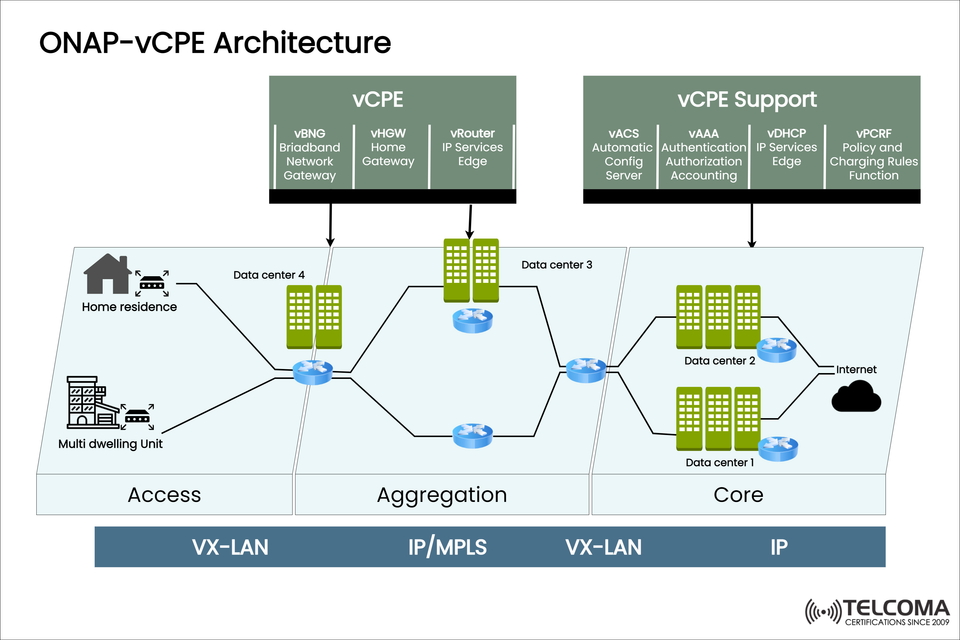
The diagram attached illustrates the ONAP vCPE architecture and shows how VNFs (Virtual Network Functions) take the place of older hardware while support functions help maintain smooth connectivity and service delivery.
What is vCPE?
Traditional CPE uses physical devices installed at customer locations. These devices can be expensive, difficult to scale, and require a lot of manual setup.
vCPE (Virtualized Customer Premises Equipment) shifts these functions into the cloud or edge data centers. Instead of relying on hardware, telecom companies deliver their services through software-based VNFs that are centrally managed.
Key Benefits of vCPE:
Lower CapEx and OpEx: No specialized hardware needed at customer sites.
Centralized Management: Easier orchestration and configuration.
Faster Service Deployment: New services can go live in just minutes.
Scalability: Functions can adjust dynamically based on demand.
Flexibility: Supports multiple vendors’ VNFs and evolving standards.
ONAP’s Role in vCPE
ONAP brings automation, orchestration, and lifecycle management to vCPE services. By using ONAP:
Operators can create, deploy, and manage VNFs from a central location.
Closed-loop automation helps in early detection and resolution of issues.
Policy-driven orchestration allows for dynamic scaling and optimization.
Integration with OSS/BSS facilitates smoother customer service delivery.
ONAP makes sure that the access, aggregation, and core parts of the telecom network are fully automated and optimized for vCPE.
ONAP vCPE Architecture Overview
The ONAP vCPE architecture has three main areas, as depicted in the image:
vCPE Functions (VNFs)
vCPE Support Functions
Network Layers (Access, Aggregation, Core)
- vCPE Functions (VNFs)
These are the virtualized network functions that take over the hardware role at customer sites:
vBNG (Broadband Network Gateway): Handles broadband access sessions and routes traffic.
vHGW (Virtual Home Gateway): Offers residential gateway capabilities in a virtual format.
vRouter (IP Services Edge): Manages IP routing, security, and edge services.
👉 Together, these VNFs replicate all the functions that hardware traditionally provided at customer locations.
- vCPE Support Functions
Support VNFs ensure services run smoothly for customers, covering authentication, configuration, and policy management.
vACS (Automatic Configuration Server): Automates the setup of devices and services.
vAAA (Authentication, Authorization, Accounting): Manages secure access and billing.
vDHCP (Dynamic Host Configuration Protocol): Dynamically assigns IP addresses.
vPCRF (Policy and Charging Rules Function): Enforces policy rules and manages charging.
👉 These functions are essential for ensuring QoS (Quality of Service), security, and compliance in virtualized settings.
- Network Layers in ONAP vCPE Architecture
The architecture spans across Access, Aggregation, and Core layers, each interconnected through various protocols.
Access Layer:
Connects houses and multi-dwelling units to the network.
Utilizes VX-LAN tunnels for secure and scalable connectivity.
Aggregation Layer:
Gathers data from multiple access networks.
Employs IP/MPLS transport for efficient traffic routing.
Core Layer:
Contains most of the vCPE functions in data centers (DC1, DC2, DC3, DC4).
Connects to the Internet and external services.
Utilizes IP and VX-LAN for routing and tunneling.
👉 This layered structure ensures low latency, scalability, and high availability.
Data Center Integration in vCPE
As shown in the image, several data centers are set up at different layers:
Data Center 4 (Access): Closest to users for quick response times.
Data Center 3 (Aggregation): Collects and routes traffic regionally.
Data Centers 1 & 2 (Core): Central hubs linking to the Internet and housing critical VNFs.
By spreading vCPE functions across these edge and core data centers, operators can optimize performance, scalability, and cost.
ONAP vCPE Workflow Example
Here’s how a broadband service might operate with ONAP vCPE:
A new home subscriber requests internet access.
ONAP kicks off the vBNG and vHGW setup in the closest edge data center.
vAAA authenticates the user and makes sure they have the right access.
vDHCP dynamically assigns an IP address.
vPCRF enforces policy rules for bandwidth management.
Traffic securely flows through the aggregation layer (IP/MPLS) to the core data centers and out to the Internet.
ONAP monitors performance with closed-loop automation, making adjustments as necessary.
Benefits of ONAP vCPE Architecture
Using ONAP vCPE offers a range of operational and business benefits:
Quick Service Deployment: New subscriber onboarding happens in minutes.
Cost Efficiency: Hardware CPE is replaced with centralized VNFs.
Improved User Experience: Faster connections and optimized bandwidth.
Easier Operations: Automated provisioning and centralized control.
Multi-Vendor Flexibility: Open-source design accommodates a variety of VNFs.
Edge Readiness: Supports edge computing for low-latency uses.
Use Cases of ONAP vCPE
Residential Broadband: Offering scalable internet services to homes.
Enterprise Connectivity: Providing virtualized edge routers and firewalls.
IoT Networks: Safe onboarding and management of IoT devices.
Managed Services: Allowing ISPs to deliver customizable value-added services.
Comparison: Traditional CPE vs ONAP vCPE
Feature Traditional CPEONAP vCPE Architecture Deployment Time Weeks/Months Minutes/Hours Cost High (Hardware-intensive)Low (Software-based)Scalability Limited Dynamic and Elastic Service Flexibility Fixed Customizable VNFs Management Manual Automated & Centralized Edge Computing Support No Yes
Conclusion
The ONAP vCPE architecture signifies a significant advancement in how telecom companies deliver broadband and enterprise services. By replacing old CPE hardware with virtualized, cloud-native VNFs, operators gain scalability, flexibility, and cost savings.
With ONAP taking care of orchestration, automation, and continuous monitoring, vCPE services can be set up in no time, scaled dynamically, and optimized intelligently.
Whether it’s for residential broadband, enterprise networking, or IoT applications, ONAP vCPE serves as a key driver for next-gen telecom services, enhancing networks to be smarter, faster, and more efficient.