
One-Stop Service Providers in 5G Edge and MEC: Deployment, Applications, and Managed Services
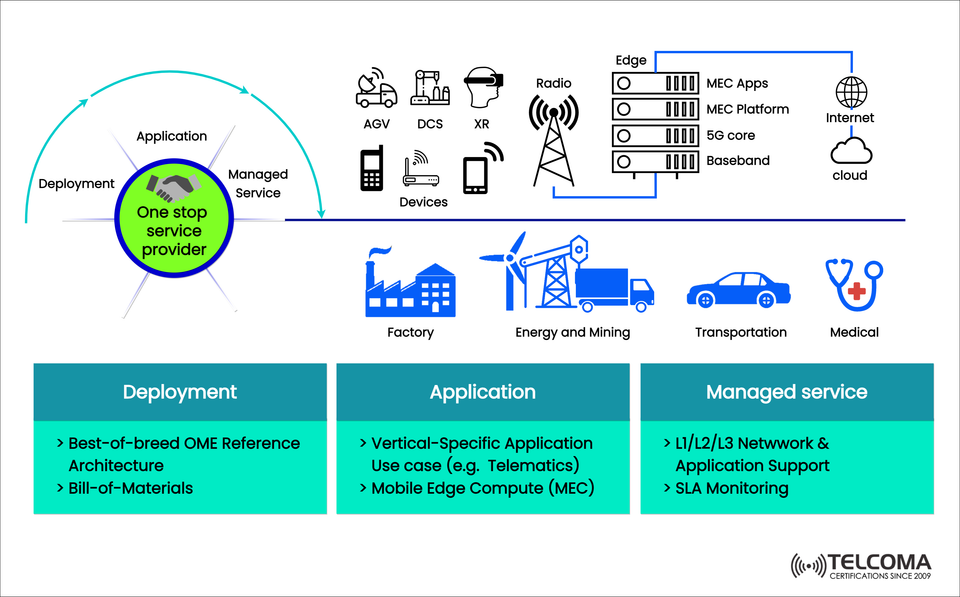

Everything You Need for 5G Edge and MEC: Deployment, Applications, and Managed Services
The telecom industry is undergoing a major transformation, thanks to 5G, edge computing, and Mobile Edge Compute (MEC). Companies from various sectors—like factories, mining, transport, and healthcare—are looking for flexible, scalable, and secure options to tackle the challenges of Industry 4.0.
That's where a one-stop service provider comes into play. Instead of dealing with different vendors for hardware, software, deployment, and monitoring, businesses can count on a single partner who offers complete solutions—from deployment to enabling applications and providing managed services.
The diagram shared provides a clear view of this ecosystem, so let’s break it down step-by-step.
The Role of a One-Stop Service Provider
A one-stop service provider makes it easier to roll out 5G and MEC by providing:
Deployment of network architecture along with a bill of materials.
Application enablement tailored for specific uses like telematics and automation.
Managed services for continuous monitoring, network support, and ensuring SLAs are met.
This all-inclusive approach speeds up digital transformation for companies while tackling integration challenges.
Deployment: Laying the Groundwork for 5G Edge
At the center of any 5G-enabled ecosystem is deployment. If the design and reference architecture aren’t solid, enterprises could face downtime, inefficiencies, or issues with scaling.
Key Components of Deployment
Best-of-Breed OME Reference Architecture: Providers use optimized multi-vendor reference architectures to ensure different devices, radios, and edge systems can work together seamlessly.
Bill of Materials (BOM): This includes a detailed list of necessary hardware (like basebands, servers, and devices) and software (including the 5G core, MEC platform, and orchestration tools).
Effective deployment gives companies a future-proof architecture, helping them avoid being locked into one vendor while meeting global standards.
Application: Bringing Industry-Specific Use Cases to Life
Once the foundation is set, applications bring the real-world benefits of 5G and MEC into play. Since applications can differ greatly across industries, vertical-specific solutions are essential.
Two Pillars of Application Enablement
Vertical-Specific Applications:
Factory Automation: Digital control systems (DCS) and automated guided vehicles (AGV) for smarter manufacturing.
Energy and Mining: Remote monitoring, predictive maintenance, and safe equipment usage.
Transportation: Telematics, autonomous driving, and connected vehicle platforms.
Medical: Remote diagnostics, real-time patient monitoring, and XR-assisted surgeries.
Mobile Edge Compute (MEC): MEC enhances processing closer to devices, reducing latency for critical applications.
MEC Apps perform real-time analytics for industrial IoT.
MEC Platforms manage orchestration and distribute workloads.
Integration with the 5G Core supports ultra-reliable, low-latency communication (URLLC).
These applications turn the potential of 5G into tangible business results.
Managed Services: Keeping the Ecosystem Running
Implementing 5G and MEC isn’t a one-off effort—it requires ongoing management and optimization. Managed services give businesses end-to-end operational support.
Core Elements of Managed Services
L1/L2/L3 Network & Application Support:
L1: Troubleshooting hardware and ensuring physical connectivity.
L2: Supporting network protocols and configuring devices.
L3: Providing advanced diagnostics for applications and software.
SLA (Service Level Agreement) Monitoring: Keeps track of quality of service (QoS) for businesses with real-time performance checks, alerts, and dashboards for analytics.
With managed services, companies can focus on their primary operations, while the provider handles uptime and performance seamlessly.
The Technology Ecosystem: From Devices to Cloud
The diagram also highlights the interconnected technologies that make this ecosystem work:
Devices: Smartphones, routers, IoT gadgets, XR headsets, AGVs, and industrial controllers.
Radio Access: Cellular radios that provide connectivity.
Edge Infrastructure: Baseband units, 5G core, MEC platforms, and MEC applications.
Cloud Integration: Linking edge workloads with centralized internet/cloud services.
This layered setup ensures data gets processed in the right place: at the edge for low latency and in the cloud for in-depth analytics.
Why Enterprises Should Choose One-Stop Service Providers
Managing this ecosystem with numerous vendors can be quite overwhelming. A one-stop provider brings some unique benefits:
Easier Vendor Management: One partner means one contract and one SLA.
Complete Integration: Deployment, applications, and managed services are all tightly bound.
Faster Time-to-Market: Fewer delays in testing, integration, and rollouts.
Scalability: Future growth is simpler with a unified architecture.
Operational Efficiency: Businesses can concentrate on outcomes rather than infrastructure management.
The Impact of One-Stop Service Providers on Industries
Here’s how these advantages play out in key sectors:
Industry Use Case Example Impact of One-Stop Service Provider Factory AGV and DCS integration Reduced downtime, boosted efficiency Energy/Mining Predictive maintenance Safer operations, cost savings Transportation Telematics and connected vehicles Real-time insights, improved logistics Medical Remote monitoring & XR surgery Better patient outcomes, increased reliability
The Future of 5G Edge and MEC with One-Stop Service Providers
As 5G adoption speeds up, the need for low-latency, high-bandwidth, and ultra-reliable networks will rise. Companies can't afford to take piecemeal approaches anymore.
One-stop providers are likely to become the foundation of digital transformation, enabling:
AI-driven analytics at the edge.
Fully autonomous industrial operations.
Real-time healthcare solutions.
Sustainable practices in energy and mining.
They act not just as service providers but as innovation enablers, helping industries tap into the full potential of 5G and MEC.
Conclusion
The future of telecom and enterprise connectivity hinges on integrated service delivery. A one-stop service provider fills the gap between deployment, application enablement, and managed services. By providing cohesive solutions across devices, radio, edge, and cloud, these providers empower industries to leverage the transformative power of 5G and Mobile Edge Compute.
For businesses, it's clear: teaming up with a one-stop partner isn't just about ease; it’s about enhancing efficiency, scalability, and fostering innovation in this connected age.