
ONF’s Distributed Network Cloud Architecture: A Game Changer for Telecom Edge & Core
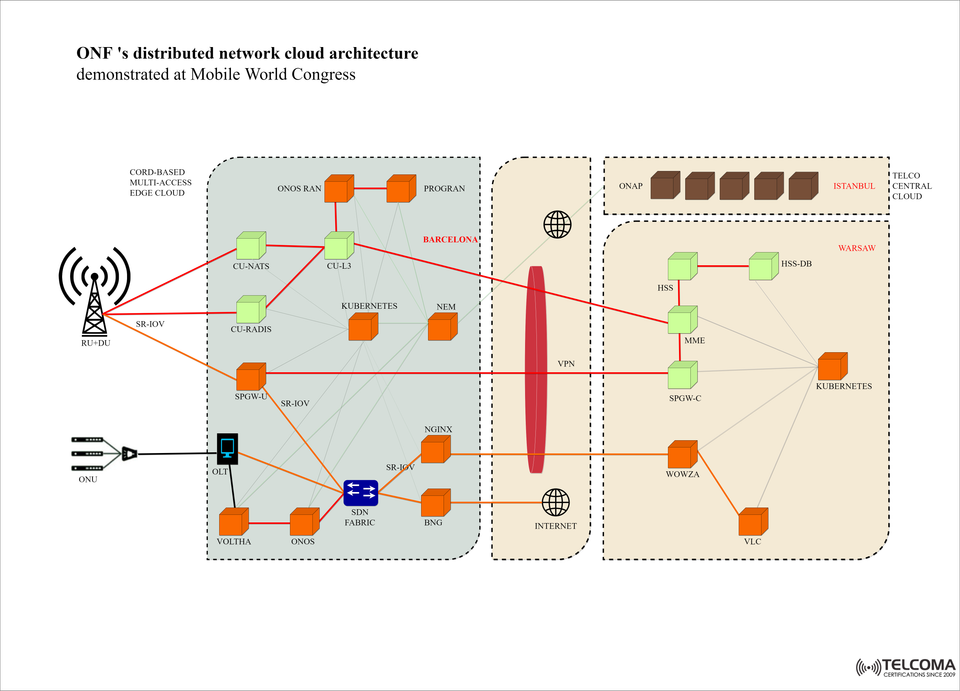

🌐 ONF’s Distributed Network Cloud Architecture: Connecting Edge and Core in Telco
At Mobile World Congress, the Open Networking Foundation (ONF) showcased its distributed network cloud architecture to illustrate how modern telecom networks can connect multi-access edge computing (MEC) with a centralized, cloud-native core. This architecture is a model for operators to implement scalable, containerized, and software-defined infrastructure across geographical areas, including the places underlying the demo such as Barcelona, Istanbul, and Warsaw.
Now, let’s take a close look at the components and ideas behind the architecture.
🧠 Key Ideas and Technologies in the Architecture
📍 1. CORD-based Multi-Access Edge Cloud (Barcelona Region)
The point of access and edge processing for users of the services defined within telecom networks, close to RAN (radio access network) and fibre access.
Core Components:
RU+DU (Radio Units + Distributed Units): All connected to the edge via SR-IOV (Single Root I/O Virtualization) enabled high-performance I/O.
CU (Centralized Units): All made up of submodules such as CU-NATS, CU-L3, CU-RADIS for both radio and user plane processing.
ONOS RAN & PROGRAM: Provide software-defined RAN control and programmability.
VOLTHA & ONOS: Used in fixed access networks with control of OLTs (Optical Line Terminals) and controlling ONUs (Optical Network Units) for access to fibre.
📍 2. Centralized Telco Cloud (Warsaw and Istanbul)
This area is where centralized control plane functions and value-added services are offered.
The main workloads are:
MME (Mobility Management Entity) and HSS (Home Subscriber Server) – are components of the traditional EPC
SPGW-C (Control Plane) – responsible for dealing with the SPGW-U at the edge.
HSS-DB: database backend for subscriber information.
VLC and WOWZA: streaming services demonstrating value-added applications.
ONAP: Management and orchestrator (MANO) platform in the Istanbul cloud.
Kubernetes Clusters: orchestrators of the core and application services from the centralized viewpoint.
📍 3. SDN Fabric and SR-IOV
The SDN Fabric (managed by ONOS) allows for fast packet forwarding with precise traffic flow management.
SR-IOV provides quick packet transport – to/from virtualized network functions (VNFs) to the physical interfaces.
🔄 How the Architecture Works: A Functional Overview
Function Layer - Components - Role
- Access Network: RU + DU, OLT, ONU - Provides mobile and fiber connectivity
- Edge Compute: SPGW-U, ONOS RAN, VOLTHA, BNG, NGINX - Processing for local breakout, RAN and fixed access control.
- SDN Control Layer: SDN Fabric, ONOS - Manages dynamic traffic flows and connectivity.
- Cloud Native Stack: Kubernetes (Edge & Core) - Container orchestration and scaling.
- Control Plane: MME, SPGW-C, HSS, HSS-DB - Control functions or 4G EPC control functions.
- Service Layer: WOWZA, VLC, ONAP - Application services and orchestration.
- Interconnectivity: VPN, SR-IOV - Provides security and speed.
📦 The Importance of This Architecture
✅ Benefits to Telecom Operators:
Disaggregation of hardware & software
Rapid deployment with Kubernetes and containers
Latency optimization through user plane functions at the edge.
End-to-end virtualization and programmability via Software Defined Networking (SDN).
Flexibility in deploying services through distributed clouds.
🚀 Use Cases Enabled:
Streaming media & content caching (WOWZA, VLC)
Enterprise Private 5G deployments
Broadband access using software-defined Optical Line Terminal (OLT)
Real-time mobile and fixed network slices
📍 Locations Validated:
Barcelona: Edge access, Multi-ACCESS Edge Compute (MEC) and local breakout
Warsaw: EPC control functions and media applications
Istanbul: Centralized orchestration and management via ONAP
🔚 Summary: A Reference Model for Future Telecom Networks
The Open Networking Foundation's distributed network cloud architecture is not just a research demo — it is a realistic, deployable, solution and represents the future of telecom networks. When operators combine open-source tools, cloud-native and containerized core functions, SDN-based traffic control, and edge compute, they are afforded tremendous opportunity to build:
Agile Networks
Scalable Networks
Vendor-neutral Networks
Networks Ready for 5G and Beyond
Whether you are a network engineer, cloud architects and telecom strategist, the reference model is a great reference for moving towards the modernization of network infrastructure to use cloud-native and open networking principles.
🛠️ ONF'S Distributed Cloud Architecture Implementation Considerations
Telecom operators wishing to deploy the ONF model need to consider both infrastructure capabilities and software readiness. Here are two considerations:
📌 1. Infrastructure Requirements
- High-performance SR-IOV NICs: Required at the edge to offload data plane processing (e.g., SPGW-U, BNG).
- Distributed Compute Nodes: MEC (Multi-Access Edge Computing) sites like those in Barcelona require container-hosting hardware with GPU/NFV acceleration.
- High-bandwidth backhaul: For low-latency VPN interconnection between edge and central cloud regions (e.g., Warsaw, Istanbul).
- SDN-capable fabric switches: Required for ONOS-based SDN control and dynamic routing.
📌 2. Software Stack
- Kubernetes at both Edge and Core: Provides orchestration uniformity across distributed sites.
- ONOS and VOLTHA: For PON and RAN control, tightly integrated with OLTs and RUs.
- OpenCore/ONAP: As shown in the Istanbul deployment, ONAP provides closed-loop automation and lifecycle management.
🌍 Real Domain Deployment Scenarios
Note that this is not a lab prototype of an architecture; it has direct applicability across modern telco use cases.
Scenario Description Value Proposition
Fixed Wireless Access (FWA) RAN and VOLTHA combined for rural broadband Quickly cover areas with low capex
Enterprise 5G Edge UPFs and NGINX for slicing Private networks, SLA enforcement
🔭 Looking Forward: The Role of ONF in 5G/6G Networks of the Future
ONF's architectural vision acknowledges where telecom operators are headed:
✅ 5G Standalone (SA) readiness
✅ Open RAN and RIC integration
✅ Edge AI support using Kubernetes and GPU orchestration
✅ Service-Based Architecture (SBA) ready for core migration
This architecture is safeguarded for the future due to its vendor-agnostic, open-source, CI/CD optimized setting that will allow for continuous upgrades and innovation without interruption.
🔄 Summary: Why Telecom Leaders Care
🔍 Key Highlights:
ONF's demonstration combines edge computing, SDN, and VNFs into an architecture that is ready for the real-world.
Makes telecommunications distributed, scalable, and affordable.
Is compatible with 4G EPC while enabling future integration into 5G cores.
Uses modern, open-source software frameworks such as ONOS, VOLTHA, ONAP, and Kubernetes.
📣 Conclusion
The ONF distributed cloud architecture shown at MWC is more than a demonstration—it is a reference model for a transformation for the future of telecom. It offers a path for CSPs:
Moving from monolithic to cloud-native networks
Delivering low-latency services at the edge
Automating services with ONAP & SDN
Providing seamless user experiences across fixed and mobile access
As 5G matures and 6G is on the horizon, architectures, like this will